/ Blog ·
Block Cleaning London: What Managing Agents Should Expect


Good block cleaning in a large London development means a defined scope written down task by task, a team whose hours match the size of the building, a named person accountable for it, and evidence of every visit. If you manage several 100+ flat blocks and leaseholder complaints are rising, the cause is usually one of those four being vague. This guide sets out what to specify, how a daily on-site team compares with a visiting crew, how to check quality, and when it is time to retender.
TL;DR
- Write the scope as a schedule with frequencies (every visit, weekly, monthly, quarterly), not as a list of areas. Published housing specifications show how detailed that can be.
- For blocks of 100+ flats, a daily on-site team usually gives you more control over entrances, lifts, stairwells and bin stores than a visiting crew.
- Your management code expects you to inspect the common parts and check service quality, so build inspections and photo reports into the contract.
- Monthly reviews and one named account manager turn complaints into tracked actions rather than arguments.
- A takeover from an underperforming contractor can be planned around rota mapping, key transfer and TUPE where it applies.
Table of Contents
- What should block cleaning in a large London development include?
- Is a daily on-site team better than a visiting crew for a 100+ flat block?
- How many hours does a 100+ flat block need?
- How should you vet a block cleaning contractor?
- How do you check quality and keep leaseholders informed?
- What does good look like in Tower Hamlets and Wandsworth?
- What affects the cost of block cleaning in London?
- Why do we run large London blocks with a dedicated on-site team?
- When should you retender, and how does a takeover work?
- What does Harmony Cleaning offer large London blocks?
- FAQ
- Sources
What should block cleaning in a large London development include?
Start with the areas, then attach a frequency to every task. For a large residential development the areas are normally entrances and lobbies, corridors, stairwells, lifts, bin stores, front windows, bike stores and car parks.
Published specifications from large landlords show the level of detail worth copying. The City of London’s Barbican Estate service level agreement covers all common parts on working days. It lists daily refuse collection, bin-area and lift-lobby cleaning, weekly sweeping and mopping of lobby stairs and carpet vacuuming, and monthly cleaning of doors, frames and window ledges (updated March 2025). Its weekly tasks go further, down to vacuuming lift thresholds, cleaning entry phone panels and removing marks from interior glass and walls.
A housing association specification is just as granular. Clarion’s communal cleaning specification covers mats, floors, doors, entry panels, lights, noticeboards, post boxes, glazing, lifts, walls, graffiti, litter, chutes and bin stores. It also covers the removal of sharps, needles and broken glass. It defines frequencies such as on every occasion, as required, after refuse collection, quarterly, twice yearly and once a year, and reviews them at each contract review.
External areas matter too. Women’s Pioneer’s specification (amended 2019) has hard standings, pathways and car parks swept weekly, with moss and algae removed from external stairs. In a London estate with podium gardens and undercroft parking, that is where complaints about “the state of the outside” often start.
What the service charge typically pays for is also worth stating to leaseholders. Peabody explains that the communal cleaning charge covers regular cleaning of shared internal areas such as entrances, corridors, lifts, lobbies, stairwells and bin stores, including labour, equipment, materials and periodic deep cleaning. If your tender leaves out any of those, expect questions at the next service charge meeting.
Is a daily on-site team better than a visiting crew for a 100+ flat block?
For most large blocks, yes, because daily wear is the problem. A building with 100+ flats generates bin store overflow, lift marks, muddy entrances, deliveries and parcels every single day. A crew that visits two or three times a week can clean to a good standard on the day and still leave the building looking tired on the other days.
Here is how the two models compare on the points managers raise most.
| Point | Daily on-site team | Visiting team |
|---|---|---|
| Presence | Same people in the building every working day | Rotating crew arriving on set visits |
| Response to spills, litter, bin store overflow | Dealt with as it happens by someone already there | Waits for the next visit or a call-out |
| Knowledge of the building | Cleaner learns the lifts, the problem corners, the residents | Knowledge resets when the crew changes |
| Accountability | One person is visibly responsible for the block | Responsibility is spread across a route |
| Supervision | Quality can be seen daily by the site team and concierge | Quality is seen only on inspection days |
| Fit | Blocks of 100+ flats, multi-block estates, build-to-rent | Small or low-footfall blocks |
| Hours | Matches the building’s footfall, often a full-time cleaner plus part-time support | Set by visit length |
That is how our own model works. We provide a dedicated on-site team for daily common-area cleaning, typically 50+ hours a week on large blocks, with a full-time cleaner and part-time support. It is designed so that the person who cleans your lobby on Monday is the person who cleans it on Thursday.
A visiting model can still make sense for a small block. This guide, though, is about the 100+ flat developments where the question is usually why the building never looks consistently clean.
How many hours does a 100+ flat block need?
There is no official hours-per-flat figure, so be wary of anyone who quotes one as a rule. The hours depend on the building, and you can work them out from your own schedule.
Build the number from the bottom up:
- List every area and its frequency from your schedule.
- Estimate the time each task takes, using the floors, lifts, stair cores and bin stores you actually have.
- Add the daily recurring items: bin stores after collections, lift wipe-downs, entrance mats and glass.
- Add the periodic items: deep cleans, window cleaning, carpet and hard floor care.
- Compare the total with what the contractor has priced. If a large block is covered by a few visiting hours a week, the maths rarely works.
Factors that push hours up in London buildings: multiple cores or towers, several lifts per core, a concierge lobby with heavy footfall, a gym or co-working space in a build-to-rent building, shared courtyards and car parks, and refuse chutes on every floor.
Once the hours are agreed, the contract should say who is on site and when, so that cover for sickness and holidays is planned rather than improvised.
How should you vet a block cleaning contractor?
Ask for documents, not reassurance. A sensible vetting list for a managing agent runs as follows.
- Health and safety. Specifications such as Clarion’s require work in line with the Health and Safety at Work Act 1974, the COSHH Regulations 2002, the Environmental Protection Act 1990 and BICSc standards, with a health and safety review of the contractor at intervals of no less than 18 months (source: Clarion specification). Use that as a model of what a client can ask for.
- Risk assessments. The Women’s Pioneer specification asks for written risk assessments covering at least lone working, lifting and handling, and working at heights, plus the contractor supplying wet floor signs. Lone working matters in a block where a cleaner may be alone in a stair core.
- Materials. Clarion requires the contractor to provide all cleaning materials, assessed as safe for use, with records available for inspection and revised documentation for any change. Ask for the same.
- Fire awareness. Women’s Pioneer expects operatives to be familiar with the fire evacuation procedure for any building they work in. Cleaners are in your stairwells and corridors every day, so this is a practical point, and trip hazards and cluttered escape routes are things a trained cleaner should report.
- Accreditation and insurance. We are SafeContractor approved, ISO 9001 and ISO 14001 certified, a BICSc member and a Living Wage employer, with £10m public liability cover. Our staff are Enhanced DBS checked and trained. Ask any contractor to show you the certificates.
Do not forget the people. Enhanced DBS checks matter in buildings where cleaners work near front doors and in lifts at all hours.
How do you check quality and keep leaseholders informed?
You are expected to inspect. The RICS Service Charge Residential Management Code, 4th edition, effective from 7 April 2026, says managing agents should arrange and manage contracts such as cleaning. It also says they should have procedures to visit and inspect the building regularly, including a visual inspection of the accessible common parts to check the quality of services. A cleaning contract that makes this easy helps you meet that expectation.
Three practical tools:
A simple grading system. The City of London’s Estate Services Standards 2024 use a simple grading system routinely assessed for quality assurance, with results reported to residents and used by managers to improve standards. The same document tells assessors to account for general wear and tear, ingrained stains and unforeseen conditions such as adverse weather, which are outside a cleaner’s control. Borrow that fairness: it stops disputes about things cleaning cannot fix.
Photo-evidenced visit reports. A dated photograph of the lobby, bin store and stair core after each visit gives you something to put in front of a complaining leaseholder or a board. We provide photo-evidenced visit reports on every contract for that reason.
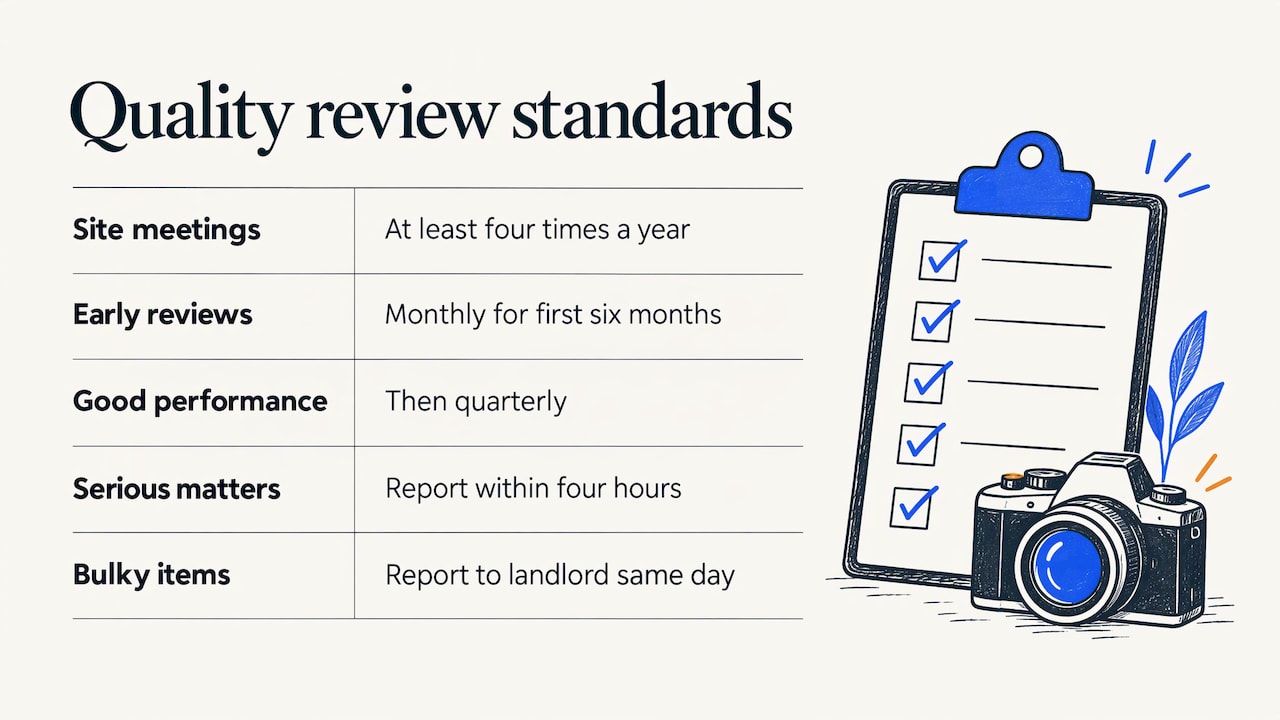
Regular reviews. Clarion’s specification has contractor meetings on site at least four times a year, monthly for the first six months and then quarterly if performance is good. It also has serious contract or health and safety matters reported within four hours, followed by a written report. Those are Clarion’s terms, but the pattern is a good template. We carry out monthly reviews with you, led by one named account manager, so there is one person to call when something is wrong.
Also require the contractor to report dumped bulky items and fly tipping. Clarion’s specification has dumped household items reported to the landlord’s representative on the same day, with evidence passed on where the culprit is obvious. In practice that saves your site team a lot of chasing.
What does good look like in Tower Hamlets and Wandsworth?
The two examples below are illustrations, not client stories.
Illustration: a 180-flat riverside block in Tower Hamlets
Imagine a purpose-built block near Canary Wharf with two cores, four lifts, a ground-floor lobby with heavy parcel traffic and a shared bike store. Leaseholders complain that lifts are marked by midday, the bin store is overflowing after collection days and the lobby floor is dirty after rain.
The visiting-team contract covers three visits a week. The fix is a schedule rather than a lecture: lift and lobby touch-ups every day, bin store checks after each collection, a weekly stair and landing clean, and monthly attention to doors, ledges and the bike store. A dedicated on-site cleaner covers the daily items, with part-time support covering the longer weekly tasks. The managing agent receives photo reports, and a monthly review checks which complaints have dropped.
Illustration: a 250-flat multi-block estate in Wandsworth
Now picture an estate of four blocks with shared podium gardens, an undercroft car park and a long run of external stairs. The complaints are about moss on steps, litter in the car park and stairwells that are clean on Monday but not by Friday.
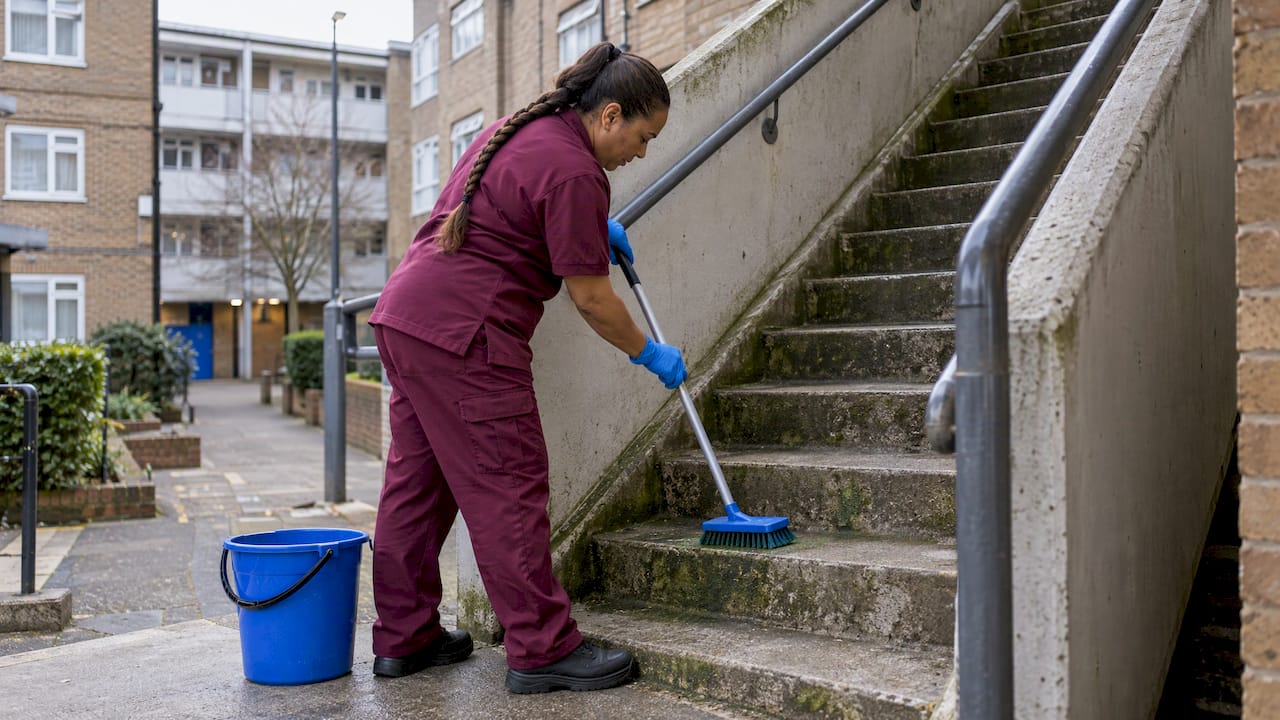
Here the scope needs an external section: weekly sweeping of hard standings and car parks, and removal of moss and algae from steps, as the Women’s Pioneer specification shows. The internal scope is split by block so each core has its own checklist. One named account manager covers the whole estate, so the managing agent has a single point of contact instead of four. Inspections use the same grading across blocks, so you can see at a glance which block is slipping.
Both examples share a pattern: the problem is rarely effort, it is a schedule that does not match how the building is used.
What affects the cost of block cleaning in London?
We do not publish prices here, because the right figure depends on the building. These are the factors that move any large-block quote, so you can compare like with like.
- Hours on site. The biggest driver. Daily cover for a large block costs more than a few visits a week, but it covers far more of the day.
- Size and layout. Number of cores, floors, lifts and stair flights.
- Footfall. Build-to-rent buildings with amenity spaces and heavy parcel traffic wear faster than quiet blocks.
- Scope. Whether external areas, car parks, bike stores and front windows are in or out.
- Periodic work. Deep cleans, window cleaning, carpet and hard floor care, priced separately or inside the contract.
- Staffing standards. Paying the Living Wage, training and consumables all affect the quote. A very cheap bid usually means one of these is missing.
- Consumables. Whether materials and equipment are included, as in the Clarion specification.
Ask every bidder to price the same written schedule so the quotes are comparable.
Why do we run large London blocks with a dedicated on-site team?
We started from a simple observation: a big residential building is not cleaned in a visit, it is kept clean across a day. Lifts get marked at 8am, bin stores fill after collections, and the lobby takes the weather. A dedicated on-site team is the model we built for exactly that.
On a large block we put a full-time cleaner in the building, with part-time support, for 50+ hours a week of common-area cleaning. The same people learn the building and its quirks, and they are visibly responsible for it. That matters to leaseholders, who judge a building by the entrance they walk through every day.
Accountability is the second half. Each contract has one named account manager, photo-evidenced visit reports and a monthly review with you. If something slips, you see it in a photo and in a review, and you know who to call. Our staff are Enhanced DBS checked and trained, and we bring more than 20 years of combined team experience to the work.
If you manage blocks of 100+ flats, we think this is the right standard to hold any contractor to, including us.
Drahim Hasula, CEO and Founder of Harmony Cleaning
When should you retender, and how does a takeover work?
Retender when the problems are structural, not occasional. Signs include repeated complaints about the same areas, inspections that fail on the same items, missed visits, no evidence of what was done, a contractor who cannot name who is responsible, or a scope that no longer matches the building.
Before you do, check the basics. Is the scope current? Have frequencies been reviewed since the building changed? Clarion reviews frequencies at each contract review, and you can do the same. If a review does not change anything, that is your answer.
Then plan the changeover so residents barely notice:
- Map the rota. Record who cleans what, and when, in each block.
- Transfer keys and access. Fobs, bin store keys and plant room access, with a logged handover.
- Handle TUPE where it applies. Where staff transfer, the new contractor needs the employee information early. Take advice on whether TUPE applies to your contract.
- Keep the SLA going. The service levels you have promised leaseholders should not drop during the changeover.
- Hold a first review. A monthly review early on catches teething problems.
We manage takeovers from an incumbent contractor with this sequence, including rota mapping, key transfer, TUPE handling and SLA continuity.
What does Harmony Cleaning offer large London blocks?
We clean large residential developments across Greater London, from purpose-built blocks and multi-block estates to build-to-rent towers and mixed-use buildings. Daily common-area cleaning is our focus: entrances, lobbies, stairwells, corridors, lifts, bin stores, front windows, bike stores and car parks. We also offer periodic deep cleans, window cleaning, carpet and hard floor care, and contract takeovers, and clean offices and workspaces too. See our cleaning services for the full list.
If you would like to discuss a specific block, send us a quote request and tell us about the building.
FAQ
What is included in communal area cleaning for a large block?
Typically entrances, lobbies, corridors, stairwells, lifts, bin stores, windows at ground level, bike stores and car parks. Each area should have a frequency attached. Housing associations such as Peabody include periodic deep cleaning in the service charge, so check yours is covered.
Do managing agents have to inspect the cleaning?
The RICS Service Charge Residential Management Code, effective from 7 April 2026, says agents should have procedures to visit and inspect common parts and check service quality. It is a professional code, so read it for the exact wording and how it applies to your instructions. Photo reports and monthly reviews make the inspections easier to evidence.
How do I reduce leaseholder complaints about cleaning?
Match the schedule to the building, make the contractor visible, and keep evidence. Daily on-site cover, one accountable contact and dated photos let you answer a complaint with facts. Regular reviews turn repeated complaints into agreed actions.
Is a takeover from another contractor disruptive?
It does not need to be. A planned changeover covers the rota, keys and access, staff transfer where TUPE applies, and continuity of the service levels you have promised residents. We handle that process for incoming contracts.
Can the same contractor clean offices and blocks?
Yes, if your portfolio includes mixed-use buildings or offices alongside residential blocks. We clean both, as well as offering deep cleans, window cleaning and carpet and hard floor care.
Sources
- SLAs - Estate management, City of London
- Service charges explained, Peabody
- Communal Cleaning Specification, Clarion Housing Group
- Communal Cleaning Specification, Women’s Pioneer (amended 2019)
- Estate Services Standards 2024, City of London
- Service Charge Residential Management Code, 4th edition, RICS
To request a free quote, use our quote form, email admin@harmony-cleaning.co.uk or call 020 8092 8835.