/ Blog ·
Communal Cleaning Responsibilities: Who Does What

In a leasehold block, the lease decides who is responsible for cleaning the communal areas. It usually puts that duty on the landlord, freeholder, management company or right to manage (RTM) company. If you are a director of a newly formed RTM company, that duty is now yours. Your managing agent normally arranges and supervises the work for you. The cleaner delivers it to a written specification, and leaseholders pay through the service charge. This guide sets out who does what, what to check in your lease and how to keep the arrangement under control. It is general information, not legal advice.
TL;DR
- Responsibility sits in three layers: legal (the lease or statute), contractual (the agent and the cleaning contract) and operational (the cleaner on site).
- Once your RTM company takes over, you answer for the common parts. Appointing an agent or contractor delegates the work, not the accountability.
- Costs reach leaseholders through the service charge, and they must be reasonably incurred and clearly documented.
- There is no statutory cleaning frequency. Your written specification sets the zones, tasks and standards.
- Fire safety duties for common parts sit with the responsible person, and a cleaner’s reports can support them.
Table of Contents
- Who is responsible for cleaning communal areas in a London block?
- Who does what? The responsibilities at a glance
- What should you check in your lease?
- How does the service charge pay for communal cleaning?
- What does the cleaning contractor do on site?
- What are the fire safety duties for common parts?
- How should you oversee the agent and the contractor?
- What does this look like in a real London block?
- Need a contractor that works to your specification?
- How do residents make a communal cleaning complaint?
- FAQ
- Sources
Who is responsible for cleaning communal areas in a London block?
Start with the lease. In a typical leasehold block, the lease allocates responsibility for common-part services to the landlord, freeholder, management company or RTM/RMC. A managing agent normally organises the service on that party’s behalf. The agent is not usually the ultimate responsible party under the lease.
It helps to separate three kinds of responsibility:
- Legal responsibility. This is what the lease or a statute places on the owner, the RTM company or, in some buildings, a named manager.
- Contractual responsibility. This is what the management agreement and the cleaning contract oblige the agent and the contractor to do.
- Operational responsibility. This is who physically turns up, cleans and reports what they find.
The RICS guidance on residential health and safety is clear on the consequence: appointing competent experts does not remove the statutory duties of owners, operators or people in control of property. For a first-time RTM director, that is the sentence to remember.
Who does what? The responsibilities at a glance
The table shows the usual position under typical leases. Your own lease and management agreement always come first.
| Party | Usual role for communal cleaning | What it should not be assumed to do |
|---|---|---|
| Freeholder or landlord | Holds the covenant to provide common-part services unless management has passed to an RTM company or other management company | Does not clean, and cannot ignore complaints just because an agent is appointed |
| RTM or RMC (your board) | Takes on the management functions, sets the budget, appoints and instructs the agent, approves the specification | Cannot hand over legal accountability by appointing an agent |
| Managing agent | Arranges the cleaning contract, supervises and inspects, keeps records, collects the service charge, handles complaints, when instructed | Is not the ultimate responsible party under the lease, and acts only within its instructions |
| Cleaning contractor | Performs the agreed specification, reports defects, follows health and safety and COSHH rules | Does not take over the owner’s management duties |
| Leaseholders | Pay their share of reasonable costs through the service charge and keep their own flat and its entrance door in line with the lease | Do not normally clean common parts themselves |
| Tenants (sublet flats) | Keep belongings out of corridors and stairwells, use bin stores properly | Do not usually pay the service charge directly, as the landlord does |
| HMO manager | In a house in multiple occupation, must keep common parts clean, safe and clear | Does not apply to most purpose-built leasehold blocks |
The HMO row matters only if part of your building is let as an HMO. In that case regulation 7 of the 2006 Management of HMOs (England) Regulations requires the manager to keep common parts in good and clean decorative repair, safe and working, and reasonably free of obstruction. It lists entrances, staircases, corridors, halls, lobbies, balconies and porches among the common parts.
What should you check in your lease?
Before you sign anything as a new RTM director, read these points in the lease and the management agreement:
- The landlord’s covenant. Does it name cleaning, lighting and maintenance of the common parts? Which areas count as common parts?
- Which parts are included. Entrances, lobbies, corridors, stairwells, lifts, bin stores, bike stores, car parks, external paths, front windows.
- The service charge clause. What can be recovered, in what proportions and through which accounting year?
- Any standard of service. Some leases set one, many are silent. Where silent, your specification fills the gap.
- Reserve fund provisions. Whether periodic work such as carpet renewal or deep cleans can be funded from reserves.
- Leaseholder obligations. Rules on keeping corridors clear, flat entrance doors and bin use.
- Your management agreement. What your agent is instructed to do, its fee and the documented level and frequency of services.
- Handover documents. Existing cleaning contracts, keys, rotas, risk assessments and insurance certificates, especially if a contractor is already in place.
How does the service charge pay for communal cleaning?
Leaseholders pay for cleaning through the service charge, but the law limits what can be recovered. Under section 19 of the Landlord and Tenant Act 1985, costs must be reasonably incurred. A leaseholder can apply to the First-tier Tribunal under section 27A to decide whether a charge is payable. Both points are set out in a recent Upper Tribunal decision.
The RICS service charge code, effective 7 April 2026 in England, adds that the level and frequency of services and the management fees should be clearly documented in the management agreement. It also says service levels should reflect the property’s location, use and character and aim at value for money, not simply the lowest cost.
In practice, that gives you three habits:
- Write the scope down zone by zone, so every leaseholder can see what they are paying for.
- Keep visit records, so a disputed charge can be answered with evidence.
- Choose a contractor on specification and value, not on the cheapest quote alone. Our guide on what cover to check first when hiring an insured cleaning company covers the insurance side.
What does the cleaning contractor do on site?
The contractor works to the specification the agent issues on your behalf. A published housing association specification, Clarion’s communal cleaning specification, is a useful model of the level of detail. It covers doors, glazing and door furniture, lift interiors and exteriors, mirrors, switches, noticeboards and post boxes, litter-picking, cobweb removal, stain and scuff removal, carpet shampooing and hard-floor treatment. It also requires the contractor to report defects and graffiti.
A workable specification for a larger London block lists:
- entrances and lobbies;
- corridors and landings;
- stairwells;
- lifts;
- bin stores and bike stores;
- front windows and glazing in common areas;
- car parks and external paths, where they are in scope.
For each zone, state the tasks, the frequency and what an acceptable result looks like. There is no statutory cleaning frequency. The right schedule depends on the building’s size, how many people use it and what happens if it is left.
The contractor’s own obligations sit alongside this. The same specification requires compliance with the Health and Safety at Work Act 1974, the COSHH Regulations 2002 and the Environmental Protection Act 1990, with risk assessments, COSHH assessments, training and hazard reporting. Ask any bidder to show you theirs.
What are the fire safety duties for common parts?
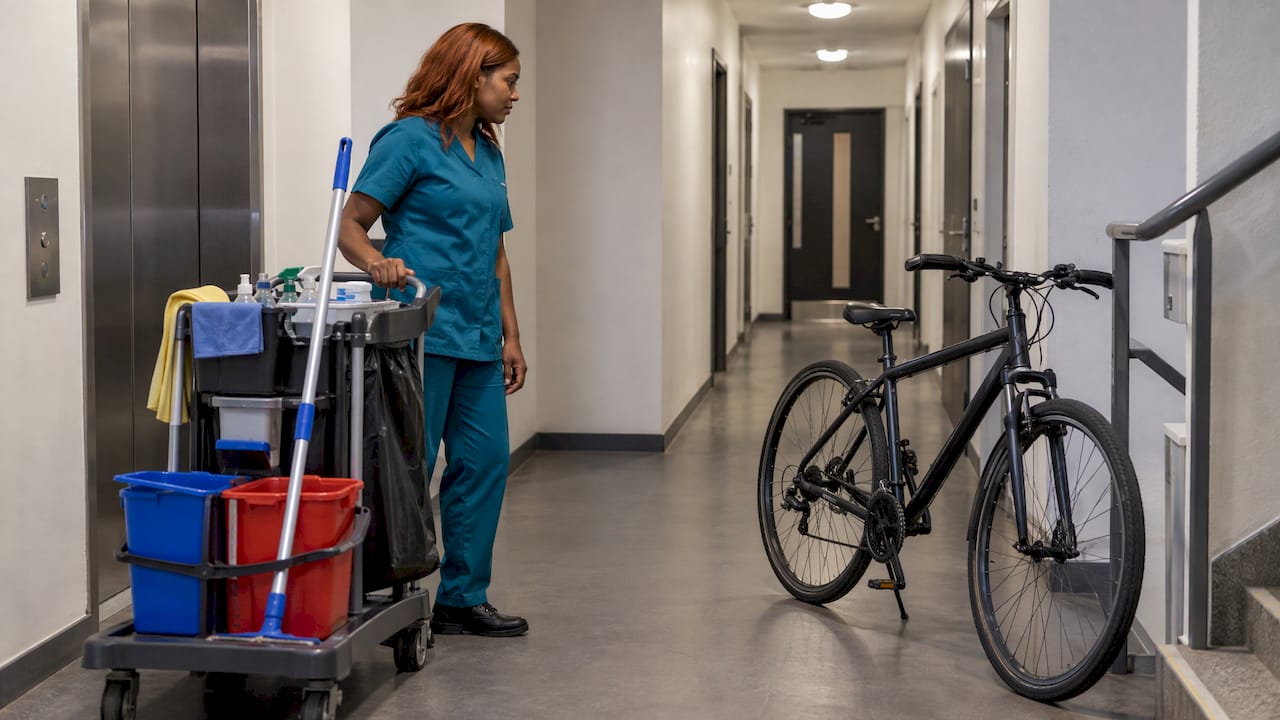
Cleaning and fire safety overlap more than most new directors expect. A blocked stairwell, a bike left in a corridor or a propped fire door is a cleaning observation and a fire safety matter at once.
The Fire Safety (England) Regulations 2022 came into force under the Fire Safety Act framework and add duties for the responsible person in multi-occupied residential buildings. These include giving residents fire safety instructions and, in taller buildings, carrying out regular checks on fire doors in common parts. Check the regulations and the Home Office guidance for the thresholds and intervals that apply to your building, and take advice from your fire risk assessor. Your RTM company will usually be, or share the role of, the responsible person, so this is not something to leave entirely to the agent.
What a cleaner can do is notice and report. A good specification asks the cleaning team to report blocked escape routes, damaged or wedged-open doors, failed lighting and items stored in common areas. The cleaner does not carry out fire door inspections or fire risk assessments unless a separate competent party is engaged to do so.
How should you oversee the agent and the contractor?
You can delegate the work, so oversight is where your duty shows. The RICS code says agents should use a written specification identifying zones, tasks, frequency, standards, reporting and exclusions. They should appoint a competent, insured contractor and inspect against the specification. The statutory-approved 2016 RICS code also says agents should routinely monitor service quality and cost effectiveness and visit the property at an agreed frequency.
The Property Institute’s Consumer Charter adds that agents should require contractors to comply with health and safety, fire and building legislation. They should also ensure appropriate public liability insurance, use written contracts and keep controls showing work was done to an acceptable standard.
As a board, ask your agent for:
- the signed specification and a copy of the contractor’s insurance;
- a record of each inspection, including missed tasks and corrective action;
- a defect and repairs log;
- a summary of complaints and how they were resolved;
- a short report at each board meeting.
A useful reference point is a 2015 First-tier Tribunal decision. After complaints about communal cleaning, the manager replaced the contractor, and the tribunal accepted the cleaning costs as reasonable on the facts reported. Acting promptly on complaints strengthens your position.
For a wider view of what to expect from a London block contract, see our guide to block cleaning in London.
What does this look like in a real London block?
These are illustrations, not client stories.
Illustration 1: a 120-flat purpose-built block in Lewisham. The leaseholders have just exercised the right to manage. The old landlord’s cleaner turned up three days a week, and nobody can say what the visits covered. The new board reads the lease, finds that cleaning of the entrance, stairwells, lifts and bin store is a recoverable cost, and asks the agent to issue a zone-by-zone specification. It lists tasks and frequencies, reporting duties and the evidence expected after each visit. The agent tenders the work on that specification, so the quotes can be compared like for like. The board now knows what it is paying for, and so does every leaseholder who asks.
Illustration 2: a 200-flat multi-block estate in Southwark. Residents complain about bin store smells and sticky lift floors. The agent checks the specification, which does cover both, and the contractor’s visit records, which show gaps in one block. The agent requires corrective action and reinspection, and logs the complaint and the outcome. When one leaseholder later challenges the cleaning charge, the board can show the specification, the inspections and the response. That is the kind of documented trail the RICS code asks for.
A build-to-rent tower in Stratford would run along the same lines, with a larger lobby and amenity footprint to specify. Our build-to-rent cleaning page covers that building type.
What we think about communal cleaning responsibilities
Most disputes we hear about do not start with dirt. They start with an unclear specification. When nobody can say what was agreed, the board, the agent and the contractor each assume someone else is checking.
Our approach is built for large London residential developments. We use a dedicated on-site team for daily common-area cleaning, and each contract has one named account manager. We provide photo-evidenced visit reports and carry out monthly reviews, so the agent and the board have a record to inspect against, not a promise.
We work to the agent’s specification. If we see a blocked corridor, a damaged door or failed lighting, we report it with photographs so the right person can act. Our staff are Enhanced DBS-checked and trained, and we hold SafeContractor approval, ISO 9001 and ISO 14001 certification. We are a BICSc member and a Living Wage employer, with 20+ years of combined team experience.
The board stays in charge, and we give it the evidence to exercise that control.
Drahim Hasula, CEO and Founder of Harmony Cleaning
Need a contractor that works to your specification?
We clean the common parts of large London residential developments, with a dedicated on-site team, a named account manager, photo-evidenced visit reports and monthly reviews. If you are replacing an existing contractor, we also manage the takeover, including rota mapping, key transfer and TUPE where it applies. You can see everything we cover on our services page, or read more about communal cleaning for managing agents in London.
We do not do domestic cleaning, end of tenancy cleans or one-off cleans. Our focus is daily on-site cleaning for blocks of 100+ apartments and multi-block estates, and we also clean offices and workspaces.
How do residents make a communal cleaning complaint?
When the first complaint lands on your desk, the process matters as much as the cleaning. The draft Block Management Sector Code says a managing agent’s written complaints procedure should give clear response times and prompt investigation. It should also provide a formal written response, a review by a senior person not directly involved and, at the end, a letter explaining further redress and the 12-month referral deadline.
For social landlords and housing associations, the Housing Ombudsman applies its Complaint Handling Code. A 2024 Islington Council decision shows a typical multi-stage process, with a stage one response, a stage one review and a Chief Executive stage.
For your block, make sure residents know where to report a problem, that each complaint is logged and that the contractor’s records can be pulled up when you investigate.
FAQ
Is the managing agent legally responsible for cleaning the communal areas?
Usually not under the lease. The landlord, freeholder, management company or RTM company holds that responsibility, and the agent arranges and supervises the work on its behalf when instructed. The agent does owe duties to you under the management agreement and under professional codes. Read both documents to see exactly what your agent has taken on.
Can leaseholders refuse to pay for communal cleaning?
Not simply because they are unhappy with it. A leaseholder can ask the First-tier Tribunal under section 27A to decide whether a service charge is payable, and costs must be reasonably incurred under section 19. A clear specification and a record of inspections are your best evidence that the charge is fair.
How often should communal areas be cleaned?
There is no statutory frequency. Set it from the size of the building, how many people use it and the consequences of leaving it. A large block with a busy lobby and lifts needs a different schedule from a small one. Record the frequency per zone in the specification.
Does hiring a cleaning contractor transfer our legal duties to them?
No. The contractor performs the agreed work and has its own health and safety duties. Your duties as owner or responsible person remain, so oversight, records and prompt action on reports matter.
What should I ask a contractor before appointing them?
Ask for their insurance, risk assessments, COSHH assessments, staff vetting and training, and how they report issues. Compare quotes against your written specification.
Sources
- RICS Service Charge Residential Management Code, 4th edition (2026)
- RICS Health and Safety for Residential Property Managers (2016)
- Management of Houses in Multiple Occupation (England) Regulations 2006, regulation 7
- Upper Tribunal (Lands Chamber) decision on service charges (2025)
- Communal cleaning specification (Clarion Housing)
- Communal area cleaning guide (Siteclara, 2026)
- Fire Safety (England) Regulations 2022
- Service Charge Residential Management Code (2016, legislation.gov.uk)
- The Property Institute Consumer Charter and Standards
- First-tier Tribunal decision (2015)
- Block Management Sector Code, 1st edition
- Housing Ombudsman, Islington Council decision (2024)
Request a free quote through our quote form, email admin@harmony-cleaning.co.uk or call 020 8092 8835.