/ Blog ·
Communal Area Cleaning: What It Covers and How Often

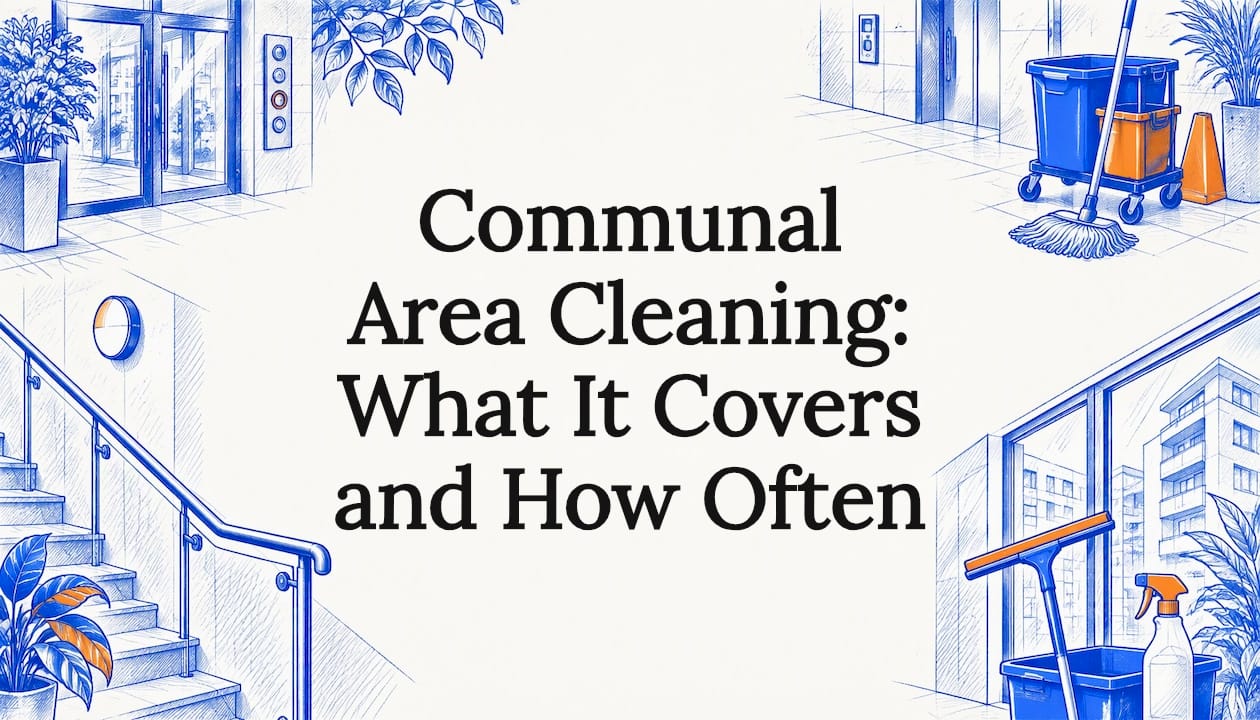
Communal area cleaning is the routine cleaning of the shared parts of a residential building that everyone uses: entrances, lobbies, corridors, stairwells, lifts, bin stores, bike stores and car parks, kept clean, safe and presentable to an agreed written standard.
If you have just taken charge of a 300-home London estate, that definition is your starting point. The harder job is turning it into a specification: which areas, which tasks, how often, and how you will know the work has been done. This guide explains each of those, using published London council and housing association standards as reference points, and leaves the rota template for another day.
TL;DR
- Communal areas are every part of a block that residents share, from the front door to the bin store and car park, not only the lobby.
- Frequencies should follow footfall and risk: entrances, lifts and hazard checks daily, stairs and landings weekly, windows and deep cleans on a longer cycle.
- Health and safety basics are COSHH-compliant products, wet-floor signs, clear escape routes and immediate reporting of hazards.
- A standard only works if it can be checked: written task lists, photographs, inspections and a regular review with the contractor.
- A dedicated on-site team keeps every area on spec between periodic cleans, rather than relying on visits that catch problems late.
Table of Contents
- What counts as a communal area on a 300-home estate?
- What does communal area cleaning cover, area by area?
- How often should each area be cleaned?
- What are the health and safety basics for cleaning shared areas?
- How do you check that communal cleaning is done properly?
- What does this look like in a real London building?
- Why do we use a dedicated on-site team?
- How do you set a communal cleaning standard from scratch?
- What if the current contractor is underperforming?
- Who can keep every area on spec?
- FAQ
- Sources
What counts as a communal area on a 300-home estate?
A communal area is any part of a building or estate that more than one household uses and that the landlord or managing agent is responsible for maintaining. On a large estate that is a much longer list than most people expect when they first walk it.
The London council standards give a good picture. Islington’s Caretaker Quality Assurance Manual describes caretakers as responsible for maintaining and cleaning communal areas to an acceptable standard and for reporting repairs and other estate issues. The areas it covers include entrances, porches, halls, corridors, landings, stairs, handrails, lifts, communal windows, bin chambers and refuse chutes, paths, parking areas, play and seating areas and lighting. It also covers graffiti and dumped items.
For a 300-home estate made up of several blocks, walk the site and list every one of these spaces by block. Include the ones nobody thinks about until a complaint arrives: the cycle store behind block C, the side stair that only the bin crew use, the lift lobby on the top floor. If it is not on the list, it will not be on the specification and it will not be cleaned.
What does communal area cleaning cover, area by area?
The scope below reflects the areas that matter in purpose-built blocks, multi-block estates, build-to-rent buildings and mixed-use schemes across London.
Entrances, lobbies and porches
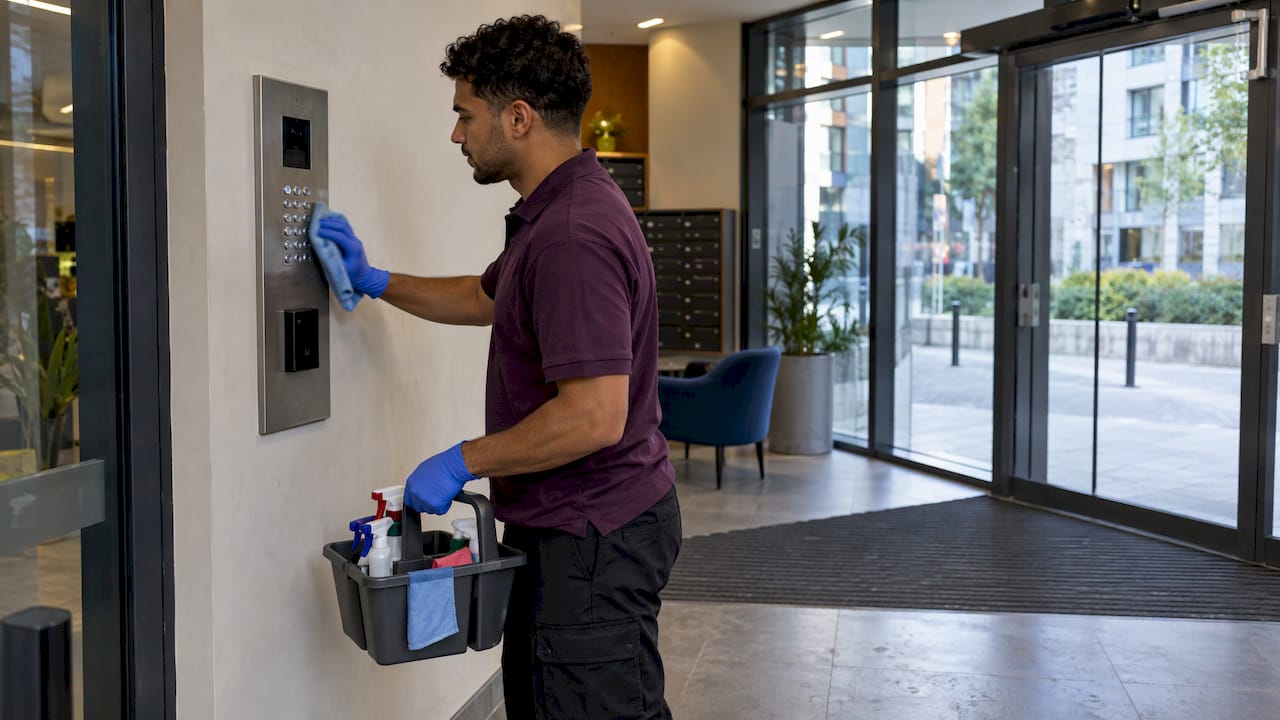
These are the first thing residents, visitors and delivery drivers see, and they take the heaviest footfall. Typical tasks are sweeping and mopping hard floors, cleaning entrance doors and glazing, wiping door handles, intercom panels and fob readers, emptying bins, and keeping mats clean. In blocks with a concierge desk or parcel room, the surrounding surfaces belong in the specification too.
Corridors, landings and stairwells
Stairs and landings collect dust, grit, litter and scuff marks, and handrails are touched constantly. Tasks include vacuuming carpets or mopping hard flooring, dusting ledges and window sills, cleaning handrails and balustrades, removing scuff marks and checking that nothing is stored on landings.
Lifts and lift lobbies
Lift floors, walls, buttons and door tracks show wear fast. Daily floor cleaning, regular wiping of control panels and mirrors, and periodic work on lift doors and light fittings keep them presentable. On a tall block, a lift out of service puts extra traffic on the stairs, which is another reason to keep stair cleaning reliable.
Bin stores, chutes and refuse areas
Bin stores generate the most resident complaints about odour and pests. Tasks include sweeping and washing the floor, clearing spilled waste, cleaning bin chamber doors and chute hoppers, and reporting overflowing or damaged bins. Refuse storage is also a legal expectation in some settings: the HMO manager duties reproduced in the West Suffolk Landlord’s Handbook include maintaining refuse storage and keeping common stairs, carpets and lights clean and in working order.
Bike stores, car parks and external paths
These are easy to overlook. Car parks need sweeping, litter and leaf removal, and attention to oil stains and drains. Bike stores need floors swept and any abandoned or hazardous items reported. Paths and approaches should be kept clear of litter and leaves, because slips outside are as much your problem as slips inside.
Communal windows and front glazing
Front windows and entrance glazing shape how a building looks from the street. They run on a longer cycle than daily cleaning and are usually specified separately, internal and external, with access method noted for upper floors.
How often should each area be cleaned?
There is no single correct answer, because frequency depends on footfall, the number of homes per core, building height and how the space is used. What you can do is anchor your specification to published standards from London landlords and then adjust.
The table below uses the schedule in Islington’s Caretaker Quality Assurance Manual as a worked reference. It is one council’s standard for its own estates, not a universal rule and not a Harmony schedule.
| Area or task | Example frequency |
|---|---|
| Entrances, porches and lift floors | Daily |
| Hazard and risk checks | Daily |
| Car parks and bin chambers | Twice weekly |
| Litter and leaf removal | Three times weekly |
| Stairs, landings, ledges, handrails and scuff marks | Weekly |
| Lift doors and light fittings | Every four weeks |
| Communal windows | Every eight weeks |
Ealing’s Estate Services Service Standard shows a different pattern. It promises a full clean of every block weekly, with lifts and ground-floor lobbies mopped daily in tower blocks that have a lift. It also specifies annual communal-window cleaning for blocks under six storeys and an annual deep clean of concrete tower-block stairs.
Two councils, two patterns, and both are reasonable. The lesson is the structure: a short daily layer for the highest-traffic and highest-risk spaces, a weekly layer for the rest, and a periodic layer for deep cleaning and glazing.
Adjusting frequency to your estate
Start from a published standard, then test it against reality for the first few months. A block with 150 flats on one core will see far more traffic through its lobby than a low-rise block of twelve. Complaints about specific areas, delivery volumes, weather and the position of bin stores all justify changing the frequency of a task. Fix the daily and weekly layers first, then decide which deeper work goes on a periodic cycle.
What are the health and safety basics for cleaning shared areas?
Cleaning in a building where residents are walking through creates hazards for them as well as for staff. Your specification should state the basics plainly so the contractor and you share the same expectations.
Housing association specifications are a useful model. Clarion’s Communal Cleaning Specification requires contractors to comply with the Health and Safety at Work etc. Act 1974, the COSHH Regulations 2002 and the Environmental Protection Act 1990, to display wet-floor signs, to dispose of dirty water appropriately and to report hazards.
COSHH and cleaning products
COSHH is the set of rules on controlling hazardous substances, and cleaning chemicals fall within it. In practice, ask for a product list with safety data sheets, secure storage of chemicals away from resident access, and trained operatives who know what they are using. Make sure anything stored in a cupboard on site is locked.
Wet floors
The same Clarion specification requires wet-floor warning signs during cleaning, including at the top and bottom of stairs, with the signs removed once floors are dry. It also restricts mopping of floors liable to freeze during extreme cold. For an estate with external walkways and open stairwells, that last point matters in winter.
Clear escape routes
Cleaners see the building more often than anyone else, which makes them well placed to notice blocked routes. The HMO manager duties in the West Suffolk handbook include keeping fire escape routes unobstructed. Riverside’s Building Safety Management Policy applies to communal areas and says building-safety management must address fire spread, structural failure, escape routes and emergency lighting, which is particularly relevant to higher-risk residential buildings. Your specification should require cleaners to report bikes, prams, furniture or rubbish left on landings and in stairwells, and to avoid blocking routes themselves with equipment.
Sharps, hazards and repairs
Clarion requires cleaners to report communal repairs and health-and-safety hazards immediately, followed by a written report, and to remove sharps, needles, broken glass and comparable harmful materials immediately when found. Whatever your own policy says about sharps, make sure it is written down and that staff are trained to follow it.
Electrical equipment and who is responsible
Electrical Safety First’s guidance for communal areas says landlords, management companies and managing agents are responsible for health and safety duties in common parts insofar as matters are within their control, and identifies the Electricity at Work Regulations 1989 as relevant to controlled electrical work. For cleaning, the practical point is that damaged lighting, exposed cabling or faulty plant seen during a clean should be reported, not worked around.
For legal advice about your own building, including fire risk assessments and your duties as the responsible person, speak to your health and safety adviser or fire risk assessor.
How do you check that communal cleaning is done properly?
A standard that cannot be inspected is only a hope. The councils above all build in ways to check the work.
Islington’s manual uses written standards and photographs so cleaning can be assessed objectively and transparently. It recommends inspecting blocks against set criteria, recording service standards, gathering resident feedback and reviewing service agreements. The City of London’s Estate Services Standards 2024 treats cleaning, caretaking and grounds maintenance as estate services assessed through a routine quality-assurance grading framework.
Ealing goes further on transparency. It publishes current cleaning schedules and contact details online and on estate noticeboards, and involves residents in monitoring performance. Its stated targets include 90% of blocks cleaned weekly and 100% of weekly communal-area safety checks.
A simple inspection routine
- Write a one-page standard for each area, with a photograph of what acceptable looks like.
- Inspect a sample of blocks each month against that standard, scoring each area pass or fail.
- Keep the scores, so trends show up before residents complain.
- Put the schedule on noticeboards so residents know what to expect and can flag gaps.
- Review results with the contractor on a regular cycle and agree actions.
Where photo reports fit
Photo-evidenced visit reports give you an inspection record for every visit, not only the days you are on site. At Harmony, each visit comes with a photo-evidenced report, and we hold monthly reviews with the client to go through them. That gives you a paper trail to take to a board, a residents’ association or a regulator.
What does this look like in a real London building?
The two examples below are illustrations of how a specification might be structured. They are not client stories, and the details are invented to show the thinking.
Illustration: a 300-home estate in Southwark
Imagine six blocks of around fifty homes each, built in the 1970s, with open walkways, two bin chambers, a shared cycle store and a surface car park. The estate manager starts by mapping every communal space by block, then groups them into three layers.
The daily layer covers entrances, lift floors and a hazard check of stairs and landings. The twice-weekly layer covers bin chambers and the car park. The weekly layer covers stairs, handrails and ledges, with periodic work on windows and deep cleaning of stair cores. Each area gets a one-line standard and a photograph. The manager inspects two blocks a month and rotates through them.
The result is a specification a new contractor can price and an outgoing one can be measured against, without anyone arguing about what clean means.
Illustration: a build-to-rent tower in Stratford
Now imagine a 30-storey build-to-rent tower with a concierge desk, two lifts, a residents’ lounge, a bike store and a ground-floor retail unit. Footfall is high and constant, parcels arrive all day, and residents are paying for a premium experience.
The lobby, lifts and entrance glazing sit in the daily layer, with attention to presentation through the day rather than a single clean at dawn. Corridors on each floor are cleaned on a weekly cycle with a daily visual check. Bike store and bin store are checked daily because odour and clutter show up quickly in a tall building with a shared core. External glazing and carpet care run on a periodic cycle.
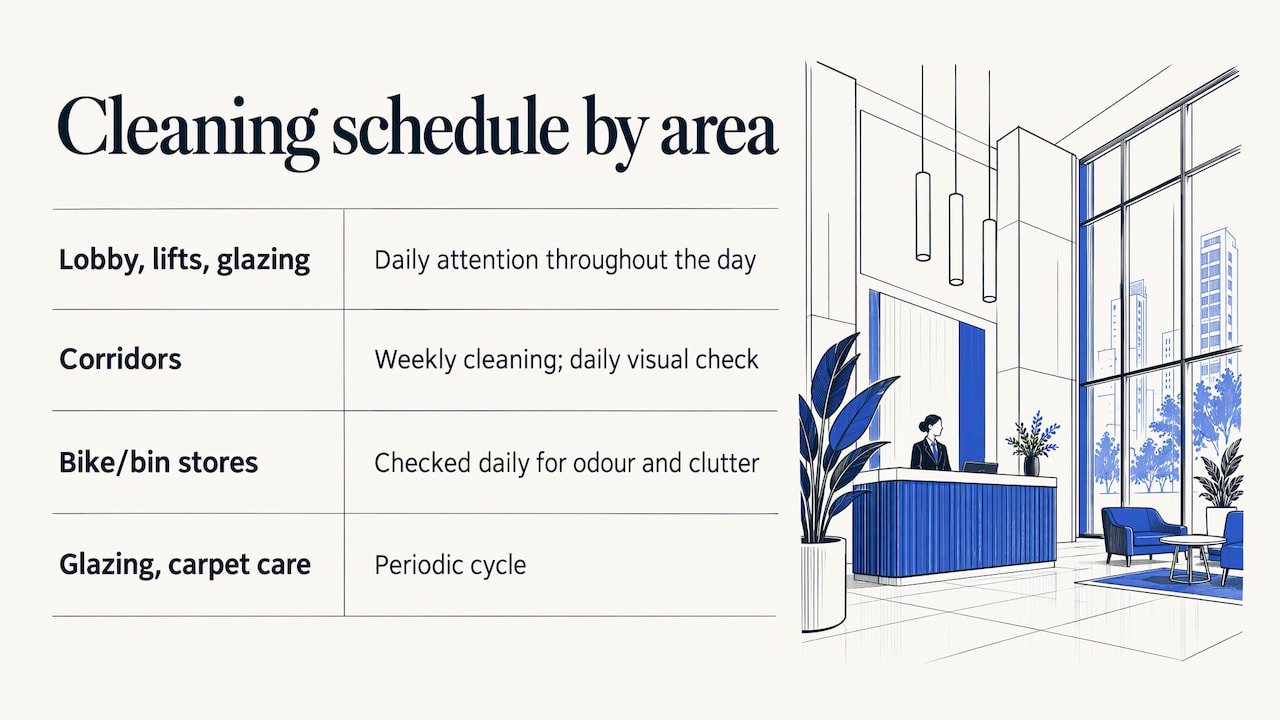
The point is that the same list of areas produces a different schedule depending on the building type, and that the daily layer carries most of the weight in a high-footfall block.
Why do we use a dedicated on-site team?
We run daily common-area cleaning for large London developments with a dedicated on-site team, and we think that is the right model for an estate of 300 homes.
Periodic cleans matter, and we carry them out: deep cleans, window cleaning, carpet and hard floor care. But a deep clean only resets a building. What residents notice is the lobby on a Tuesday afternoon, the bin store after collection day and the lift after a delivery. A team that is on site every day sees those things as they happen and fixes them, and a team that visits less often finds them later.
The on-site team also becomes part of the building. They know which stairwell collects leaves, which resident needs a door held for a pushchair and which bin store is a problem after a bank holiday. They report hazards and repairs as they find them, and that feeds straight into your inspections.
That is why each contract has one named account manager and photo-evidenced visit reports, with monthly reviews to go through them together. You get one person to call and a record of what was done. Our staff are Enhanced DBS-checked and trained, we are a Living Wage employer, and we hold SafeContractor approval, ISO 9001, ISO 14001 and BICSc membership. Our team brings more than 20 years of combined experience.
Drahim Hasula, CEO and Founder of Harmony Cleaning
How do you set a communal cleaning standard from scratch?
As a new estate manager you have an advantage: no habits to unpick. A clear process makes the first quarter much easier.
- Survey the estate. Walk every block and list each communal space, including the ones off the main routes.
- Group areas by use. Separate high-traffic, high-risk spaces from lower-traffic ones, because they need different frequencies.
- Write the task list for each area. Say what is cleaned and how, not only how often.
- Draw on published standards. Use the London council examples above as a benchmark, then adjust to your footfall.
- Set health and safety requirements. COSHH documentation, wet-floor signage, hazard reporting and escape-route checks go in the contract.
- Agree how quality will be measured. Photographs, inspections and resident feedback, with a review cycle.
- Separate routine from reactive work. CETRA’s estate cleaning contract distinguishes routine block cleaning, which keeps communal parts clean and hazard-free, from reactive cleaning outside scheduled work or needing specialist treatment. Defining that line early avoids disputes about what is in scope.
What if the current contractor is underperforming?
Many estate managers inherit a contract that is not delivering. The first step is evidence: your inspection scores and photographs show where the standard is slipping. The second is a structured review.
CETRA’s proposed contract requires performance figures to be scrutinised at monthly operational meetings, quarterly strategic meetings and a yearly review, with financially linked KPIs. You do not need a contract that elaborate, but the rhythm is a good one: frequent, factual conversations backed by data.
If the contract does need to change hands, a managed takeover protects continuity. That means mapping the existing rota, transferring keys, handling TUPE where it applies and keeping the service level in place while the new team settles in. We handle contract takeovers on that basis, so residents see no gap in service.
Who can keep every area on spec?
We are a London commercial and communal cleaning company, and our main focus is daily on-site common-area cleaning for large residential developments: blocks of 100+ apartments, multi-block estates and build-to-rent buildings. We cover entrances, lobbies, stairwells, corridors, lifts, bin stores, front windows, bike stores and car parks, and we also provide periodic deep cleans, window cleaning, carpet and hard floor care and contract takeovers. See our communal and commercial cleaning services for the full range.
If you would like to talk through your estate and the standard you want to set, you can send us an enquiry through the quote form.
FAQ
What is the difference between communal area cleaning and a deep clean?
Communal area cleaning is the routine, scheduled upkeep of shared areas, usually daily or weekly. A deep clean is a periodic, more intensive job such as scrubbing stair cores, treating hard floors or cleaning carpets. You normally need both: routine cleaning keeps standards steady and deep cleans reset surfaces that routine work cannot fully restore.
How often should a large residential block be cleaned?
That depends on footfall and building type. Published London council standards give a guide: Islington schedules entrances and lift floors daily and stairs weekly, while Ealing cleans every block weekly and mops lifts and ground-floor lobbies daily in towers with a lift. Use these as a benchmark and adjust for your own estate.
Who is responsible for health and safety in communal areas?
Landlords, management companies and managing agents carry duties for common parts insofar as matters are within their control, according to Electrical Safety First. Contractors have their own duties, including COSHH compliance and safe working. Confirm your specific obligations with your health and safety adviser.
How can I check the cleaning is actually being done?
Use written standards with photographs, inspect a sample of blocks each month and record the scores. Photo-evidenced visit reports from the contractor add a record of every visit. Review results regularly with the contractor and listen to resident feedback.
Can a new contractor take over without disrupting the service?
Yes, if the handover is planned. That means mapping the current rota, transferring keys, handling TUPE where it applies and keeping the agreed service in place from day one. A named account manager on the incoming side makes it easier to resolve issues quickly.
Sources
- Islington Council, Caretaker Quality Assurance Manual
- Ealing Council, Estate Services Service Standard
- City of London, Estate Services Standards 2024
- Clarion Housing, Communal Cleaning Specification
- CETRA, Estate Cleaning contract FAQs
- West Suffolk Council, HMO Suffolk Landlord’s Handbook
- Riverside, Building Safety Management Policy
- Electrical Safety First, Electrical safety in communal areas
Request a free quote through our quote form, email admin@harmony-cleaning.co.uk or call 020 8092 8835.