/ Blog ·
Commercial Deep Cleaning: Scope, Timing and Hiring

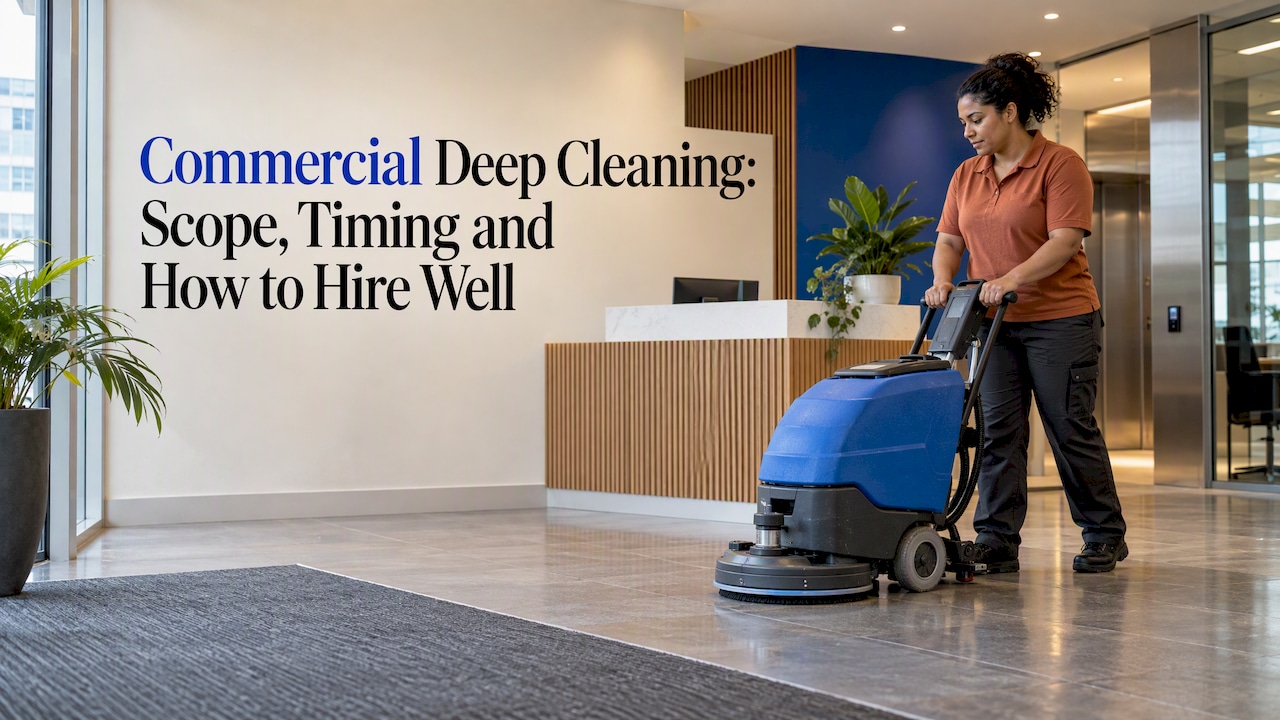
Commercial deep cleaning is a scheduled, detailed reset of a workplace or communal building: the areas, surfaces and equipment that routine cleaning only touches lightly, or never reaches. It is not a longer version of the nightly clean. It is a separate piece of work with its own scope, access needs, equipment and safety paperwork. This guide explains what it includes, when to book it, what UK rules apply, how to compare contractors and how to change provider without disrupting your building.
TL;DR
-
A deep clean resets a building: high-level dust, hard floor restoration, carpet extraction, descaling, sanitising of touch points and detailed work behind and under fixed items.
-
Book one at set intervals, after refurbishment, before or after a tenancy change, after illness outbreaks, or when a new contractor takes over and you want a clean baseline.
-
UK rules apply: COSHH for chemicals, the Work at Height Regulations 2005 for high-level and window work, and a written scope before anyone starts.
-
Judge a contractor on a written scope, vetted and trained staff, insurance, a named account manager and evidence of what was done.
-
Cost depends on size, condition, time since the last deep clean, access and out-of-hours working, so a site survey beats any rate card.
Table of Contents
What commercial deep cleaning includes
Routine commercial cleaning keeps a building presentable day to day. Bins are emptied, floors vacuumed or mopped, toilets and kitchens wiped down, desks and reception areas tidied. A deep clean goes beneath that layer and deals with what builds up over weeks and months.
The usual split looks like this:
| Area | Routine clean | Deep clean |
|---|---|---|
| Floors | Vacuum, mop | Machine scrubbing, polishing or restoration of hard floors; hot water extraction of carpets |
| Surfaces | Wipe desks and counters | Wipe and sanitise everything, including partitions, ledges, radiators and skirting |
| High level | Rarely touched | Dusting of light fittings, vents, tops of cabinets and door frames |
| Washrooms | Clean and restock | Descale taps, tiles, grout and fittings; clean behind and around fixtures |
| Kitchens and breakout areas | Wipe, empty bins | Inside and behind appliances, cupboards, extractor grilles, sink and drain areas |
| Touch points | Occasional wipe | Systematic disinfection of handles, switches, lift buttons, handrails, door plates |
| Windows and glazing | Not included | Internal and external glass, frames and sills, where access allows |
The exact list depends on the building. A deep clean for a twelve-person office is not the same document as one for a six-storey residential block with stairwells, bin stores, lifts and a car park. That is why the scope should be written down before the quote is accepted.
Offices and workspaces
In an office, the deep clean usually centres on the places staff actually touch and the places nobody reaches: desk surfaces and the gaps around them, chair bases, meeting room tables, phones and shared equipment, kitchen appliances, and carpets that hold months of traffic. Upholstered furniture and fabric screens are often included when requested. Hard floors in reception and corridors are scrubbed and resealed or polished, because that is where a visitor forms a first impression.
Residential and mixed-use blocks
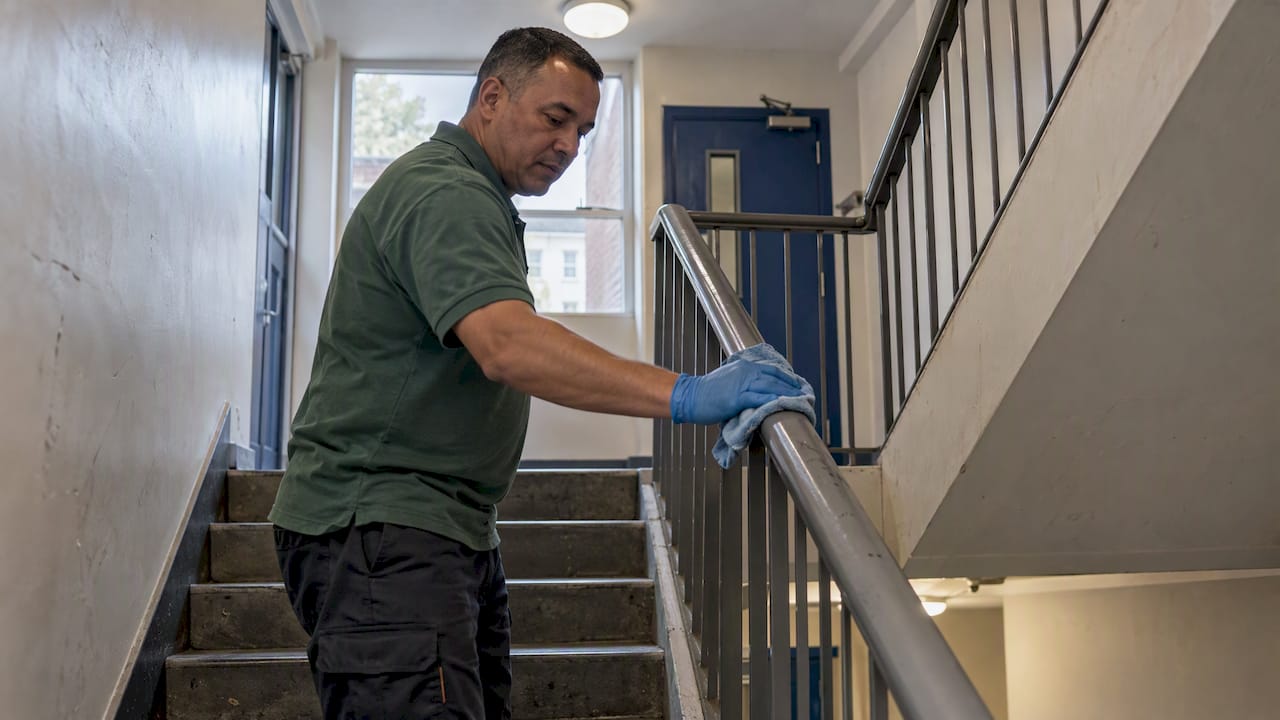
For block managers the picture is different. Communal areas see heavy traffic from residents, deliveries and contractors. A deep clean here typically covers entrance lobbies, stairwells, handrails, landings, lift interiors, hard floor and carpet restoration, glass in communal doors and windows, bin rooms and cycle stores, and the high-level dust that settles on corridor lights and vents. Because residents live next to the work, timing and noise matter as much as the task list.
When to book a commercial deep clean
There is no single universal interval, because use varies so much. What matters is having a clear trigger. In UK guidance, deep cleaning is typically tied to specific events such as an infection outbreak, an end of tenancy, a refurbishment, or a set periodic interval to reset environmental hygiene standards. That guidance is written for care settings, but the logic carries over to any workplace.
In practice, these are the moments property and office managers book one:
-
On a calendar. Many organisations schedule deep cleans quarterly, twice yearly or annually, on top of the routine contract. High-footfall sites and shared washroom-heavy buildings tend towards the shorter end.
-
After building work. Fit-outs and refurbishments leave fine dust in places no one will see until it falls. A post-works clean should happen after the trades have gone and before staff or residents return.
-
At a tenancy change. Before new tenants move into a unit, or when a tenant hands back a floor, a deep clean sets the condition both sides agree on.
-
After illness. If a cluster of illness hits a workplace, a targeted disinfection of touch points and shared facilities is a sensible response. Check any public health advice that applies to your premises.
-
When changing contractor. A deep clean at the start of a new contract gives the incoming team a known baseline, so standards can be measured from day one.
-
Before an event or inspection. Audits, client visits, open days and insurance or lender inspections all reward a building that is visibly well kept.
The routine contract and the deep clean should be planned together. If the deep clean is a recurring line in the agreement, it is cheaper to schedule, easier to staff and less likely to be skipped when budgets tighten.
UK health and safety requirements
Deep cleaning uses stronger products, more equipment and often more working at height than the daily clean. As the person commissioning the work, you share responsibility for the conditions around it. Three areas deserve attention.
Chemicals and COSHH
The HSE explains that cleaning products can irritate the skin, trigger allergies or asthma, or cause burns and eye damage. Its COSHH guidance for cleaners points to controls such as minimising contact, safe storage, protective equipment where needed and good ventilation. Ask any contractor how they assess the products they use, how staff are trained to handle them and where safety data sheets are held. Tell them about anything in your building that changes the risk: people with asthma, a nursery or clinic on the premises, or sensitive equipment.
Spills need dealing with straight away. HSE guidance on cleaning and disinfection says so plainly, and in a deep clean, with wet floors and machinery, a spill is also a slip hazard for your staff and residents.
Working at height
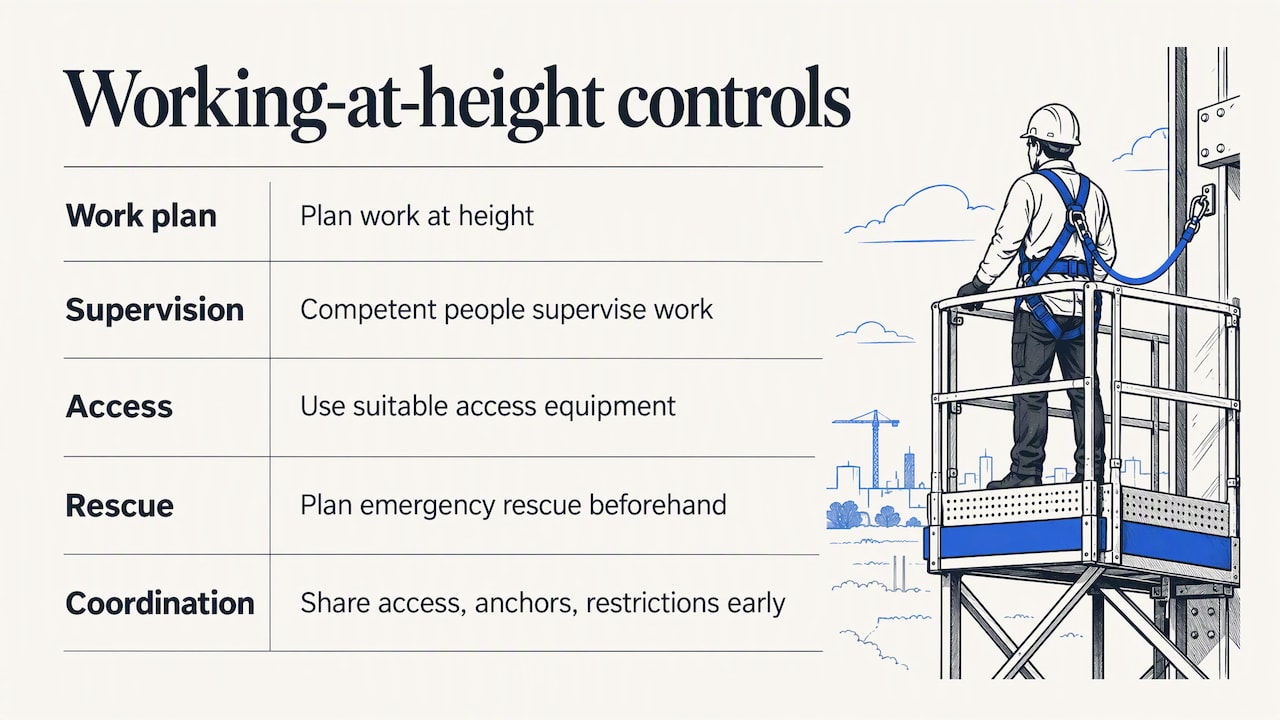
High-level dusting, light fittings, atrium glass and external windows all involve height. HSE guidance states that work at height must be planned, supervised by competent people and use suitable access equipment under the Work at Height Regulations 2005. For window work specifically, the HSE says that emergency and rescue arrangements must be planned before work begins, and that relying on the emergency services alone is not enough.
The same HSE page stresses cooperation between building owners, managing agents and contractors, including whether a building’s design lets windows be cleaned safely from the inside. If you manage the building, that means sharing roof access details, anchor points, fall-protection arrangements and any restrictions with the contractor early, not on the morning of the job.
The workplace itself
The Workplace (Health, Safety and Welfare) Regulations expect the workplace and its equipment to be kept, including cleaned as appropriate, in an efficient state and good repair. Deep cleaning is one of the ways employers show they are meeting that duty. Keep a record of what was done, when and by whom.
How to assess a deep cleaning contractor
Public buyers set a useful benchmark. In one UK government cleaning specification, suppliers must agree the activity with the buyer and provide health and safety documentation before periodic deep cleaning begins, and COSHH is listed among the legislation that applies. Private organisations can ask for exactly the same things.
Before you sign, ask for:
-
A written scope. Room by room or zone by zone, with the tasks, the method and the frequency. Vague wording such as “deep clean as required” is where disputes begin.
-
A site survey. A reputable contractor will walk the building before quoting. A price given blind from a square footage is a guess.
-
Risk assessments and method statements. Particularly for work at height, floor machines and chemical use.
-
Insurance. Public liability at minimum, with the certificate and its limits shown to you. Ask what it covers when work is done out of hours.
-
Staff standards. How operatives are vetted (for example DBS checks), how they are trained and whether they work in uniform and carry identification. In residential blocks, this is often the first question residents ask.
-
Quality systems and standards. Look for recognised management certifications and professional training standards, then ask how they translate into daily practice on your site.
-
Evidence of work done. Photo-evidenced reports, sign-off sheets and an agreed way of raising snags.
-
A named contact. One person who knows your building and answers when something goes wrong.
Compare quotes like for like. If one contractor includes carpet extraction and window glass and another does not, the cheaper quote may simply be a smaller job.
What affects the cost
No honest contractor can give a reliable figure without seeing the building, but the drivers are consistent.
-
Floor area and layout. More square metres means more labour and machine time; many small rooms take longer than one open floor.
-
Condition. The length of time since the last deep clean, and the level of build-up, decides how many passes are needed.
-
Scope. Adding carpet cleaning, hard floor restoration, windows or washroom descaling changes the number of operatives and the equipment.
-
Access and height. Atriums, high glazing and external elevations need specialist access equipment and extra planning.
-
Timing. Evenings, nights and weekends are common for minimal disruption, and out-of-hours work can change the price.
-
Building type. Residential blocks with lifts, stairwells and bin stores differ from open-plan offices.
-
Whether it sits inside a contract. A deep clean planned into an ongoing agreement is usually easier to price than a one-off emergency booking.
Ask for a fixed price per defined scope, and ask what happens if the job needs extra time. Quotes normally exclude VAT for businesses that can reclaim it, so check how the figure is presented.
Planning the deep clean to cause minimal disruption
The best deep cleans are the ones nobody notices happening. A few practical steps make the difference:
-
Choose the window. Weekends, evenings or a quiet week in an office; midweek daytime hours for residential stairwells, with notices posted in advance.
-
Clear the ground. Ask staff to clear desks and floors. In blocks, move bikes, prams and parcels from areas to be scrubbed.
-
Brief the contractor. Share alarm codes, key arrangements, restricted areas, lift booking rules and any areas with confidential material.
-
Warn people. Tell staff or residents when floors will be wet, which areas are closed and when they will reopen.
-
Walk it afterwards. Inspect with the account manager before signing off, and record anything that needs correcting.
Switching cleaning provider without losing standards
Many managers put off changing cleaner because they fear a messy handover: missed visits, lost keys, unhappy staff. A well-run changeover avoids that, and a deep clean is often the best first step with the new team.
A sound transition covers:
-
Contract review. Check the notice period and the specification you are leaving, so the new agreement matches or improves it.
-
Rota mapping. The new contractor should map who cleans where and when, so no area falls through the gap.
-
Key and access transfer. Keys, fobs and codes should be logged, handed over and signed for.
-
Staff transfer. Where existing cleaners may transfer to the new contractor under TUPE, the incoming contractor should handle the process properly. Take employment advice if you are unsure whether it applies.
-
Service level continuity. Response times and inspection frequency should carry across without a gap.
-
A baseline clean. An initial deep clean sets the standard the new team is then held to.
Our view: why deep cleans work best as part of a contract
We see the same pattern across offices and residential blocks in London. A deep clean booked in a panic, with no scope and no baseline, disappoints. A deep clean planned into a contract, with a surveyed scope and a named person accountable, holds.
That is why every contract we run has a dedicated account manager. They know the building, the access arrangements and the people in it, so a deep clean is scheduled around your calendar, not ours. Our staff are DBS-checked, uniformed and trained through an onboarding process before they set foot on site, and we operate to ISO and BICSc standards for quality and environmental management.
We also believe the work should be visible. Our visit reports are photo-evidenced, so you can see what was done without walking every floor yourself. When we take over from another provider, we map the rota, manage the key transfer, handle TUPE and keep your service levels continuous, and a deep clean is a natural first step to set the baseline.
Drahim Hasula, CEO and Founder of Harmony Cleaning
Deep cleaning with Harmony Cleaning
We provide periodic deep cleans for offices, workspaces and residential and mixed-use blocks across Greater London, alongside routine office cleaning, communal area cleaning, window cleaning, carpet and hard floor care and contract takeover. Each contract comes with a dedicated account manager, DBS-checked staff and fully insured service, and we can plan deep cleans to fit around your working hours.
If you want a scoped deep clean or a smooth change of provider, request a free quote, email admin@harmony-cleaning.co.uk or call 020 8092 8835.
FAQ
What is the difference between commercial deep cleaning and regular cleaning?
Regular cleaning maintains a building day to day: bins, vacuuming, surface wiping and washroom care. Deep cleaning is a detailed, periodic reset that reaches high-level areas, behind and under fixtures, floors and carpets needing machine treatment, and touch points needing systematic disinfection. It usually takes more time, more equipment and a written scope.
How often should an office or block have a deep clean?
There is no fixed legal interval. Most organisations choose a periodic schedule, such as quarterly, twice a year or yearly, based on footfall and how the building is used. Add extra cleans after refurbishment, a tenancy change or an illness outbreak.
Can a deep clean happen without disturbing staff or residents?
Yes. Work is commonly scheduled in the evening, overnight or at weekends for offices, and in agreed daytime windows for blocks, with notices posted ahead. Your contractor should agree access, closed areas and reopening times with you before starting.
Do I need to provide anything for a deep clean?
You need to share access details, alarm and key arrangements, any hazards or restricted areas, and information on work at height such as roof access or anchor points. Your contractor should provide risk assessments, method statements and details of any chemicals used under COSHH.
What should I ask a contractor before booking?
Ask for a site survey, a written scope, insurance certificates, staff vetting and training details, risk assessments, a named contact and the way work will be evidenced. Compare quotes on identical scope so the prices mean the same thing.