/ Blog ·
Commercial Window Cleaning London: A Buyer Guide


For most London residential blocks and offices, the right window method comes down to three things: the height of the glass, how you can safely reach it, and how often it needs doing. Reach-and-wash (a water-fed pole working from the ground) suits the lower and middle part of most buildings. Taller elevations, recessed glazing and glass that can’t be reached from the ground bring in cradles, rope access or powered platforms (MEWPs). This guide is written for block managers and managing agents first, with office managers in mind too. It covers how to choose a method, what the Work at Height Regulations 2005 mean for you as the client, how to set a schedule and how to warn residents.
TL;DR
- Under the Work at Height Regulations 2005, HSE guidance says to avoid work at height where reasonably practicable, for example with telescopic water-fed poles or by cleaning from inside.
- Choose the method by height, glass type and access: reach-and-wash for the lower and middle storeys, specialist access above that or where poles can’t reach.
- As the client you must check competence, risk assessments and method statements, not just accept a price.
- Set frequency by the building: entrance glazing and ground floors often need more visits than upper elevations.
- Give residents written notice before external work, and agree who handles balconies and internal glass.
Table of Contents
- What does commercial window cleaning cover in a London block or office?
- Which window cleaning method suits my building?
- What does the Work at Height Regulations 2005 mean for a block manager?
- How do I check a window cleaning contractor is competent?
- How often should commercial windows be cleaned?
- What does a London window cleaning specification need to include?
- How do I tell residents about window cleaning?
- What does this look like in practice? Two London illustrations
- Why combine window cleaning with a communal contract?
- Can Harmony Cleaning take over my window cleaning?
- FAQ
- Sources
What does commercial window cleaning cover in a London block or office?
In a residential development or mixed-use building, the scope is usually broader than “the outside of the windows”. A proper specification names each glazed area separately:
- Entrance and lobby glazing, internal and external, including doors, side panels and frames. This is the glass every resident, visitor and inspector sees first.
- Front-facing and street-level windows, often cleaned alongside the daily communal contract.
- Stairwell and corridor windows, which are easy to forget and are often awkward to reach.
- Upper elevations, which depend on the building’s design and access arrangements.
- Frames, sills and signage, where included in the specification.
- Internal glass in offices, such as partitions, meeting-room glazing and internal windows.
In offices, the same logic applies: street-facing glazing and reception glass are visible daily, while upper-floor and internal glass can follow a lower frequency. Write each of these into the specification so there is no argument later about what was or wasn’t included.
Which window cleaning method suits my building?
The HSE says the choice of access equipment for each job is determined by the height to be negotiated, site conditions, duration and extent of work, and frequency of access. In other words, there is no single best method, only the best method for your elevations.
Here is a decision table you can use as a starting point. Treat it as a planning aid: the contractor’s own risk assessment for your site decides the final method.
| Building height | Glass type and situation | Usual method | What to check |
|---|---|---|---|
| Up to about 6 storeys | Flat, flush glazing reachable from ground level | Reach-and-wash (water-fed pole) | Safe pole footing, pedestrian segregation, car park or forecourt access |
| About 6 storeys up to around 20 metres | Large flat elevations, no deep recesses | Reach-and-wash with extended poles, where the site allows | Ground space for the operative, wind conditions, pole stability |
| Any height | Balconies, deep reveals or glass set back from the face | Reach-and-wash where it reaches, otherwise inside access or specialist access | Resident access to balconies, internal cleaning arrangements |
| Above pole reach | Tall curtain walling, atria, high stairwell glass | Cradle (building maintenance unit), rope access or MEWP | Installed equipment, LOLER certification, rescue plan, ground conditions |
| Any height | Ground-floor entrance doors and lobby glass | Hand cleaning with squeegee, or a pole | Door operation, wet floor protection, timing outside peak movement |
| Any height | Internal windows and partitions | Hand cleaning from floor level or steps | Occupier access, furniture, working hours in offices |
We use reach-and-wash up to about 20 metres alongside our communal cleaning contracts. That covers a large share of London’s purpose-built blocks and many build-to-rent buildings, where the lower and middle elevations are made up of regular, flush glazing. Above that height, or where the glass is set back from a podium, roof or terrace, specialist access is a separate piece of work with its own risk assessment and equipment checks.
Why reach-and-wash is the starting point
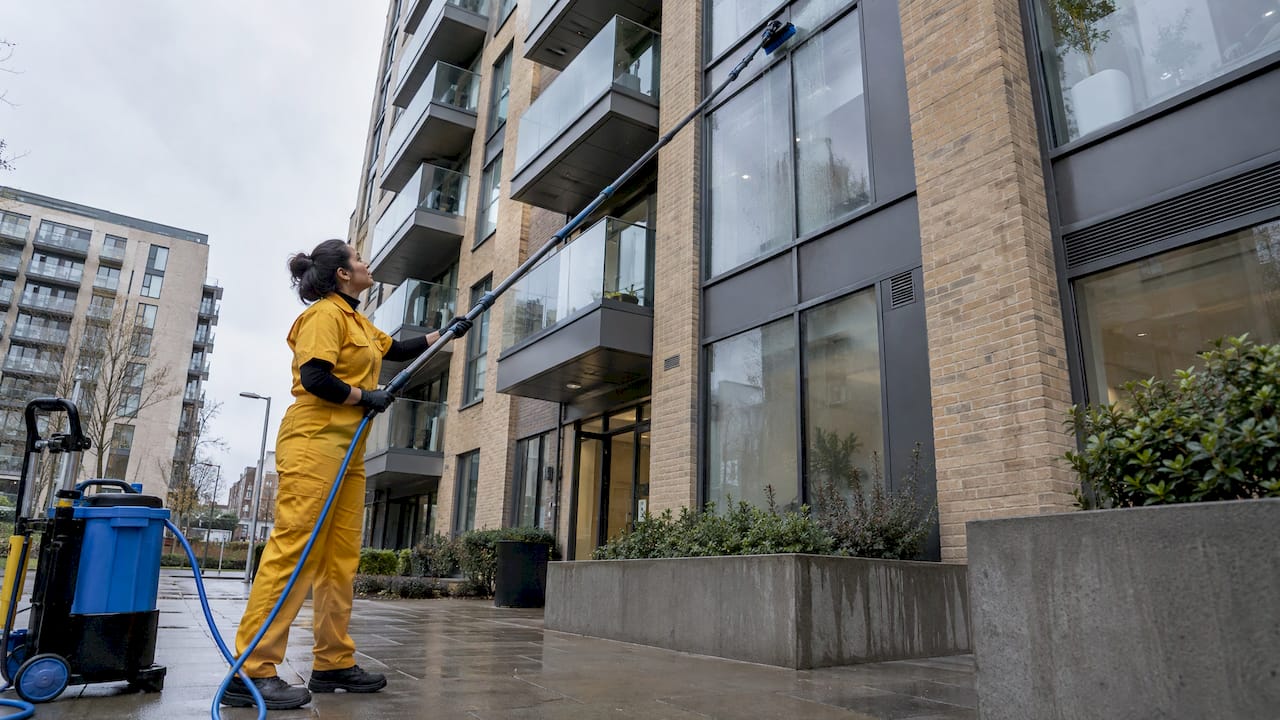
HSE guidance puts the principle plainly: avoid work at height where you can. The HSE gives telescopic water-fed poles and cleaning from inside as examples. A pole keeps the operative on the ground, and the pure-water rinse leaves the glass and frames clean without ladders. For a block manager it also means less disruption: no platform on the forecourt for long periods, and no need to enter flats for exterior glass.
When you need cradles, rope access or MEWPs
If there is no safe place to work and poles can’t do the job, suitable access equipment must be provided, and where the risk of falling isn’t eliminated, extra fall arrest measures are needed, according to the HSE. Typical triggers on London buildings are:
- tall glazed facades above podium levels;
- atria and double-height lobbies;
- glass over roofs, canopies or water features where a platform can’t stand;
- elevations on narrow streets where pole footing is unsafe.
These methods need more planning, and sometimes road or pavement permissions, so allow time before your first clean.
What does the Work at Height Regulations 2005 mean for a block manager?
The HSE’s window cleaning guidance explains that the Work at Height Regulations 2005 require work at height to be properly planned, supervised and carried out by competent people. It also says emergency evacuation and rescue procedures must be in place before work starts and covered in the risk assessment.
The duty doesn’t stop with the contractor. The Government’s Facilities Management Standard 001 (published 2022) says the Health and Safety at Work etc. Act 1974 places a legal obligation on both the service provider and the person overseeing window cleaning. The standard is written for government property, but its principle is a sensible benchmark for any managing agent.
Where a building has installed access equipment
If your building has a cradle, a roof-mounted unit or anchor points, the HSE says the building owner or person in control must give window cleaning contractors:
- site-specific instruction on using the equipment;
- the operating and maintenance instructions;
- copies of certification, including the LOLER certificate and inspection, maintenance and testing records;
- emergency procedures and the rescue plan.
The same page says contractors must make sure their people are trained and competent on the equipment, request LOLER thorough examination reports before work, and have confirmed they understand the emergency procedures. If you manage a 12-storey Southwark development with a roof cradle, find that paperwork before you ask for quotes. Tenders without it are guesses.
How do I check a window cleaning contractor is competent?
The City of London Corporation states that if you manage work at height contracts, you must make sure suitable risk assessments and method statements have been provided. As the client, you need to show that you have assessed competence, with the evidence depending on the nature of the work and the size of the workforce. It adds that clients still have a duty to monitor outsourced work, and that checking contractor work at least annually is appropriate where a serious incident is foreseeable.
A practical checklist before you appoint:
- Risk assessment and method statement written for your building, not a generic template.
- Training evidence for the operatives who will attend, including any powered access or rope access qualifications where relevant.
- Equipment checks, including LOLER examination reports for any lifting equipment.
- Rescue plan for any method above ground level.
- Insurance: ask for the certificate and read the limits and scope. Our guide to what cover to check on an insured cleaning company goes through it.
- Staff vetting, important where operatives work close to resident entrances and communal areas.
On our side, our staff are Enhanced DBS-checked and trained, and we are SafeContractor approved, ISO 9001 and ISO 14001 certified, BICSc members and a Living Wage employer. We carry £10m public liability cover.
How often should commercial windows be cleaned?
There is no single legal interval for window cleaning in a commercial or residential block, so set frequency from the building and what it needs to look like. Four factors usually decide it:
- Visibility. Entrance glazing and street-facing ground floors are seen daily and show marks fast, so they are often placed on a tighter cycle than upper elevations.
- Location. Buildings on busy roads, near construction or under trees collect dirt faster than those in quiet streets.
- Method and cost of access. Where cleaning needs a platform or rope team, schedules tend to be less frequent because each visit is a bigger operation.
- Resident and tenant expectations. In build-to-rent buildings, presentation is part of what residents pay for, so lobby and front glass often sit on the same rhythm as daily communal cleaning.
A common pattern is to keep entrance and lobby glass inside the daily communal routine, put street-level and front windows on a short rolling cycle, and schedule upper elevations on a longer cycle agreed with you in writing. For offices, reception and street-facing glazing tend to take priority, with upper floors and internal partitions on a lower frequency. Our communal area cleaning guide shows where front windows sit within a wider communal scope.
What does a London window cleaning specification need to include?
A specification turns “clean the windows” into something you can inspect. Published housing and council documents show what good ones contain. Here are the elements worth borrowing:
- Scope by elevation and glass type, with a plan or schedule of which windows are internal, external, balcony or entrance.
- Method per area, stating where reach-and-wash is used and where specialist access applies.
- Quality standard and defect handling. Slough Borough Council’s specification (2024) sets KPIs such as a streak-free finish and a defect rate below 1% of windows needing re-cleaning.
- Complaints logging. The City of London’s 2023 tender specification requires the contractor to log all complaints within 48 hours, and bans leaving equipment unattended on balconies.
- Contract meetings and reporting. Clarion Housing Association’s specification asks for monthly meetings for the first six months, reducing to quarterly if performance is good, with reports and KPI information supplied ahead of each meeting.
- Access arrangements: keys, fobs, concierge sign-in, balcony access and who contacts residents.
- Safety documents: risk assessments, method statements, rescue plan and equipment certification, supplied before the first visit.
Use these as models for the level of detail, then adapt the targets to your own building and contract. Our guide to what managing agents should expect from block cleaning covers how the same discipline applies to the rest of the communal scope.
How do I tell residents about window cleaning?
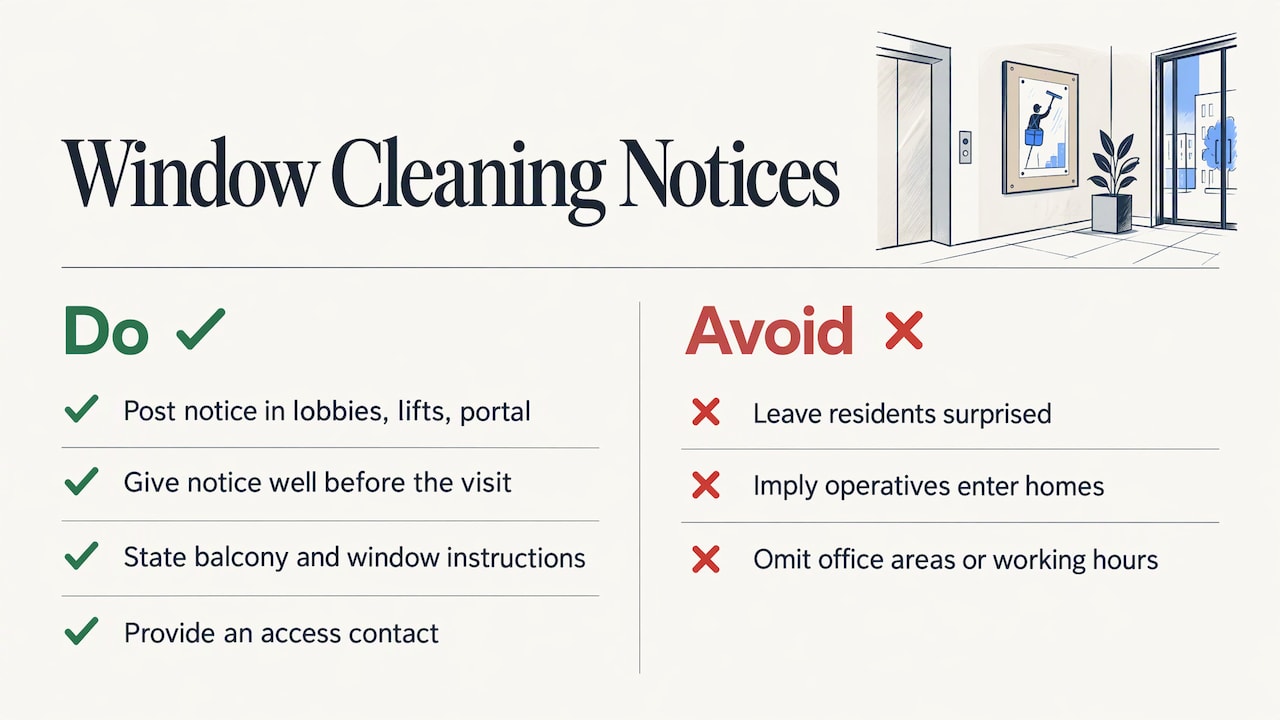
Residents mind two things: surprise and access. A written notice a sensible time before the visit, posted in lobbies, lifts and on your resident portal, avoids most complaints. Say clearly whether balconies need to be cleared, whether windows should be left closed, and who to contact.
Here is a short template you can adapt:
Notice: external window cleaning at [Building name]
Dear resident,
Our window cleaning contractor will be cleaning the external windows and glazing at [Building name] on [date or date range, weather permitting].
- Please keep windows and balcony doors closed on the day.
- If your balcony is part of the access route, please clear it of furniture and plants beforehand.
- Operatives will not enter your home. If you need to arrange access, contact [name and contact details].
- If the work is delayed by weather, we will update this notice.
Thank you for your patience.
[Managing agent or block manager name]
In offices, send a similar message to tenants or occupiers, adding which internal areas will be accessed and the working hours for internal glass.
What does this look like in practice? Two London illustrations
The two examples below are illustrations, not client stories. They show how the decision table works on typical London buildings.
A 12-storey block in Southwark
Imagine a purpose-built block with 12 storeys, flat glazing on the street elevation and balconies on the rear. The ground-floor lobby and entrance doors sit inside the daily communal routine. The first six storeys of the front elevation are reachable by pole from the pavement and forecourt, so reach-and-wash is the starting method. Upper storeys depend on pole reach and site space: if the forecourt allows an extended pole safely, the whole front may be covered. Rear balcony glass is a different question, as poles may not reach past the balconies, so the manager would check whether inside access with resident notice is workable or whether specialist access is needed. The block manager’s tasks are to confirm each of these in writing, request the risk assessment and method statement, and send a resident notice.
A build-to-rent tower in Stratford
Now picture a tall build-to-rent tower with a podium, a double-height lobby and a curtain-wall upper section. The lobby and podium glazing are priority areas because prospective residents see them on viewings. They sit on a short cycle, handled by the on-site team. The podium level is cleaned from the ground. The curtain wall above is beyond pole reach, so the operator’s installed cradle or a rope access contractor takes that scope, with LOLER documents and a rescue plan on file before work. Frequency for the tower sections is agreed with the operator and tied to a monthly review. Our build-to-rent cleaning page explains how we approach these buildings day to day.
Why combine window cleaning with a communal contract?
We run daily communal cleaning for large London residential developments with a dedicated on-site team, and in our experience window cleaning fits best when it sits inside the same contract. The people who look after the lobby each morning already know the building: the entrance doors, the stairwell windows, the front glazing that shows every fingerprint.
One named account manager looks after each contract, so you have one person to ask about the window schedule, the notice to residents and any change in access. Every visit is backed by photo-evidenced visit reports, and we hold monthly reviews, so the window programme is looked at alongside the rest of the scope rather than being a separate job nobody owns.
Our reach-and-wash service covers up to about 20 metres, which suits a large share of the purpose-built blocks, multi-block estates and mixed-use buildings we see across London. Where a building needs specialist access above that, we would rather say so at the start and plan it properly with you than stretch a method past what is safe. Our team brings 20+ years of combined experience, and window cleaning is one part of a wider approach to keeping common areas presentable.
Drahim Hasula, CEO and Founder of Harmony Cleaning
Can Harmony Cleaning take over my window cleaning?
If you are replacing a contractor who isn’t delivering, the key is a managed changeover, not a gap. Ask for the outgoing schedule, the list of glazing and access points, any keys or fobs held, and the incoming contractor’s risk assessment before the first visit. Where staff transfer, TUPE may apply, and we handle that as part of contract takeovers. Review the first few visits against the specification and photo reports, then settle into a regular monthly review.
Our offer for managing agents, block managers, housing associations and large residential landlords is a communal cleaning contract with window cleaning, carpet and hard floor care, periodic deep cleans and takeovers available alongside. For offices and workspaces we provide office cleaning with internal and external windows. You can see the full range on our services overview or read about communal cleaning for managing agents in London.
To discuss your building, use our quote form, email admin@harmony-cleaning.co.uk or call 020 8092 8835.
FAQ
Is reach-and-wash enough for a 12-storey block?
Often it covers the lower and middle storeys, and with extended poles up to about 20 metres where the site allows it. Recessed glass, balconies and podium obstructions can limit reach. A site survey and the contractor’s risk assessment decide it.
Who is responsible for safety when a contractor cleans our windows?
Both of you. The Government’s FM Standard 001 says the Health and Safety at Work etc. Act 1974 places a legal obligation on the provider and the person overseeing the service. Ask for risk assessments, method statements and evidence of competence before work starts.
Do we need to tell residents before external window cleaning?
There is no need to wait for a complaint to find out. A short written notice in lobbies, lifts and your resident portal, saying whether to close windows and clear balconies, avoids most problems. Use the template above and adapt it for each visit.
How often should entrance and lobby glass be cleaned?
Entrance glass is seen every day, so it usually sits inside the daily communal routine, with a deeper clean on a regular cycle. Agree the interval in writing and review it monthly. Our communal cleaning responsibilities guide helps you decide who does what.
What should I ask for when we change window cleaning contractors?
Ask for the schedule, a list of all glazing and access points, keys held, and the new contractor’s risk assessment and method statements. Agree who tells residents and when. Review the first visits with photo reports.
Sources
- Working at height whilst window cleaning, HSE
- Specialist access equipment, HSE
- Work at height, City of London
- Facilities Management Standard 001, GOV.UK
- Window Cleaning Specification, Slough Borough Council
- Window Cleaning Service tender specification, City of London
- Window Cleaning Specification, Clarion Housing Association
Request a free quote through our quote form, email admin@harmony-cleaning.co.uk or call 020 8092 8835.