/ Blog ·
Insured Cleaning Company: What Cover to Check First

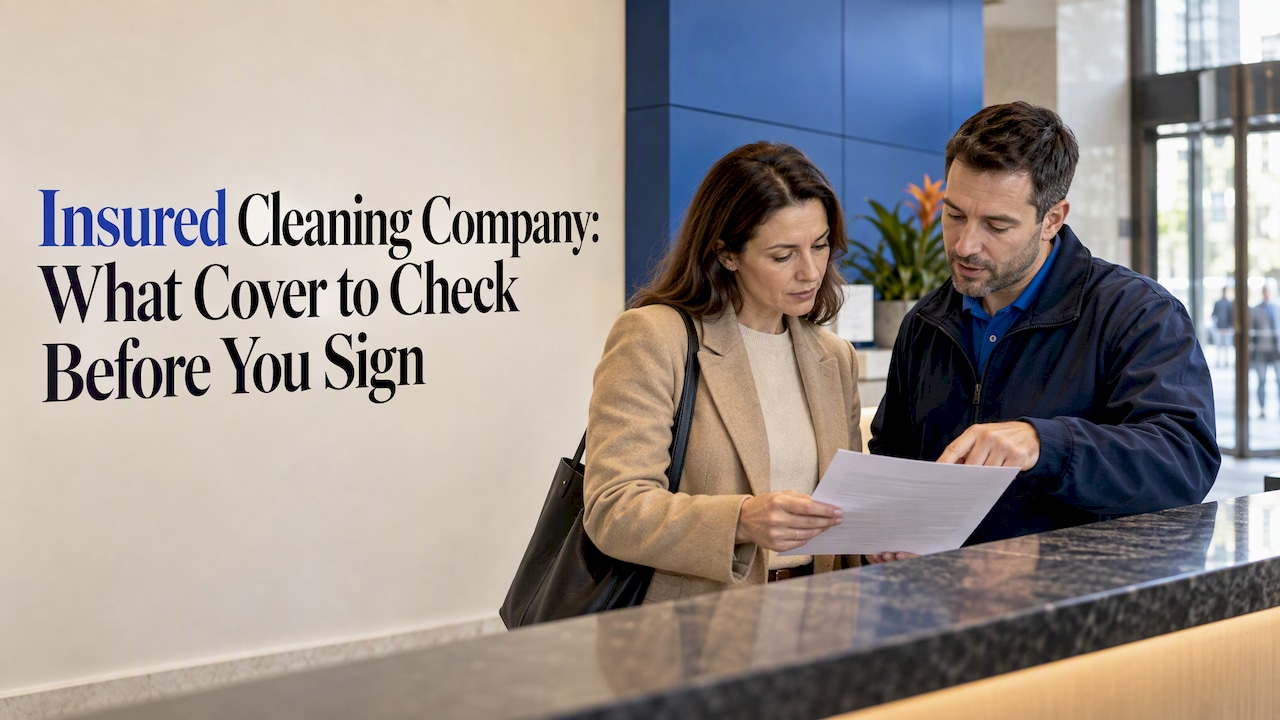
An insured cleaning company holds current insurance that covers its staff, the damage it could cause and the work it actually does on your premises. For a UK commercial contract, that starts with Employers’ Liability insurance, which the law requires of most employers, and public liability cover appropriate to your building. Ask for the certificates, read the limits and dates, and confirm the cover is still live. “Fully insured” on a website is a claim. A certificate is evidence.
This guide is for property managers, office managers and residential block managers in London who are appointing a cleaning contractor or replacing one. It covers which policies matter, what the law says, how to verify cover, what changes for window cleaning at height, and how to write insurance into the contract so a switch of provider does not leave a gap.
TL;DR
-
Employers must carry Employers’ Liability insurance of at least £5 million from an authorisedauthorised insurer. Ask any cleaning contractor for the current certificate.
-
Public liability cover protects against damage or injury to third parties. Choose a limit that matches your building’s value and footfall, and write it into the contract.
-
Verify cover, do not assume it: check the insurer, the policy dates and the endorsements, and confirm with the issuing broker or insurer.
-
External or high-level window cleaning raises the stakes: the work must be planned, supervised and done by competent people with suitable equipment.
-
Put required cover, renewal evidence and a notice duty into the contract before the first visit.
Table of Contents
-
What “fully insured” should mean for a commercial cleaning contract
-
Window cleaning and exterior work: where insurance and safety meet
-
How Harmony Cleaning works with property and office managers
What “fully insured” should mean for a commercial cleaning contract
The phrase gets used loosely. Behind it sit several different policies, and each answers a different question.
| Policy | What it answers | Who it protects |
|---|---|---|
| Employers’ Liability | A cleaner is hurt or made ill by their work. Who pays? | The cleaner, the contractor, and indirectly you |
| Public liability | A visitor trips on a wet floor, or a vacuum damages a client’s laptop. Who pays? | Third parties: your tenants, visitors, staff, and the building |
| Contract works or property cover (where relevant) | Damage to premises or fixtures caused by the contractor | The building owner |
| Motor cover for work vehicles | Staff drive to your site with equipment or supplies | Anyone affected by that driving |
Only the first is compulsory by law for most employers. The others are commercial protections, and in practice a managing agent, a freeholder or a lease will often require them. If you manage a block, check your own management agreement and your building’s insurance conditions. They may set minimum cover for any contractor who works on the premises.
Employers’ Liability: the one the law requires
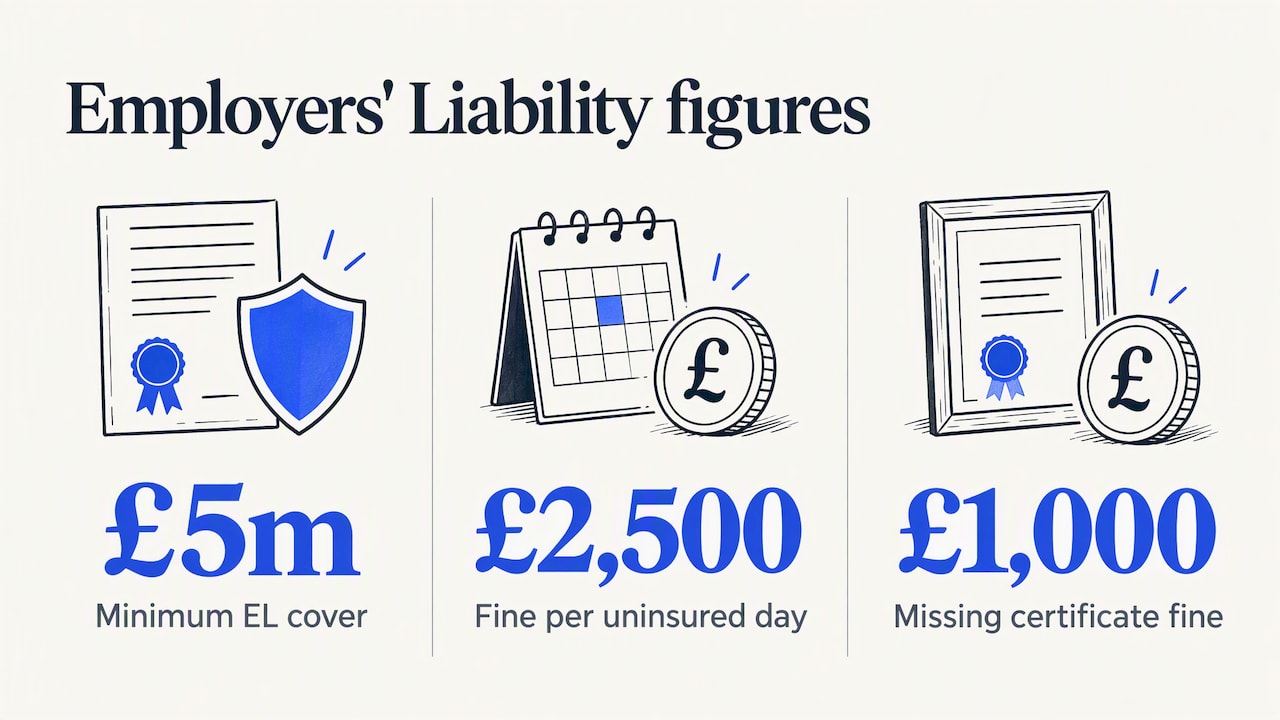
Under GOV.UK guidance, employers must have Employers’ Liability insurance covering at least £5 million and it must come from an authorised insurer. The same page explains the penalty for getting it wrong: a fine of up to £2,500 for every day a business is not properly insured, and a further £1,000 if it fails to display its certificate.
Why does this matter to you as the client? Because the contractor’s cleaners work in your corridors, stairwells and plant rooms. A contractor that is not properly insured is a legal problem for itself and an operational one for you: if the arrangement collapses or a claim arises, you are the one with a building to run and no cover in place.
HSE guidance for people who hire contractors adds that you should check whether the contractor holds Employers’ Liability Compulsory Insurance where the law requires it. Asking for the certificate is not rudeness. It is the expected first step.
Public liability: the one your building depends on
Public liability is the policy that responds when the cleaning itself causes harm or damage to someone who is not an employee. Typical examples in commercial settings include a slip on a freshly mopped lobby, a damaged glass partition, a flooded server-room corner or a scratched stone floor.
There is no single legal minimum for it, so the limit is a commercial decision. A sensible way to choose one:
-
Look at the highest-value thing a cleaner could damage in your building, or the worst injury a member of the public could suffer there.
-
Check what your lease, management agreement or building insurer already specifies.
-
Ask the contractor for its current limit and compare. Then put your required minimum in the contract.
Public bodies set their own bars as a guide. One English council’s contractor guidance, for example, recommends £10 million per event for Employers’ Liability on non-administrative contracts or contracts over £100,000. That is one authority’s internal rule, not a universal standard, but it shows how procurement teams scale cover up with the size and risk of a contract.
How to verify an insurance certificate
A certificate in a PDF proves little until you have read it properly. A short, repeatable check takes ten minutes and is worth doing for every provider, every renewal.
-
Check the name. The insured entity must match the company that will sign your contract, not a parent, a sister company or a trading name.
-
Check the insurer. For Employers’ Liability it must be an authorised insurer, as GOV.UK requires.
-
Check the dates. Policy dates must line up with the contract, and a certificate that expires in six weeks is only a promise to renew.
-
Check the limits. Compare each limit with the minimum you set. Note whether public liability is stated per claim or in aggregate.
-
Check the activities. The policy should describe the work being done. If you are buying window cleaning, deep cleans or floor care, make sure those are not excluded.
-
Check the endorsements. Ask for the policy schedule and any endorsements that matter to you, rather than relying on a summary page.
-
Confirm with the source. Phone or email the broker or insurer named on the certificate and confirm the policy is in force.
This is not about distrust. Good contractors expect it, and a well-run one will have the documents ready the day you ask.
Red flags worth acting on
-
A certificate that names a different company from the one on the quote.
-
Cover that lapses before your contract’s first review date.
-
A reluctance to let you contact the insurer or broker.
-
Vague answers on whether the policy covers window cleaning, deep cleans or floor machines.
-
A “fully insured” claim with no document offered alongside it.
Beyond insurance: what else a careful client checks
Insurance is the financial safety net. It does not tell you whether the cleaning will be good or whether the staff are suitable to work in your building. HSE’s guidance says clients should satisfy themselves about a contractor’s competence, skills, experience and knowledge, and that the depth of checking should be proportionate to the risk and complexity of the work. A weekly office clean is a lower-risk job than an external facade clean at height, and your checks should reflect that.
A practical shortlist for a commercial cleaning appointment:
-
Staff vetting. Are cleaners DBS checked? This matters in residential blocks, where staff may meet residents, and in offices that hold sensitive material.
-
Training. What does onboarding cover? Chemicals, equipment, lone working and your site rules should all be on the list.
-
Supervision and accountability. Who is your named contact, and how fast do they respond when something is missed?
-
Standards. Ask which quality and environmental management standards the contractor works to, and ask to see the certificates.
-
Evidence of work. Photo-evidenced visit reports or audit sheets make it easy to see what was done and when.
-
References. Speak to a similar client, ideally one that has been through a change of provider.
-
Staff retention. High turnover means unfamiliar faces, missed tasks and security headaches.
Window cleaning and exterior work: where insurance and safety meet
Searchers asking about building exterior window cleaning are usually asking a related question: who is responsible if something goes wrong at height? The answer is shared, and the HSE is clear on the principles.
HSE guidance says that work at height when cleaning windows must be planned, supervised and carried out by competent people using suitable equipment, and that working at height should be avoided where reasonably practicable. It also stresses coordination and communication between building owners, managing agents and contractors so everyone agrees a safe approach.
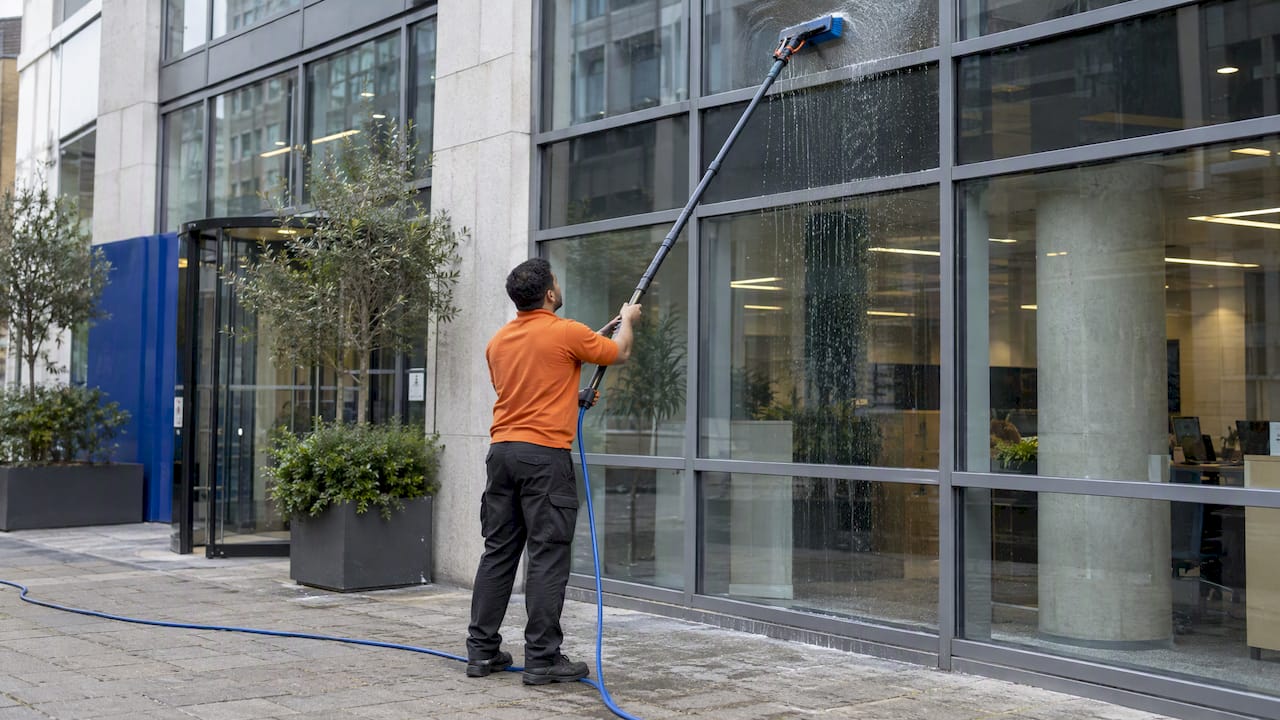
For you as building owner or manager, that has practical consequences. The same HSE page says owners should provide site-specific access instructions, relevant LOLER certification and inspection records, and emergency procedures including a rescue plan. For cradles and Building Maintenance Units, HSE’s page on specialist access equipment repeats that you must give contractors site-specific instructions, LOLER certification and inspection records.
In plain terms, before an external window clean:
-
Ask the contractor how it will reach each elevation, and whether the method avoids working at height where possible.
-
Confirm the insurance covers window cleaning and, if relevant, work at height.
-
Gather your own paperwork: access instructions, inspection records for any fixed equipment, and the rescue plan.
-
Agree who supervises on the day, and how tenants are warned about closed entrances or cordoned areas.
Internal glazing, atrium glass and ground-floor frontages are lower risk, but the same questions about competence and cover still apply.
Put insurance in the contract, not just the tender
A certificate checked at tender stage can go stale. The contract should keep the requirement alive. Write the required limits and cover into the contract before work begins. A good clause set includes:
-
Minimum Employers’ Liability and public liability limits, stated in pounds.
-
A requirement to supply updated certificates at every renewal, without being asked.
-
A duty to notify you promptly if a policy is cancelled, reduced or not renewed.
-
Any indemnity or insurance requirements your lease or management agreement demands.
-
A statement that the stated cover applies to every service in scope, including windows and deep cleans.
Put each renewal date in the diary at the start. A single calendar reminder prevents most insurance gaps.
Switching cleaners without a gap in cover or service
Most managers who search for an insured contractor are also unhappy with the current one. The fear is disruption: missed cleans during the handover, lost keys, staff confusion and a dip in standards while the new team learns the building.
A well-run takeover handles the insurance and the practicalities together:
-
Certificates first. Collect and verify the new contractor’s cover before the start date, using the checklist above.
-
Map the work. The new provider should document the existing rota, specification and service levels, so the standard does not drop.
-
Handle keys and access. Agree a key transfer, with a signed log and alarm codes issued to named people only.
-
Deal with staff transfers. Where cleaners may transfer from the outgoing contractor, TUPE rules can apply, so the incoming provider should be comfortable handling that process.
-
Run a first-month review. Compare visit reports against the specification and fix gaps quickly.
Notice periods in your existing contract will dictate timing, so read them before you announce a change.
Perspective
Most clients first ask us about price. The better question is what happens on the day something goes wrong: a slip in a lobby, a damaged fitting, a cleaner injured on site. That is when insurance stops being a line on a tender form.
Our view is that insurance, vetting and accountability belong together. We state that we are fully insured, our staff are uniformed, DBS checked and put through an extensive onboarding process, and we work to ISO and BICSc standards for quality and environmental management. We would rather you ask to see the paperwork than take our word for it.
Each contract also has a dedicated account manager. If a certificate is due for renewal, a question comes up about a specific building, or a visit needs adjusting, you speak to one person who knows your site. We think that is what turns a policy document into a reliable service, and it is why transitions from a previous provider are something we plan carefully rather than improvise.
Drahim Hasula, CEO and Founder of Harmony Cleaning
How Harmony Cleaning works with property and office managers
Harmony Cleaning provides commercial and communal cleaning across Greater London. Our services cover office cleaning, communal area cleaning for residential and mixed-use blocks, periodic deep cleans, internal and external window cleaning, and carpet and hard floor care. For clients changing provider, our contract takeover service covers rota mapping, key transfer, TUPE handling and SLA continuity.
Every contract has a dedicated account manager, DBS-checked and trained staff, consumables stock and photo-evidenced visit reports. We are happy to talk through insurance requirements for your building before you commit.
To discuss your building and the cover you need, request a free quote, email admin@harmony-cleaning.co.uk or call 020 8092 8835.
A short briefing checklist for your next tender
When you invite quotes, send every bidder the same brief so the answers are comparable:
-
The site address, floor areas, opening hours and any access restrictions.
-
Your minimum Employers’ Liability and public liability limits.
-
Whether the scope includes windows, external elevations or work at height.
-
A request for current certificates, with the insurer and broker named.
-
A request for staff vetting and training details.
-
A request for a named account contact and a sample visit report.
-
Your intended start date and any existing contract notice period.
Bidders who answer each point promptly and in writing are usually the ones who will run your contract the same way.
FAQ
What insurance does a cleaning company need?
Most cleaning companies that employ staff must hold Employers’ Liability insurance of at least £5 million from an authorised insurer. Beyond that, public liability cover is the standard commercial protection, and clients often require it. Vehicle and other cover may apply depending on the work.
How do I check a cleaning company’s insurance is valid?
Read the certificate for the correct company name, insurer, policy dates, limits and covered activities. Review the endorsements, then confirm with the broker or insurer that the policy is in force. Repeat the check at each renewal.
What cover should I ask for on exterior window cleaning?
Ask that the policy covers window cleaning and any work at height, and agree a limit that fits your building. HSE guidance also expects work at height to be planned, supervised and done by competent people, so ask for the method statement as well as the certificate.
What happens if my cleaning contractor is not properly insured?
The contractor risks a fine of up to £2,500 for each day without required Employers’ Liability cover. For you, an uninsured contractor leaves a gap if someone is hurt or property is damaged, so check cover before the first visit and keep renewal evidence on file.