/ Blog ·
Office Cleaning Costs in London: What Drives Price


Office cleaning costs in London come down to one calculation: the hours your building needs, multiplied by what it costs a contractor to put a trained, legally paid person in your office for each of those hours, plus supplies, supervision and overheads. Floor area, visit frequency, shift timing and specification move the hours. The London wage floor, employer costs and contract terms move the rate. This guide shows how a quote is built, how to compare two quotes like for like, and what a very low quote usually leaves out.
We clean offices and workspaces across Greater London, alongside our main work in daily communal cleaning for large residential developments. We do not publish prices in articles, because a fair price depends on your building. What we can do is show you how to read any quote you receive.
TL;DR
- A cleaning quote is labour hours multiplied by a charge-out rate, plus consumables, equipment, supervision and margin. Most of the spend is labour.
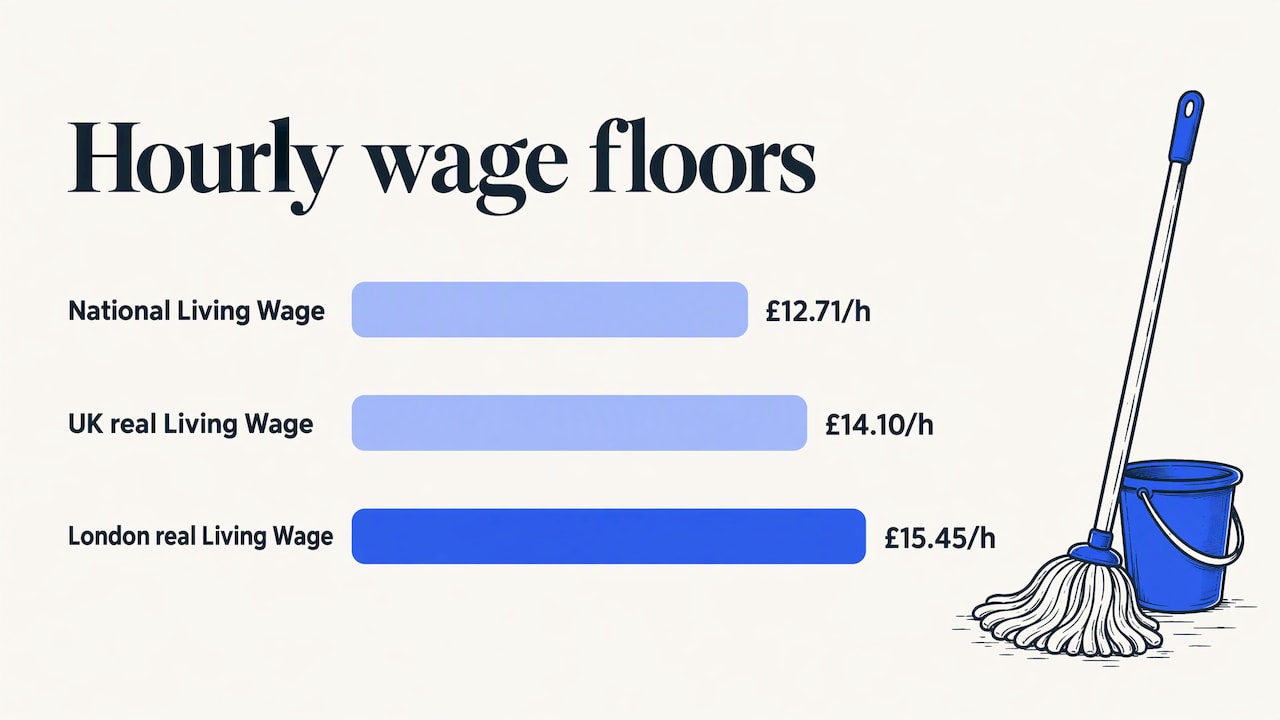
- The wage floor sets the base: the National Living Wage is £12.71 an hour from 1 April 2026, and the real London Living Wage announced in 2025 is £15.45.
- Frequency, shift times and specification change the hours more than floor area alone does.
- Compare quotes on hours per visit, visits per week, scope, who supplies consumables and what is excluded, not on the headline monthly figure.
- A quote far below the others usually means fewer hours, a lower wage, thin supervision or exclusions you will pay for later.
Table of Contents
- What makes up the cost of cleaning an office in London?
- How do cleaning hours turn into a price?
- How does the London wage floor affect office cleaning costs?
- Why do frequency and shift times change the quote?
- How does the size and type of building change the price?
- How are cleaning contracts usually priced?
- What does a cleaning quote usually include, and what is extra?
- How do you compare office cleaning quotes like for like?
- What do very cheap cleaning quotes leave out?
- What happens to costs when you change cleaning contractor?
- What do we think about the cost of office cleaning?
- Can Harmony Cleaning quote for your office?
- FAQ
- Sources
What makes up the cost of cleaning an office in London?
There are six building blocks in almost every commercial cleaning quote.
- Labour hours. The time needed per visit, multiplied by visits per week.
- Wage cost per hour. Pay for the cleaner, plus employer National Insurance, pension contributions and holiday pay.
- Supervision and management. Site checks, an account manager, rota cover and reporting.
- Consumables and equipment. Toilet rolls, hand soap, bin liners, chemicals, microfibre cloths, vacuums and machines.
- Periodic work. Carpet cleaning, hard floor machine scrubbing, internal window cleaning and deep cleans, which sit outside the daily routine.
- Overheads and margin. Insurance, training, vetting, uniforms, software and the contractor’s profit.
Labour is by far the largest block, which is why the hours and the wage are the two numbers worth understanding first. Everything else is a modifier.
How do cleaning hours turn into a price?
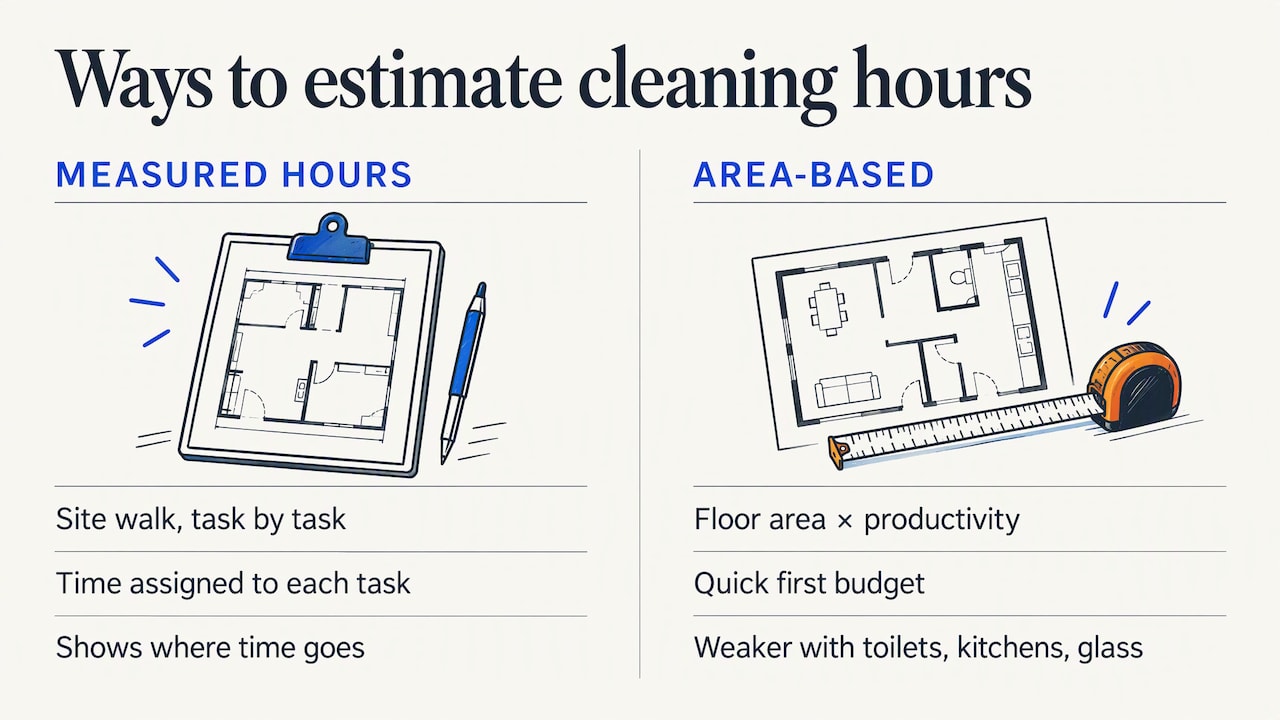
A contractor starts by estimating how long a competent cleaner takes to do your specification, then converts that to weekly hours. Two methods are common.
Measured hours. The contractor walks the site and builds up time task by task: so many desks to wipe, so many toilets, so many metres of floor to vacuum, kitchens, meeting rooms, reception. This is the most honest method because you can see where time goes.
Area-based rates. Some quotes are built from floor area and a typical productivity figure. It is quick, and it is useful for a first budget. It is weaker for buildings with lots of toilets, kitchens or glass, because those take more time than open-plan desks of the same size.
Whichever method is used, the result is hours per week. Ask to see it. If a supplier cannot tell you how many hours a week your quote includes, you cannot compare it with anything.
Worked example: a Shoreditch floorplate
This is an illustration, not a client story and not a price. Picture a single-floor creative office in Shoreditch, in the borough of Hackney, with open-plan desks, two meeting rooms, a kitchen and four toilets. Suppose the specification is a nightly clean, five evenings a week, and the contractor estimates two hours per visit.
That is ten hours a week of labour. If the same office moves to three visits a week at two hours, the labour falls to six hours. If the team adds a deeper kitchen and toilet routine, each visit might grow to two and a half hours, and the weekly total changes again. Every line in the quote traces back to those numbers.
How does the London wage floor affect office cleaning costs?
Because labour dominates, the pay rate of the person cleaning your office sets a floor under what any compliant contractor can charge.
The legal minimum for workers aged 21 and over is the National Living Wage, which rose to £12.71 an hour from 1 April 2026. Separately, the Living Wage Foundation sets a voluntary real Living Wage. Its London rate announced in 2025 is £15.45 an hour, set against a UK rate of £14.10. Accredited employers commit to paying at least that rate. Check the Living Wage Foundation site for the rate that currently applies, as it is reviewed annually.
Here is why this matters for comparison. Take a single hour of cleaning labour at the London rate of £15.45. That is the wage alone, before employer National Insurance, pension, holiday pay, training, supervision, supplies, insurance and margin, so it is not a charge-out rate. Ten hours a week at that wage is £154.50 a week, or about £8,034 over 52 weeks, and that is only the pay packet. A quote that implies a total hourly charge close to the wage floor has little room left for everything else.
We are a Living Wage employer, so our own staff costs reflect that commitment. When you compare quotes, ask each supplier what its cleaners are paid. It is a fair question and a revealing one.
Why do frequency and shift times change the quote?
Frequency. Daily cleaning of toilets, kitchens and touchpoints is the standard for most occupied offices. Desks and floors can often run on a lighter rhythm. Moving from five visits to three reduces labour hours, but it also changes what the office looks like by Thursday. Match frequency to how the building is used, not to a budget target alone.
Shift times. Most office cleaning happens early morning or evening, when staff are out. Evening and early-start shifts can carry a premium, and shorter visits are less efficient because travel and setup time is spread over fewer productive minutes. Daytime cleaning can suit a building with a visible reception, busy kitchens or toilets that need attention while staff are in. In that case a day presence is a service in its own right, and it is priced as one.
Visit length. A one-hour visit costs more per productive hour than a three-hour visit, because the cleaner still has to arrive, collect equipment and leave. When a supplier offers an hourly rate with a minimum visit length, check the minimum against your real need.
How does the size and type of building change the price?
Floor area gives a starting point, but the mix of rooms matters more.
- Toilets and kitchens are labour-heavy relative to their size.
- Glass and partitions add time for smears and fingerprints, especially in reception areas.
- Hard floors need mopping or machine work; carpets need regular vacuuming and periodic extraction.
- Multi-floor offices add walking, lift use and equipment moves.
- Mixed-use buildings combine office floors with shared lobbies, lifts and bin stores, where the common areas may need their own routine.
- Desk density affects how much wiping, emptying and tidying is needed.
Worked example: a mixed-use building near Canary Wharf
Again an illustration only. Imagine a nine-storey mixed-use building in Tower Hamlets with offices on the upper floors and a ground-floor lobby shared with a small residential element. The facilities manager asks for a quote for the office floors only. A sensible contractor will ask who cleans the lobby, lifts, entrance glass and bin store, since those areas are seen by everyone and are often the first to look tired.
If the lobby and lifts are included, the specification grows and so do the hours. If they are excluded, the quote is narrower, and the building may need a second arrangement. Either approach is valid, but only if both quotes you compare treat the lobby the same way.
How are cleaning contracts usually priced?
Three structures cover most offers.
| Pricing model | How it works | Best suited to | Watch for |
|---|---|---|---|
| Fixed monthly fee | A set sum for a defined scope and frequency | Stable offices that want predictable budgets | Scope creep disputes if the specification is vague |
| Hourly rate | You pay for hours worked | Variable or changing needs | Total spend rises if tasks overrun, so agree a weekly hours cap |
| Per visit or per area | A price per clean or per square metre | Quick budgeting, simple floors | Rooms with many toilets or kitchens are underpriced |
Most contracts for regular cleaning run on a fixed term with a monthly invoice. Check the notice period, any minimum term, how price reviews are handled (particularly after the April wage uplift) and what happens if you need to change hours.
What does a cleaning quote usually include, and what is extra?
Before you compare, build a one-page specification and give it to every supplier. It should list:
- Areas and floors covered, with the number of toilets, kitchens and meeting rooms.
- Tasks and their frequency: daily, weekly, monthly.
- Visit days, times and minimum visit length.
- Who supplies consumables, and who supplies equipment.
- Periodic work: carpet cleaning, hard floor care, internal windows, deep cleans.
- Reporting and review arrangements.
- Keys, alarms and access procedures.
Typical extras, if not in the base quote, are periodic deep cleans, carpet extraction, window cleaning, waste removal beyond normal bins, and cover for staff absence. Ask what happens when a cleaner is off sick or on holiday. A good supplier covers the shift as part of the contract, not as an added charge.
How do you compare office cleaning quotes like for like?
A headline monthly figure hides more than it shows. Use this checklist and put every quote through it.
- Hours per visit and visits per week. Divide the monthly figure by the weekly hours to find the implied hourly charge. A big gap between suppliers is a prompt to ask why.
- Specification. Are the same rooms, tasks and frequencies included?
- Consumables. Included, or billed at cost plus a handling fee?
- Periodic work. Included in the fee, or quoted separately?
- Staff pay and employment. Are cleaners employed directly and paid at least the legal minimum? Do they receive holiday pay?
- Supervision. Who inspects the work, how often, and how are findings recorded?
- Insurance. What level of public liability cover is held, and can you see the certificate?
- Contract terms. Minimum term, notice period, price review mechanism.
- Cover. How are absences handled?
- Accreditations. Safety and quality credentials relevant to your building.
On the last point, safety schemes and quality standards help you shortlist. We are SafeContractor approved, ISO 9001 and ISO 14001 certified and a BICSc member, and our staff are Enhanced DBS checked and trained. Look for similar credentials in any supplier you consider, and ask to see the certificates.
What do very cheap cleaning quotes leave out?
A price well below the others is not automatically a bargain. When the numbers do not add up, the saving usually comes from one of these places.
- Fewer hours than the job needs. The visit looks cheap, but the work is rushed and the building shows it within weeks.
- Pay at or below the legal minimum, or cash-in-hand arrangements. This creates legal risk and high turnover. Turnover means unfamiliar faces in your office and inconsistent standards.
- Thin or absent supervision. Nobody inspects, so problems are found by your staff.
- Consumables excluded or billed at a markup.
- A narrow specification. Kitchens, glass or periodic work are left out and appear later as extras.
- Weak insurance. Low premiums can mean low cover.
- No cover for absence. Missed visits become your problem.
The real cost of a poor contractor is paid in staff complaints, reception that looks neglected, time spent chasing, and the work of changing supplier. Total cost matters more than the monthly invoice.
What happens to costs when you change cleaning contractor?
If you are replacing a contractor, check whether the cleaners are protected by TUPE. GOV.UK explains that a service provision change under TUPE happens when a contract ends and the work passes to a new contractor, and that cleaning is a named example. Where it applies, the staff who are clearly assigned to your site transfer to the new supplier on their existing terms. Ask the incoming contractor to price this properly from the information your current supplier provides, because a quote that ignores it can fall apart later.
A structured takeover also covers key transfer, rota mapping and continuity of what is being cleaned and when. We manage these as part of a contract takeover.
What do we think about the cost of office cleaning?
We are often asked for a price per hour before anyone has seen the building. We understand why, but the hourly figure is the least useful number in a quote. What matters is whether the hours, the people and the supervision fit the specification.
Our approach is to build the quote from the specification. We work out the hours the building needs, staff them with vetted, trained cleaners paid properly as a Living Wage employer, and agree how the work is checked. Each contract has one named account manager, and we provide photo-evidenced visit reports and carry out monthly reviews, so you can see what was done and talk through any change in need.
Our core strength is dedicated on-site teams for daily communal cleaning in large London residential developments. We bring the same discipline of clear scope, consistent staff and visible reporting to offices and workspaces. A fair price is one where you know what you are paying for.
Drahim Hasula
Can Harmony Cleaning quote for your office?
We provide office cleaning, periodic deep cleans, window cleaning, carpet and hard floor care and contract takeovers across Greater London. Give us your floor plan or a site visit slot, the visit pattern you want and any periodic work, and we will build a quote from your specification, with the hours shown.

If you are replacing a contractor, we can handle the transfer, from rota mapping to key handover. Send your details through the quote form.
FAQ
How much does office cleaning cost per hour in London?
There is no single rate, because it depends on shift times, specification, contract size and what is bundled in. The floor is the wage: the National Living Wage is £12.71 an hour from 1 April 2026 and the London Living Wage announced in 2025 is £15.45. A compliant charge-out rate has to cover the wage plus employer costs, supplies, supervision and margin.
What should a cleaner be able to cover in two hours?
It depends on the room mix, not the clock alone. In a small open-plan office with one kitchen and two toilets, two hours can cover bins, desk wiping, kitchen surfaces, toilets and floors. Add meeting rooms, glass and more toilets, and the same two hours will not stretch. Ask the contractor for a task list against the time.
Is a fixed monthly fee better than an hourly rate?
A fixed fee gives budget certainty if the specification is clear and stable. An hourly rate gives flexibility if needs change. Whichever you choose, agree the weekly hours and the scope in writing so both sides know what is included.
Are consumables included in the quote?
It varies between suppliers, and it is one of the first things to confirm. Some include toilet rolls, soap and liners in the fee, and others bill them separately. Ask for it in writing so quotes are comparable.
Do I need to worry about TUPE when changing cleaner?
Possibly. GOV.UK sets out when TUPE applies to service provision changes, including cleaning contracts that move to a new contractor. If the cleaners on your site are covered, the new supplier needs to price their existing terms. Take advice from your legal adviser on your specific contract.
Sources
- National Living Wage UK 2026: rates, age bands and rules
- Real Living Wage increases to £14.10 in UK and £15.45 in London, Living Wage Foundation
- Business transfers, takeovers and TUPE, GOV.UK
To request a free quote, use our quote form, email admin@harmony-cleaning.co.uk or call 020 8092 8835.