/ Blog ·
Service Charge Cleaning: Budgeting for London Blocks


Cleaning is one of the easiest service charge lines to defend and one of the easiest to lose a challenge on. It is easy to defend when the lease allows the charge, the scope is written down, the budget is built from the best evidence available and every visit is recorded. It is easy to lose when any of those is missing. This guide is for managing agents setting a London block’s annual budget and answering leaseholder questions. It covers what the lease must say, how to build and explain the cleaning line, what makes a charge reasonable, and when a cleaning contract needs Section 20 consultation. It is general guidance, not legal advice. For a specific dispute or a lease you are unsure about, take advice from a solicitor who specialises in leasehold law.
TL;DR
- A cleaning cost can only be recovered if the lease allows it, so read the service charge clauses before you budget.
- Build the budget from actual contract costs first, then the current year’s likely out-turn, then last year’s accounts, then comparable schemes.
- A cleaning contract that lasts more than 12 months and costs any one leaseholder more than £100 a year is a qualifying long-term agreement and needs Section 20 consultation.
- Leaseholders challenge what they cannot see. A scope, a staffing plan, periodic work listed separately and visit records make the charge easy to explain.
- Send demands within 18 months of incurring the cost, and issue accounts promptly after year end.
Table of Contents
- Can you charge leaseholders for communal cleaning?
- What does a large block’s cleaning budget usually include?
- What drives the cleaning line in a service charge budget?
- How should you build and explain the cleaning budget?
- What makes a cleaning charge reasonable?
- When does a cleaning contract need Section 20 consultation?
- How do you answer a leaseholder who challenges the cleaning charge?
- What does a clear cleaning proposal look like?
- Perspective: what we see as the right way to budget cleaning
- Who can set this up for a large London block?
- FAQ
- Sources
Can you charge leaseholders for communal cleaning?
Only if the lease says so. The Leasehold Advisory Service states that the lease determines what is paid for through a service charge, and that a cost cannot be recovered from a leaseholder unless the lease allows it. For most leasehold properties, the same guidance says a service charge covers cleaning and lighting of communal areas.
Three practical points follow.
- Check the wording, not the habit. Many modern leases include a sweeping-up clause covering costs reasonably incurred in connection with the building. Even then, some types of charge need specific wording. If you are adding a new item, such as a bike store clean or a car park sweep, confirm the lease covers it.
- Interpretation cuts both ways. Shelter England’s guidance for professionals gives cases where a clause listing cleaning, lighting and caretaking did not stretch to major external repairs, and where a landlord could not add car park rubbish removal to a charge limited to garden maintenance and lighting. A clause that clearly covers a lobby may not cover everything on the estate.
- Management fees need their own basis. The landlord or managing agent can only recover management costs if the lease says they can.
If the lease is silent or ambiguous on a service you want to buy, resolve that before the contract starts, not after the first demand is disputed.
What does a large block’s cleaning budget usually include?
The scope should be a written list, because the list is what you will point to when a leaseholder asks what they are paying for. For the large London developments we work on, a daily communal cleaning scope typically covers entrances, lobbies, stairwells, corridors, lifts, bin stores, front windows, bike stores and car parks. Our contracts typically run 50+ hours a week, with a full-time cleaner on site plus part-time support. Our guide to what communal area cleaning covers and how often sets out the tasks and frequencies in more detail.
Two things belong in separate budget lines because they behave differently from daily cleaning:
- Periodic work, such as deep cleans, carpet and hard floor care, and window cleaning. These are scheduled, not daily, and leaseholders understand them better when they are itemised rather than buried in one figure.
- Consumables, which should be stated as included or excluded in the specification so the line is not a surprise later.
It is also worth being clear about who does what between cleaning, caretaking, grounds and repairs. Our note on communal cleaning responsibilities helps you draw those lines before they blur in the accounts.
What drives the cleaning line in a service charge budget?
Cleaning cost is not mysterious. It is hours multiplied by people, plus periodic work, supervision and consumables. The table below shows the drivers a managing agent can test against a proposal. It deliberately carries no prices: the point is to know what should move the figure.
| Cost driver | What moves it | What to ask for in a proposal |
|---|---|---|
| Weekly hours on site | Number of flats, floors, cores, lifts and entrances | Hours per week by area, not a single lump sum |
| Staffing pattern | Full-time cleaner plus part-time support, cover for leave | Who is on site, on which days, and how cover works |
| Pay basis | Whether staff are paid the Living Wage | Confirmation of pay basis for staff on your contract |
| Building type | Build-to-rent tower, purpose-built block, multi-block estate, mixed-use | A scope that reflects footfall and amenity areas |
| Periodic work | Deep cleans, carpets, hard floors, windows | Separate lines with frequency for each |
| Consumables | Bin liners, soap, cleaning materials | Whether they are included in the rate |
| Supervision and reporting | Account management, reviews, visit records | What reporting is included and how often |
| Contract takeover | Moving from an incumbent, staff transfer where it applies | How transfer, rotas and key handover are managed |
Brent Council’s 2019 review of its estate cleaning service is a useful public example of why this matters. It found that only 39% of residents were fairly or very satisfied, that the specification and costing were poorly set out, and that the ratio of operatives to dwellings was high compared with the market. It also recorded providers citing the London Living Wage as key to attracting the right people. Vague scope and unclear staffing are what make cost hard to defend.
How should you build and explain the cleaning budget?
Use the best information available, in a fixed order. The RICS Service Charge Residential Management Code, 4th edition, sets that order: actual costs where contracts are already in place, then estimates based on the current year’s likely out-turn and last year’s accounts, then comparable evidence from similar schemes. The same code says initial demands should come with the approved budget and enough information for leaseholders to see how their proportion was calculated.
In practice that means:
- Start from the contract. If a cleaning contract is in place, its schedule of hours and periodic work is your strongest evidence.
- Reconcile to last year. Compare against the previous year’s accounts and explain differences in plain words: more hours because of a new core, a change in scope, a periodic clean added.
- Be honest in both directions. The ARMA-Q standards say a managing agent must not purposely underestimate or overestimate costs and must include enough detail to justify the estimated expenditure. The same standards say to notify leaseholders of significant departures from the budget and be ready to explain them.
- Apportion as the lease says. The Estates Gazette’s series on residential service charges notes that the apportionment basis should be set by the lease and be fair, reasonable and proportionate.
- Keep management fees separate and genuine. RICS guidance for commercial property says fees should relate to work actually done and be fixed-price rather than a percentage of spend. It is written for commercial schemes, but it shows the standard leaseholders increasingly expect.
Timing matters too. Under section 20B of the Landlord and Tenant Act 1985, a demand must be issued within 18 months of incurring the cost, or a notice served within that period, otherwise the cost may not be recoverable. ICAEW guidance recommends accounts on the accruals basis and issuing the statement within six months of year end because of that 18-month limit.
What makes a cleaning charge reasonable?
The legal test is two-fold: the cost must be reasonably incurred, and the work must be to a reasonable standard. Shelter England’s guidance explains that where services fall short, the landlord can recover only what is reasonable. For payments in advance, the charge must be no greater than is reasonably payable.
Tribunal decisions show how this plays out for cleaning:
- Cheapest is not the test. In a 2022 First-tier Tribunal case (CAM/00KF/LSC/2022/0028), the tribunal said landlords are not bound to choose the cheapest option and could not find a cleaning charge unreasonable without evidence that a reliable cleaner could do the work for less.
- Evidence beats assertion. In a 2024 decision, the First-tier Tribunal found cleaning charges payable and reasonable where the applicants had not supplied an alternative quotation. It also accepted that engaging a professional contractor for consistent cleaning by vetted staff was reasonable.
- Delivery counts. In an Upper Tribunal appeal (UKUT/LC/2022/214), the tribunal substituted its own finding that two-thirds of the cleaning charges were payable, setting aside a lower reduction made below. Outcomes turn on the facts of each building.
A leaseholder who wants to challenge must make a prima facie case that the cost was not reasonably incurred. The Upper Tribunal has said this might be a cheaper quote for the same work or service. So your defence is a file that shows how you procured the service, what the scope is and how the service was delivered.
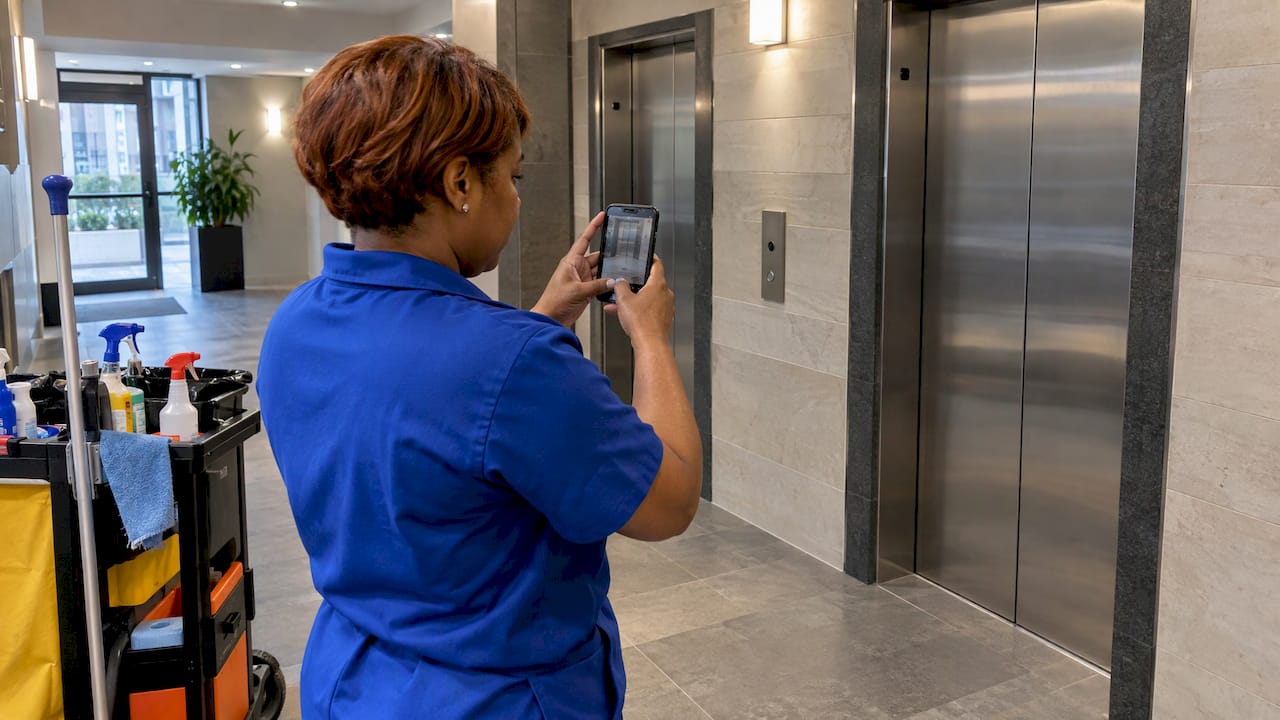
That file should hold the specification, the competitive quotations or benchmarking behind the appointment, visit reports and review notes. We provide photo-evidenced visit reports and carry out monthly reviews on our contracts, so there is a dated record of what was done on site to set beside the invoice.
When does a cleaning contract need Section 20 consultation?
When it is a qualifying long-term agreement. The Leasehold Advisory Service states that a landlord must consult before entering into a qualifying long-term agreement for services costing any one leaseholder more than £100 and lasting more than 12 months, and that this covers services such as cleaning and gardening. Consultation on qualifying works is separate, with a £250 threshold per leaseholder.
Two details trip people up:
- The threshold applies to the highest contributor. In a block of mixed-sized flats, consultation is required if the largest flat, paying the highest percentage, would pay more than the threshold.
- Length includes notice periods. The same guidance says contracts can be arranged to last 12 months or less including any notice periods to avoid triggering the QLTA rules.
The consequence of getting it wrong is real. Barking and Dagenham’s Section 20 policy states that if the landlord fails to consult or follows the wrong procedure, it cannot collect the full cost. The detailed procedure sits in the 2003 service charge consultation regulations, so take advice before you start.
Worked example: a 24-month cleaning contract
This is an illustration with invented figures, not a quote or a real building.
Imagine a 120-flat purpose-built block in Lewisham. The managing agent proposes a 24-month contract for daily communal cleaning at an annual cost of £60,000. The largest flat pays 1.2% of the service charge, so its annual share is £720.
- The contract lasts more than 12 months, so it is a long-term agreement.
- £720 a year is well above £100 for the highest contributor.
- Both tests are met, so the agent must consult before signing.
Now take a variant. The agent instead signs a 12-month contract with a notice period that keeps the total term within 12 months. The length test is no longer met, so the QLTA rules are not triggered by length. The agent should still run a competitive process and keep the evidence, because the reasonableness test applies to every charge.
Neither route is automatically better. A longer agreement can give the block stability with a settled on-site team, while a shorter one keeps options open. What matters is choosing deliberately and documenting why. The agent should also take advice if the contract has automatic renewal, extension options or a notice period that could stretch the term.
How do you answer a leaseholder who challenges the cleaning charge?
Start from the evidence, not the defence. A short, factual reply works best:
- Cite the lease clause that allows the charge and the apportionment basis.
- Show the scope: areas, days and periodic tasks.
- Show how you procured it: quotations or benchmarking, and the reasons for the choice.
- Show delivery: visit reports and review records.
- Explain variances from the budget in plain language.
If the leaseholder escalates to the tribunal, the points above are what the tribunal will look at. RICS codes are not themselves a legal duty, but an approved code can be taken into account by the tribunal, so working to the code strengthens your position.
The Leasehold and Freehold Reform Act 2024 also points towards more transparency, with changes such as standardised formats and a right for leaseholders to request service charge information being phased in. Check the current commencement position on GOV.UK before you rely on any of them.
What does a clear cleaning proposal look like?
The fastest way to make costs easy to explain is to start with a proposal that already explains them. When you tender or retender, ask each bidder for:
- hours per week broken down by area and day;
- the staffing pattern, including the full-time and part-time split and cover;
- periodic work listed separately, with frequency;
- consumables and equipment: included or not;
- reporting: what you will receive, how often, and how reviews work;
- who your day-to-day contact is.
If you are replacing an underperforming contractor, add the transfer arrangements: rota mapping, key handover and staff transfer where it applies. Our guide to block cleaning in London covers what managing agents should expect from a contractor on these points.
Worked example: a build-to-rent tower in Stratford
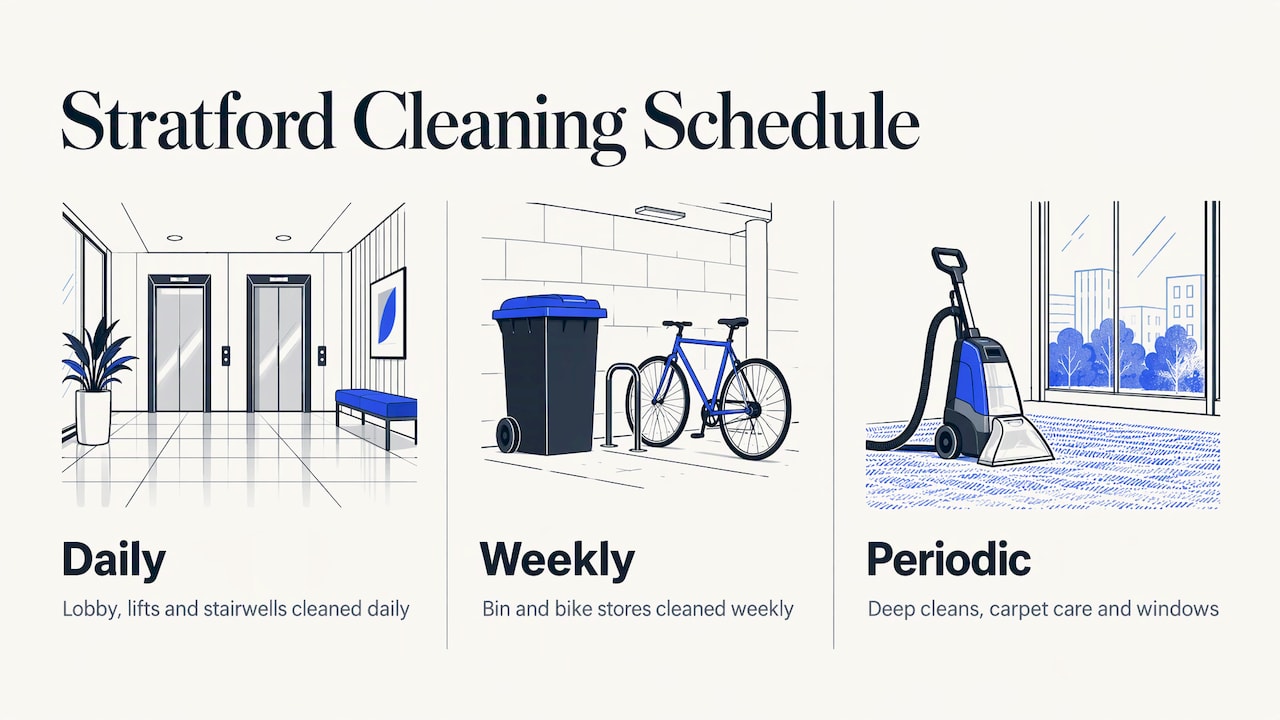
This is an illustration, not a client story. A 300-apartment build-to-rent tower in Stratford has a double-height lobby, a resident lounge, two lifts per core, a bike store and a basement car park. The operator funds cleaning through the service charge on the commercial part of the structure and the residential cores.
The agent asks for a proposal that separates three things: daily lobby, lift and stairwell cleaning; weekly bin store and bike store work; and periodic deep cleans, carpet care and window cleaning. Because each line has its own hours and frequency, a question about why the line rose is answered by pointing to the change: a new amenity floor, an extra periodic clean. No single lump sum has to be defended.
Worked example: a 200-flat estate in Southwark
Another illustration. A multi-block estate in Southwark has five blocks of differing height, each with its own entrance, stairwell and bin store. Apportionment follows the lease, and the managing agent keeps the cleaning line in the budget split by block so leaseholders see the hours that apply to their own building. Photo-evidenced visit reports are filed by block, and the monthly review notes sit alongside them. When a leaseholder in one block queries the charge, the agent can show that block’s scope and visit record without wading through the rest of the estate.
Perspective: what we see as the right way to budget cleaning
Service charge cleaning goes wrong when the charge is a number and not a description. A figure that cannot be tied to hours, people and tasks invites a challenge, and a managing agent should not have to argue from a single line in the accounts.
That is why we build large-block contracts around a dedicated on-site team: a full-time cleaner with part-time support, typically 50+ hours a week across the common parts. Leaseholders recognise the person cleaning their building, and the agent can show who is on site and for how long.
Each contract has one named account manager, photo-evidenced visit reports and monthly reviews. Together they give you something concrete to put in front of a leaseholder or a tribunal: what was agreed, what was done and what was reviewed. Our staff are Enhanced DBS-checked and trained, and we are a Living Wage employer, SafeContractor approved, ISO 9001 and ISO 14001 certified and a BICSc member. Our team brings 20+ years of combined experience.
Our advice is to put hours, staffing and periodic work in the proposal in separate lines, and to keep them separate in the budget. Cost is then a set of choices you can explain.
Drahim Hasula, CEO and Founder of Harmony Cleaning
Who can set this up for a large London block?
We are a London commercial and communal cleaning company, focused on daily on-site cleaning for large residential developments of 100+ apartments, including build-to-rent buildings and multi-block estates. Our proposals show hours, staffing and periodic work, so the cleaning line can be explained to leaseholders. We cover Greater London, and our communal cleaning service for managing agents in London describes how a contract is set up. We also take over from an incumbent contractor, including rota mapping, key transfer and TUPE handling where it applies.

If you are preparing a budget now, our services overview shows what we can include in the proposal. For insurance questions on the contract, see our note on what cover to check in an insured cleaning company. We carry £10m public liability cover.
FAQ
Can a managing agent include window cleaning and deep cleans in the service charge?
Only if the lease covers them, either specifically or through a clause broad enough to include them. Check the wording for each item before budgeting. Itemise periodic work on its own line so leaseholders can see what is daily and what is scheduled.
Does every cleaning contract need Section 20 consultation?
No. According to the Leasehold Advisory Service, consultation applies to agreements lasting more than 12 months where any one leaseholder would pay more than £100 a year. A contract kept to 12 months or less, including notice periods, does not meet the length test. If you are unsure, take advice from a leasehold solicitor before signing.
Do we have to pick the cheapest cleaning quote?
No. Tribunal decisions have recognised that landlords are not bound to choose the cheapest option, and the Estates Gazette’s service charge series makes the same point on value for money. What you need is a competitive process, a clear scope and a record of why you chose the contractor.
How long do we have to bill leaseholders for cleaning costs?
Under section 20B of the Landlord and Tenant Act 1985, a demand must be issued within 18 months of incurring the cost, or a notice served within that period. ICAEW guidance recommends issuing the service charge statement within six months of year end. That leaves room to correct problems before the limit.
What records help if a leaseholder disputes the cleaning charge?
Keep the lease clause, the specification, the quotations or benchmarking, visit reports, review notes and the budget with variance explanations. A tribunal looks for evidence on both sides, and a documented scope and delivery record is the most direct answer to a claim that a cost was unreasonable.
Sources
- What can be included in service charges, Leasehold Advisory Service (2025)
- Section 20 consultation for major works, Leasehold Advisory Service (2025)
- Challenging service charges for leasehold properties, Shelter England (2025)
- RICS Service Charge Residential Management Code, 4th edition (2026)
- RICS, Service charges in commercial property (2022)
- ARMA-Q Consumer Charter and Standards (2015)
- ICAEW Tech 03/11, residential service charge accounts (2011)
- APC series: Residential service charges, Estates Gazette (2026)
- First-tier Tribunal decision, J O’Brien (2024)
- Upper Tribunal decision UKUT/LC/2022/214
- First-tier Tribunal decision CAM/00KF/LSC/2022/0028
- Upper Tribunal (Lands Chamber) decision LC-2024-778 (2025)
- London Borough of Barking and Dagenham, Section 20 Consultation Policy (2020)
- Brent Council, Future Delivery of the Estate Cleaning Service (2019)
To request a free quote, use our quote form, email admin@harmony-cleaning.co.uk or call 020 8092 8835.