/ Blog ·
Communal Area Fire Safety: What Cleaners Must Keep Clear

If you are the Responsible Person for London blocks over 11 metres, the cleaning team is the one crew that walks every escape route every day. A dedicated on-site cleaner who knows what a clear stairwell looks like can spot blocked routes, propped fire doors and bin store build-up long before a quarterly inspection would. They do not replace your fire risk assessment or your statutory checks. They give you daily, evidenced eyes on the conditions those checks depend on. At Harmony Cleaning we run daily communal cleaning for large London developments, so this guide sets out what cleaners must keep clear, what they should report, and what stays with you.
TL;DR
- As Responsible Person you own fire safety in the common parts. Cleaners do not carry out your legal checks, but they can report what they see every day.
- In blocks over 11 metres, communal fire doors must be checked at least every three months. A daily cleaner’s walk catches the damage and wedging that happen in between.
- Escape routes should be free of combustible materials and obstructions. Agree a managed or zero tolerance storage approach and brief the cleaning team on it.
- Bin stores are a recurring ignition and fuel risk. Cleaning frequency and photo-evidenced reports show you the build-up early.
- Harmony does not carry out fire risk assessments. We log hazards with photos in the visit report, so you can act on them.
Table of Contents
- Who is responsible for fire safety in the communal areas of a London block?
- What does a cleaner actually have to keep clear?
- What should a cleaner’s daily fire safety walk cover?
- Which fire door problems should cleaners report?
- What is the difference between what cleaners report and what the Responsible Person acts on?
- Why are bin stores such a fire risk in London blocks?
- How does this work in a London build-to-rent tower?
- How does it work on a multi-block estate in Southwark?
- Do cleaners need to know the fire risk assessment?
- What should residents be told about communal areas?
- How does Harmony support managing agents on communal fire safety?
- What is our view on cleaners and fire safety?
- FAQ
- Sources
Who is responsible for fire safety in the communal areas of a London block?
You are, if you control the building on behalf of the freeholder. The Fire Safety Order 2005, as amended by the Fire Safety Act 2021, places fire safety in a block’s common parts on a Responsible Person, usually the landlord, freeholder, managing agent or housing provider. GOV.UK guidance says that in practice it is the person in control of the premises, typically the freeholder, managing agent or a residents’ management company. If part of the building is a workplace, the employer there is also a Responsible Person.
The duties that matter most for this article are:
- a suitable and sufficient fire risk assessment, kept up to date and recorded;
- fire doors, alarms and emergency lighting where the assessment requires them;
- fire safety information for residents;
- records of assessments and actions taken.
The Fire Safety (England) Regulations 2022 apply to every building in England with two or more domestic premises, including the residential parts of mixed-use buildings. They do not apply inside individual flats, apart from measures installed there for the safety of other residents, such as sprinklers or detectors linked to a communal alarm.
In high-rise residential buildings (18 metres and over) there is also an Accountable Person for building safety under the Building Safety Act. The House of Commons Library explains that this role covers building safety, while the Responsible Person covers fire safety in the common areas.
What does a cleaner actually have to keep clear?
Escape routes: corridors, stairwells, lobbies, landings and the routes to final exits. London Fire Brigade guidance note GN84 says communal areas used for escape should be free of combustible materials and obstructions. It adds that Home Office guidance recommends either a managed or a zero tolerance approach to storage in these areas.
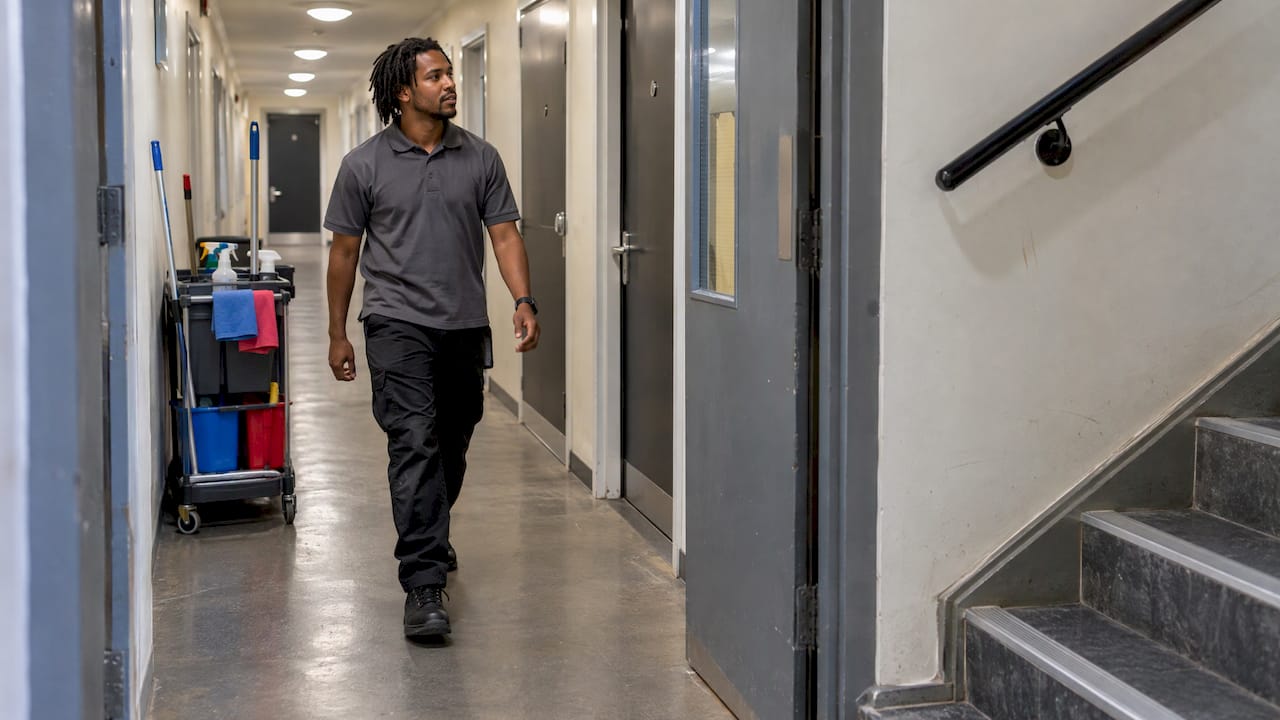
In practice, a cleaner needs a clear rule, because they cannot judge each item case by case. Under a zero tolerance approach, nothing is stored in the escape route. Under a managed approach, you define exactly what may be left and where. Lambeth Council’s September 2025 procedure for blocks it manages shows how a rule can be written down. Enclosed communal areas must be unobstructed. Mobility scooters and white goods are removed without notice, and other listed items get a 24-hour removal notice. Its reasoning is useful to any block: added combustibles can compromise the fire rating of compartment walls, items create trip hazards, and they hinder evacuation and block disabled refuge points.
Whatever rule you choose, give your cleaning team a one-page list covering:
- what must never be on a stair, landing or corridor (prams, bikes, shoes, doormats that are not fixed, boxes, furniture, waste);
- what the cleaner reports and photographs, rather than moves;
- who they report to on the day.
The cleaner should not remove residents’ belongings on their own authority. Removal and notices belong to you and your site team. The cleaner’s job is to see the item, record it and pass it on.
What should a cleaner’s daily fire safety walk cover?
This is a practical checklist for the cleaner’s normal route through a block. It sits alongside the cleaning scope described in our guide to what communal area cleaning covers. It is not a fire inspection. It is an observation routine, and anything unusual goes in the visit report.
- Escape routes. Are stairs, landings, corridors and lobbies clear end to end? Note any bikes, prams, furniture, boxes, bags of rubbish or decorative items.
- Final exits. Do exit doors open freely, without locks, chains or items behind them? Is the route outside the exit clear?
- Fire doors. Are doors to stairs, lobbies and cross-corridor positions closed, not wedged, tied or propped open? Do they swing shut and latch? Note visible damage to the door, frame or glazing, and missing or damaged seals.
- Cupboards and risers. Are electrical, meter and riser cupboard doors shut and locked? Is anything stored inside or in front of them?
- Bin stores and chutes. Is waste contained and off the floor? Is there overflow, bulky waste, or anything that could be ignited? Are doors closed?
- Lifts and lobbies. Is anything stacked in lift lobbies? Are lift areas free of waste and combustible items?
- Signs and equipment. Are fire action notices and exit signs visible, undamaged and not covered? Are extinguishers and call points where expected and unobstructed?
- Lighting. Are any emergency lights or stairwell lights out or visibly damaged?
- Ignition sources. Any signs of burning, scorching, smoke smell, tampering with electrical panels, or charging e-bikes and scooters in communal areas?
- Car parks and bike stores. Are exit routes clear? Is anything stored against walls or doors that should stay accessible?
Photograph each exception, with the location (block, floor, door reference if you have one). A photo of a wedged door on level 6 is worth more than a line saying “door issues”.
Which fire door problems should cleaners report?
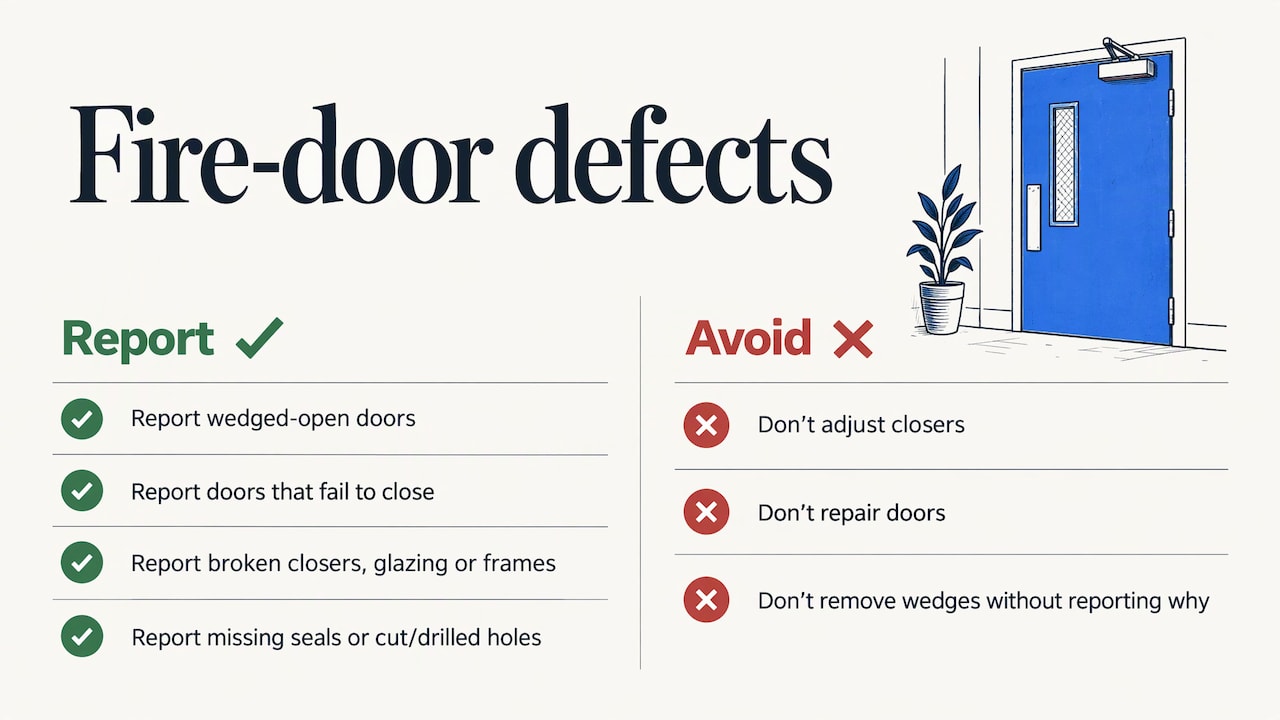
In residential buildings over 11 metres, all fire doors in communal areas must be checked at least every three months. These typically include doors to stairways and stairway lobbies, cross-corridor doors, storage and electrical cupboards, and riser shafts. The same guidance says the checks must establish that the doors are effectively self-closing, or that cupboard and riser doors are locked shut. They must also establish that doors, frames and glazing are undamaged, and that intumescent strips and smoke seals, where fitted, are intact. Defects need to be put right as soon as reasonably practicable.
Those quarterly checks are yours to arrange. Between them, damage and wedging happen quickly. London Fire Brigade notes that self-closing devices badly adjusted or of the wrong type can make doors slam and disturb residents. Residents then wedge them open, which weakens the closer and stops the door closing properly. A cleaner who passes the same door every day will notice a door that has started to bang, been wedged, or lost its seal long before the next inspection.
What to report: a door held open by any object, a door that does not close fully, a broken or detached closer, cracked glazing, damaged frames, missing seals, and holes cut or drilled in a door or the wall beside it. What not to do: adjust closers, repair doors or remove wedges and leave it at that. Wedging usually has a cause (noise, heat, deliveries), and your site team needs to know what it is.
What is the difference between what cleaners report and what the Responsible Person acts on?
The table below separates the two roles. The left column is observation and evidence. The right column is the duty and decision that stay with you.
| What the cleaner sees | What the cleaner reports | What the Responsible Person acts on |
|---|---|---|
| Items stored on stairs or landings | Location, photo, type of item | Apply your storage rule, issue notices, arrange removal |
| Fire door wedged open | Door location, photo of the wedge | Find out why, remove it, brief residents, review closer type |
| Damaged door, frame, glazing or seal | Photo and exact location | Arrange assessment and repair by a competent contractor, record the action |
| Overflowing bin store | Photo, volume, door condition | Adjust collections and cleaning frequency, deal with bulky waste |
| Burn marks, smell of smoke, scorched socket | Immediate notification and photo | Investigate the cause, involve electricians or the fire service as needed |
| Missing, damaged or covered fire notice | Location and photo | Replace and re-display information for residents |
| Failed emergency light or blocked exit sign | Location and photo | Arrange repair, update your records |
| E-bikes or scooters charging in communal areas | Location and photo | Apply your policy, notify residents |
| Locked or obstructed final exit | Immediate report | Clear it, then investigate how it happened |
Reports are only useful if they reach the right person in a form they can act on. Our visit reports are photo-evidenced and hazards are logged in them the same day, so you have a dated record of what was seen and where. That record supports your own file of actions taken, which the Regulations expect you to keep. Anything involving an immediate danger to life should go by phone to your site contact and, where necessary, the emergency services, not wait for a report.
Why are bin stores such a fire risk in London blocks?
A bin store concentrates combustible material in one place, often with a door that residents leave open. Rubbish overflow, bulky items left against walls and cardboard stacked near chutes all feed a fire. They also tend to sit beside escape routes, car parks or ground-floor lobbies. London Fire Brigade’s note GN84, titled Fires in Communal Areas, exists because communal fires start in exactly these places.
Cleaning gives you three controls here:
- Frequency. Daily attendance on large blocks keeps waste contained. Our communal cleaning responsibilities guide explains how to specify who clears what.
- Housekeeping. Floors, door areas and chute rooms stay clear of loose waste.
- Evidence. Photos show build-up trends. If one store is overflowing every Monday, you change the collection, not just the cleaning.
How does this work in a London build-to-rent tower?
This is an illustration, not a client story. Picture a 30-storey build-to-rent tower in Stratford, in the London Borough of Newham, with 300 apartments. It has a double-height lobby, two stairwells and amenity floors with lounges and a gym. It is over 18 metres, so the Fire Safety (England) Regulations 2022 add high-rise duties on top of the quarterly door checks. These include floor plans and a single-page building plan, monthly checks of firefighting lifts, evacuation lifts and essential firefighting equipment, and reporting a fault to the fire and rescue authority where it cannot be fixed within 24 hours.
The cleaning team does not do those checks. What the on-site cleaner does is walk the stairs, lobbies and amenity floors daily, and record two or three typical findings: a deliveries pile in the lift lobby, a stairwell door wedged on a hot afternoon, a damaged seal on a corridor door. The building manager gets a photo report, applies the storage rule, and books the door repair, with the report forming part of the record of action. For this kind of building, our build-to-rent cleaning service is built around a dedicated on-site team.
How does it work on a multi-block estate in Southwark?
Another illustration. Imagine a 200-flat estate in Southwark with four medium-rise blocks, each over 11 metres, a shared podium car park and a bin store serving two blocks. The managing agent is the Responsible Person and has one named account manager at the cleaning contractor.
The quarterly door checks are done block by block by a competent person. The daily cleaner covers all four blocks and notices the pattern the quarterly checks cannot: one block’s stair doors are wedged on bin day, residents in another leave prams on landings, and the shared bin store is overfull on weekends. Monthly reviews with the account manager turn that into action. The agent adjusts collections, reissues storage rules for the block with the prams, and asks the door contractor to look at closers on the block with the banging doors. Each decision is yours. The cleaning record is what makes it quick.
Do cleaners need to know the fire risk assessment?
They need the parts that affect their rounds, not the whole document. The fire risk assessment is yours to commission and keep. It identifies hazards and people at risk, assesses the risks, assesses flat entrance doors and other communal fire doors, and must be reviewed regularly and after changes, per GOV.UK’s residents’ guide. The Home Office guide says responsible persons may do their own assessment if competent, but strongly recommends a professional assessor for larger premises, preferably one certificated by a recognised third-party body. Harmony does not carry out fire risk assessments.
What helps the cleaning team is a short extract: which routes are escape routes, which doors are fire doors, where the storage rule applies and who to call. If your assessment changes, update the extract.
The assessment standards are also changing. PAS 79-2:2020, the housing code, has been withdrawn and superseded by BS 9792:2025. PAS 79-1 for non-housing premises remains in place, which matters for mixed-use buildings with commercial space below flats. Ask your assessor which standard their method follows.
What should residents be told about communal areas?
The Regulations require you to give residents fire safety instructions and display them clearly in the communal areas, and to share them directly with new residents, as GN84 summarises. A cleaner helps by noticing when notices are missing, defaced or covered. The notice itself, its content and its distribution remain yours.
A resident notice is more effective when it tells people why: kept-clear stairs are how people get out and how firefighters get in. Our guide to block cleaning in London covers how to set expectations on shared areas generally.
How does Harmony support managing agents on communal fire safety?
Harmony Cleaning provides daily communal area cleaning for large London residential developments: entrances, lobbies, stairwells, corridors, lifts, bin stores, bike stores, car parks and front windows. We use a dedicated on-site team, assign one named account manager to each contract, provide photo-evidenced visit reports and hold monthly reviews. Staff are Enhanced DBS-checked and trained, and we are SafeContractor approved, ISO 9001 and ISO 14001 certified, a BICSc member and a Living Wage employer.
For fire safety, that means the person who cleans your block every day also records, with photographs, what they see on their route, and the report reaches you. If you are replacing an incumbent contractor, our contract takeover service can include the fire-safety observation routine from the first day. See the full scope on our communal cleaning for managing agents in London page, or browse the services.
We cover Greater London, including build-to-rent towers, purpose-built blocks, multi-block estates and mixed-use buildings.
What is our view on cleaners and fire safety?
Fire safety in communal areas depends on small things staying right every day: a clear landing, a door that closes, a bin store that is not overflowing. Those things change between inspections, and the people who see the change first are usually the cleaners.
That is why we think the cleaning contract belongs in a Responsible Person’s fire safety plan. Not as a substitute for a fire risk assessment, which we do not carry out, and not as a replacement for quarterly door checks. As the daily layer that catches problems and records them with photographs.
A dedicated on-site team, one named account manager, photo-evidenced reports and monthly reviews give managing agents a continuous record they can act on. We would rather your team had the evidence early than found out at the next inspection.
Drahim Hasula, CEO and Founder of Harmony Cleaning
FAQ
Are cleaners responsible for fire safety in communal areas?
No. Legal responsibility sits with the Responsible Person, usually the landlord, freeholder or managing agent. Cleaners keep areas clean and clear, and report hazards they see. You decide and carry out the action.
How often must communal fire doors be checked in a London block?
In residential buildings over 11 metres, communal fire doors must be checked at least every three months, according to the GOV.UK guidance on the 2022 Regulations. Daily cleaner observations do not replace these checks. They flag problems in between.
Can a cleaner move items left in a stairwell?
Only if your written storage policy says so. Under a zero tolerance policy, you may authorise removal of defined items, as in Lambeth’s published procedure. Otherwise, the cleaner should photograph and report the item, and your team handles removal and resident notices.
Does Harmony carry out fire risk assessments?
No. A fire risk assessment is commissioned by the Responsible Person from a competent assessor. We provide daily cleaning and photo-evidenced reports that record hazards on the cleaner’s route.
Does the cleaning contract need to mention fire safety?
It helps to. Specify the daily walk, the items to report, who receives the report and how photographs are shared. Our communal cleaning responsibilities guide covers specifying scope.
Sources
- Residents’ guide to fire safety in blocks of flats, GOV.UK
- Check your fire safety responsibilities under the Fire Safety (England) Regulations 2022, GOV.UK
- Check your fire safety responsibilities, Home Office (2023, PDF)
- A guide for persons with duties under the Fire Safety Order, Home Office (2023, PDF)
- The Fire Safety (England) Regulations 2022, legislation.gov.uk
- Fire safety rules for blocks of flats since Grenfell, House of Commons Library (2024)
- Fire Safety Guidance Note GN84, London Fire Brigade (2023)
- Private residential blocks, London Fire Brigade
- Fire safety in communal areas procedure, Lambeth Council (September 2025)
- PAS 79-2:2020, superseded by BS 9792:2025, NBS
- Fire safety standards: what’s coming next for construction, Construction Management (2025)
Request a free quote through our quote form, email admin@harmony-cleaning.co.uk or call 020 8092 8835.