/ Blog ·
Cleaning Regulations UK: What Building Managers Must Know

No single “cleaning act” covers a London block or mixed-use building. Cleaning is governed by general health and safety law applied to cleaning tasks: COSHH for chemicals, the Health and Safety at Work etc Act 1974 for your overall duty, plus rules on waste, working at height, manual handling, lone working and fire safety in common parts. As the person who has to evidence compliance to a client, freeholder or board, your job is not to learn every regulation. It is to know which paperwork proves each one, and to have it in hand before a cleaner starts a shift.
This guide sets out each rule in plain English, what it means for daily communal and office cleaning, and what to ask your contractor for. At Harmony Cleaning we supply RAMS (risk assessments and method statements) and COSHH records before the first shift on a contract, so the evidence file exists from day one.
TL;DR
- There is no standalone cleaning law: the duties come from the Health and Safety at Work etc Act 1974 and regulations on chemicals, height, handling, waste and fire.
- Hiring a contractor does not hand over your responsibility. If people use your premises, you keep a duty towards them.
- The proof that matters is site-specific RAMS, a COSHH register with safety data sheets, training records, and a visit log.
- Inspectors test whether staff can show safe practice, not just whether a folder exists.
- The table below maps each law to the evidence to request.
Table of Contents
- What UK laws actually apply to cleaning in a London building?
- Which cleaning regulations must you be able to evidence?
- What does COSHH require when cleaners use chemicals?
- What should a commercial cleaning risk assessment cover?
- Do the Work at Height and manual handling rules apply to cleaners?
- How does the waste duty of care affect communal cleaning?
- What fire safety rules apply to cleaning in common parts?
- What about lone working and out-of-hours cleaning?
- How do you check a contractor is actually compliant?
- What does compliance look like in two London buildings?
- How we handle this at Harmony Cleaning
- Our view: compliance is a routine, not a folder
- FAQ
- Sources
What UK laws actually apply to cleaning in a London building?
The foundation is the Health and Safety at Work etc Act 1974. HSE’s short guide for managers explains that employers must ensure, so far as reasonably practicable, the health, safety and welfare of their employees (section 2), and that people in control of non-domestic premises owe a duty to non-employees who use them (section 4). In a mixed-use building, that second duty is the one that lands on you: residents, visitors, retail tenants and contractors all use the same lobbies and stairwells.
HSE’s workplace law summary also sets what clean premises look like in practice: clean floors and stairs, regular removal of dirt and refuse, waste containers, prompt spillage clearance and clean toilets with hot and cold running water, soap and drying facilities.
On top of that sit the specific regulations covered below. Note that this article covers Great Britain-wide health and safety law as it applies to cleaning; residential-specific duties on landlords sit elsewhere and are not the focus here.
Which cleaning regulations must you be able to evidence?
Use this table as a contractor-assurance checklist. It is a summary of the duties, with the evidence you should ask for.
| Law or duty | What it means for cleaning | Evidence to ask your contractor for |
|---|---|---|
| Health and Safety at Work etc Act 1974 | Safe working for staff and for others who use the premises, so far as reasonably practicable | Health and safety policy, insurance certificates, site-specific RAMS |
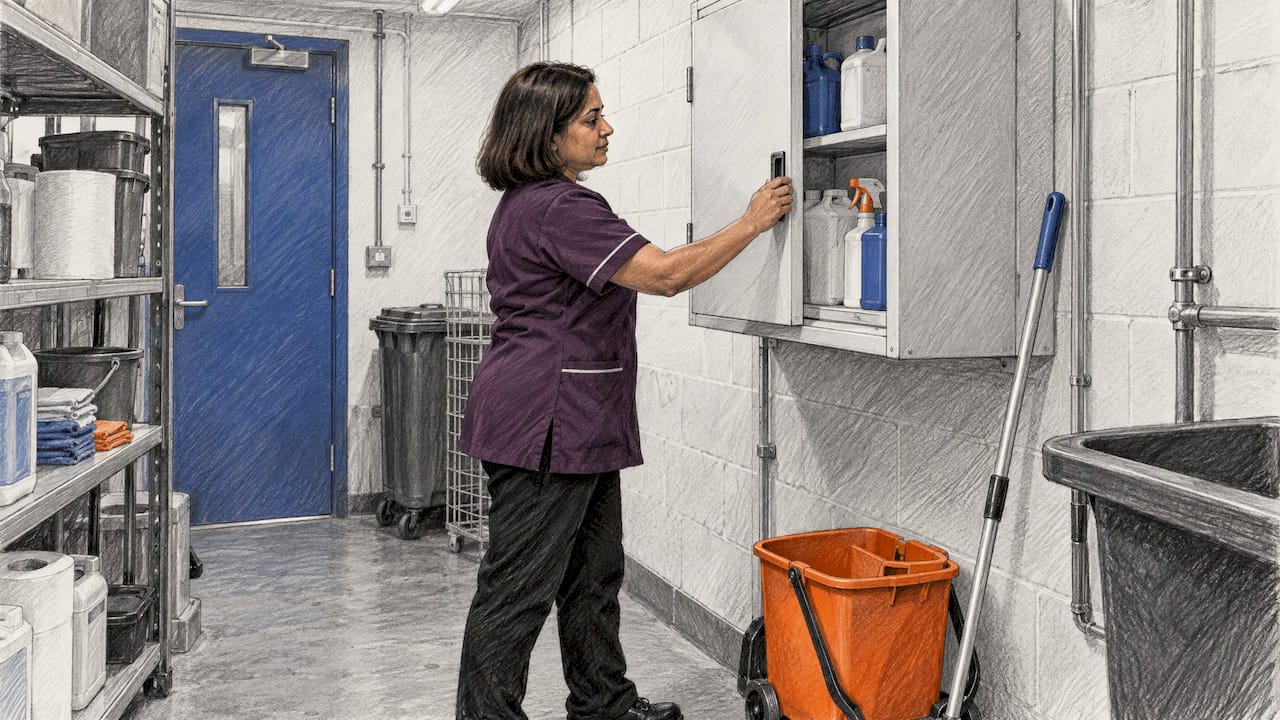
| COSHH Regulations 2002 | Assess, control and train for hazardous substances such as disinfectants, descalers and bleach | COSHH register, product risk assessments, safety data sheets, training records |
| Management of Health and Safety at Work Regulations 1999 | Suitable and sufficient risk assessment for each site and task | Written, building-specific risk assessment reviewed when things change |
| Work at Height Regulations 2005 | Avoid work at height where possible; use suitable equipment where not (stairwell lights, high glazing, atria) | Method statement for height tasks, equipment checks, operative training |
| Manual Handling Operations Regulations 1992 | Avoid, assess and reduce risk from lifting and moving loads such as bins and machines | Manual handling assessment, trolleys and equipment list, training record |
| Environmental Protection Act 1990, waste duty of care | Keep waste secure and pass it only to authorised carriers | Waste handling procedure, carrier details, transfer records |
| Regulatory Reform (Fire Safety) Order 2005 and Fire Safety (England) Regulations 2022 | Keep escape routes and fire doors clear; do not store items in common parts | Site fire induction, escape route checks recorded in visit reports |
| Lone working (general duty under HSWA and management regulations) | Assess and control risks for cleaners working alone or out of hours | Lone working procedure, check-in arrangements, emergency contacts |
Table entries describe the duties in general terms; the sections below link the official guidance for each.
What does COSHH require when cleaners use chemicals?
COSHH is the regulation most often checked. HSE’s COSHH guidance for cleaning says employers must assess the risks from hazardous substances, including storage, handling, disposal and serious spillages, prevent or control exposure, and give staff information, instruction and training on the risks and precautions, such as suitable rubber gloves or eye protection.
A proper assessment is not a generic sheet. HSE’s assessment guidance asks you to consider how workers are exposed (breathing in, skin contact, swallowing), how often and for how long, and who else could be affected, including contractors, visitors and members of the public. In a lobby that residents cross all day, that last point matters.
Three practical checks:
- Product list. Every product on site should appear in a COSHH register with its safety data sheet. HSE’s guidance on manual cleaning and disinfecting surfaces (SR4) advises avoiding biocidal concentrates that are toxic by inhalation or skin contact, or sensitisers such as quaternary ammonium compounds, unless absolutely required, and warns never to add other chemicals to bleach because dangerous chlorine gas can be released.
- Labels. HSE explains that cleaning mixtures must be classified, labelled and packaged under GB CLP, with serious eye damage products carrying the H318 corrosive pictogram and eye irritants H319. Decanted bottles need the same clarity.
- Controls before PPE. Substitution, ventilation and safe systems of work come first; gloves and goggles are the last line of defence. Where ventilation cannot control exposure, SR4 expects suitable respirators, with fit testing for tight-fitting types.
Product classifications also move. A 2026 industry update reports that the latest GB mandatory classification and labelling list had to be fully applied by 15 August 2026, so ask for refreshed safety data sheets when your contractor’s product range changes.
What should a commercial cleaning risk assessment cover?
The law does not expect every risk eliminated. HSE’s cleaning risk assessment page says people must be protected “as far as reasonably practicable”, through straightforward measures such as clearing spillages promptly and keeping drawers shut so nobody trips.
The test is whether the assessment describes your building, not a generic one. A useful assessment names the floor types, the products, how windows and high areas are reached, who else is in the building, and whether anyone works alone or out of hours. Method statements are expected for tasks such as window cleaning and jet washing.
For a facilities manager, this is also the document to read before you sign off. The safe-working questions to ask of any RAMS:
- Does it name this building and its specific hazards (lift lobbies, bin stores, car parks, plant rooms)?
- Does it say who is on site at different times, including residents, retail tenants and visitors?
- Are the controls specific (wet-floor signs, a two-mop system, long-handled tools) rather than “take care”?
- Is there a review date and a named person responsible?
If you want to sense-check the format a principal contractor or managing agent would expect before granting site access, this precheck for contractor RAMS is a handy five-point reference.
Do the Work at Height and manual handling rules apply to cleaners?
Yes, and they are easy to overlook in communal areas. The Work at Height Regulations 2005 apply to any task where a fall could cause injury, which includes changing a stairwell light, dusting high ledges, or cleaning internal atrium glazing. The principle is to avoid working at height where you can, and otherwise use suitable, inspected equipment. Cleaners should not stand on chairs, bins or improvised platforms. External glazing adds its own planning, which we cover in our London window cleaning buyer guide.
HSE’s manual handling guidance applies to moving bins, buckets, machines and consumables stock. In a large block, the daily reality is bin stores and refuse runs, so the assessment should show trolleys and wheeled equipment rather than carrying.
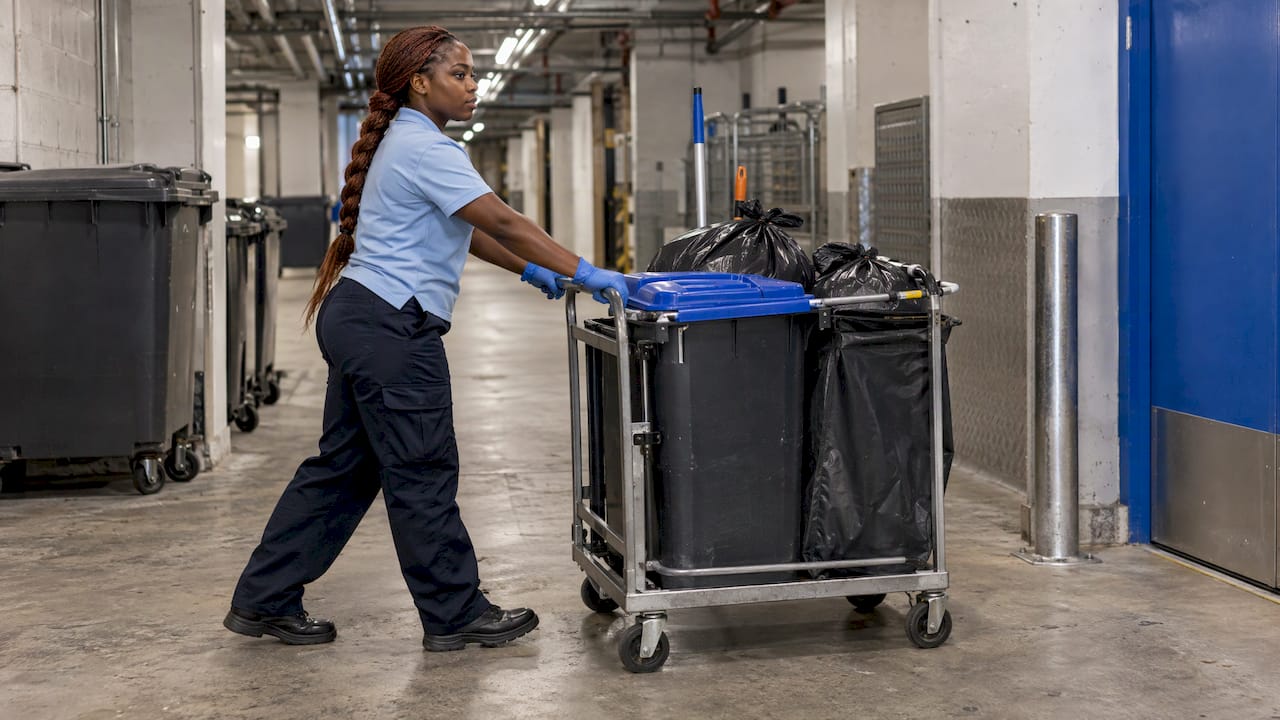
Wet floors deserve a line of their own, since slips are the commonest cleaning hazard in busy lobbies. HSE’s example office cleaning assessment shows sensible controls: wet then dry mopping, warning cones in wet areas, long-handled mops and checking staff for dry, red or itchy skin on their hands.
How does the waste duty of care affect communal cleaning?
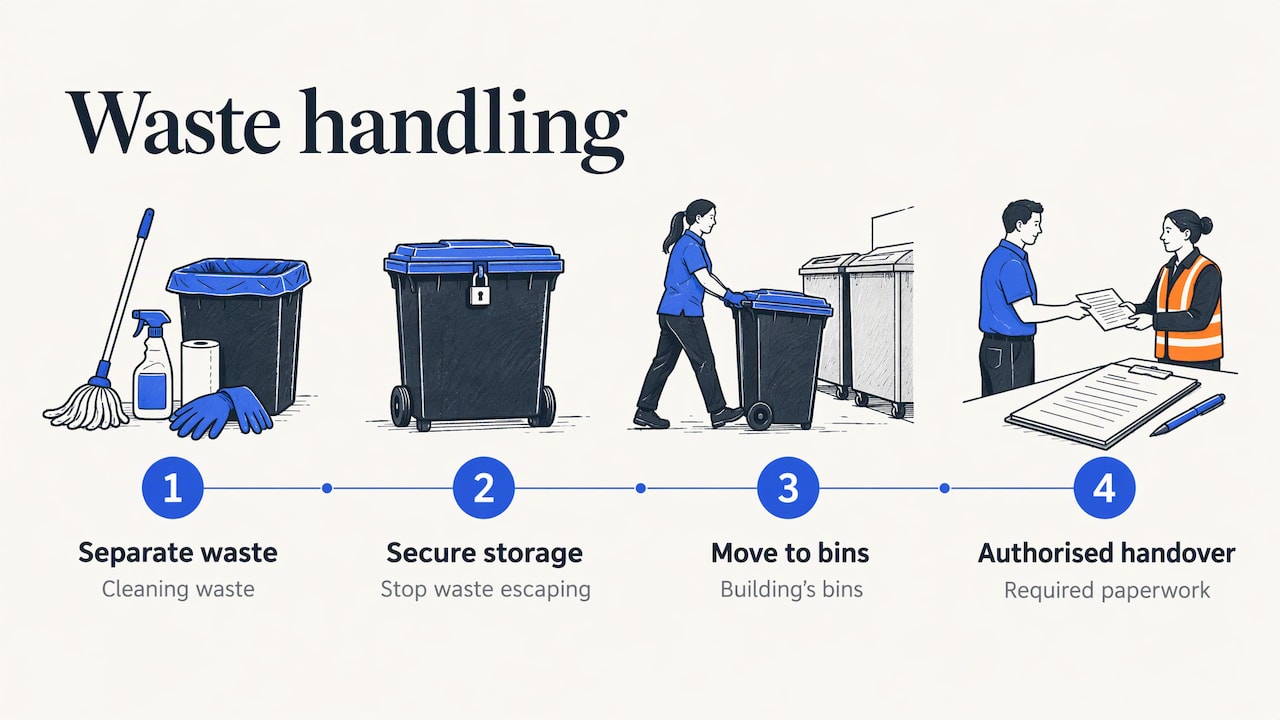
Cleaners handle waste daily: lobby bins, bin store tidying, bulky items left in corridors. Under the waste duty of care set out in GOV.UK’s code of practice, anyone who produces or handles business waste must keep it secure, stop it escaping, and pass it only to an authorised person, with the right paperwork.
For your evidence file, that means a written procedure for how cleaning waste is separated, stored and moved to the building’s bins, and clarity on who holds the commercial waste contract (usually you or the managing agent, not the cleaner). A good contractor reports fly-tipping or overflowing bins rather than leaving them unrecorded.
What fire safety rules apply to cleaning in common parts?
In multi-occupied residential buildings in England, the Fire Safety (England) Regulations 2022 place duties on the responsible person, including steps on fire doors and common parts information. For cleaning the practical point is simple: escape routes, stairwells and corridors must stay clear, and nothing should be stored or left in them.
Cleaners are often the people who see a blocked stairwell, a wedged fire door or stored bikes first. That is why we have written a separate guide on what cleaners must keep clear in communal area fire safety. Build a reporting line into the contract so these sightings reach you in writing.
What about lone working and out-of-hours cleaning?
Many cleaning shifts are early, late or solitary. HSE’s lone working guidance says lone working is not prohibited in general, but you must assess and control the risks. For a cleaner in a 200-flat block at 6am, that means a procedure for check-ins, a charged phone or radio, known emergency contacts and a site induction covering the building layout and emergency arrangements.
How do you check a contractor is actually compliant?
Paperwork alone is not enough. A public-sector contractor-control procedure, such as Southampton City Council’s, is a good model: proof of health and safety competence and insurance at tender, site- and task-specific RAMS checked before work starts, annual re-checks of documents and documented monitoring through the contract.
Apply that to your building:
- Ask for RAMS, the COSHH register and safety data sheets before the first shift.
- Ask for training records for the people who will actually be on your site.
- Ask how incidents and near misses are reported back to you.
- Walk the building with the cleaner and ask them to show you how they dilute and label a product. Inspectors look at demonstrated competence, not only files.
The same principle applies to accreditations. SafeContractor approval, ISO 9001 and ISO 14001 certification and BICSc membership tell you a supplier has been assessed, and they sit alongside, not instead of, site-specific documents.
What does compliance look like in two London buildings?
These are illustrations, not client stories.
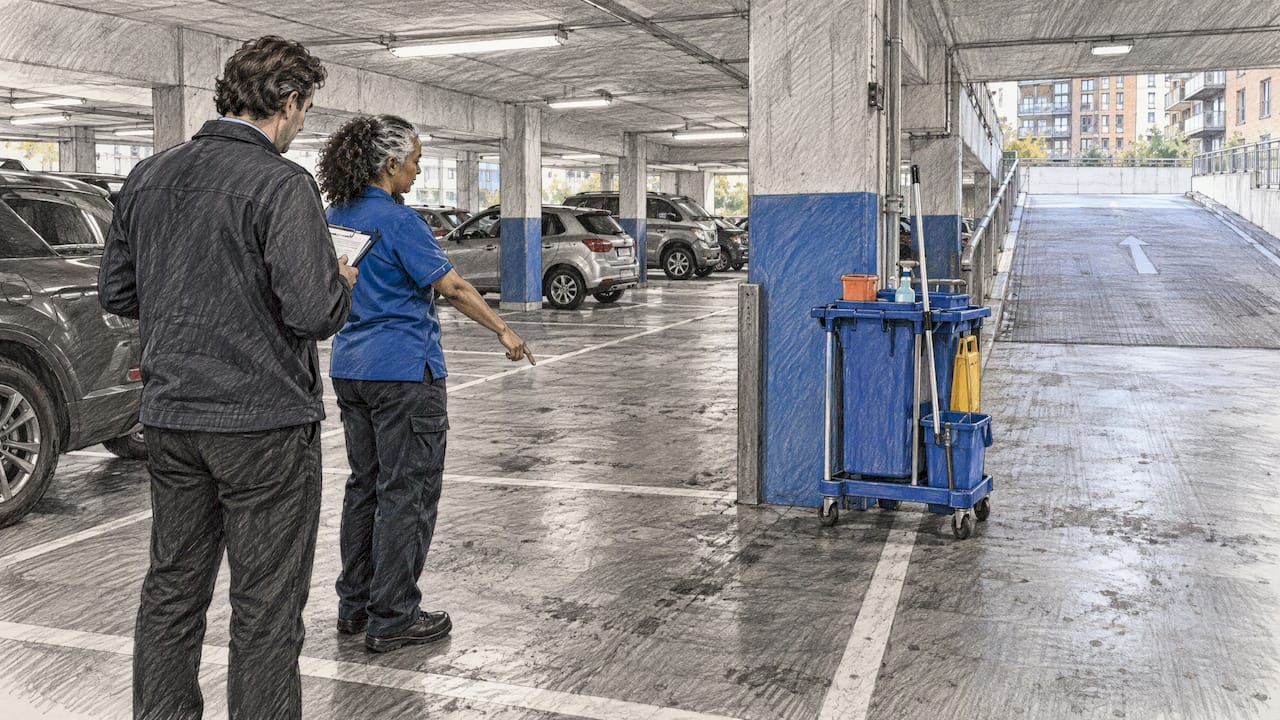
A build-to-rent tower in Stratford. A managing agent runs a 300-apartment tower with a concierge desk, two lift cores, a podium car park and a ground-floor retail unit. The facilities manager needs to show the owner that the cleaning contract is safe. The evidence file would hold RAMS naming the lift lobbies and car park, a COSHH register for the products used on stone, glass and car park surfaces, a manual handling note for bin store runs, and a fire-route check at each visit.
A 200-flat estate in Southwark. A housing association manages four linked blocks with shared bin stores, bike stores and stairwells. Several teams visit the site, so contractor control matters. The file would add a lone working procedure for early shifts, a waste handling note agreeing who deals with bulky items, and a monthly review where the contractor’s records are checked against what inspectors would ask.
How we handle this at Harmony Cleaning
For large London residential developments, we run daily communal cleaning with a dedicated on-site team, covering entrances, lobbies, stairwells, corridors, lifts, bin stores, front windows, bike stores and car parks. Each contract has one named account manager, and we provide photo-evidenced visit reports and monthly reviews, which give you a dated record to show a client or board. Our staff are Enhanced DBS-checked and trained, and we are SafeContractor approved, ISO 9001 and ISO 14001 certified, a BICSc member and a Living Wage employer, with £10m public liability cover.
We supply RAMS and COSHH records before the first shift. See our communal cleaning for managing agents in London page for what a contract covers, or our guide to communal cleaning responsibilities if you are mapping who does what. If you are replacing a contractor, our contract takeover service covers rota mapping, key transfer and TUPE where it applies.
Our view: compliance is a routine, not a folder
The buildings that cope best with an audit are the ones where compliance is a weekly habit rather than a binder produced under pressure. The regulations are not complicated, but they ask for evidence that stays current: a COSHH register that matches the products actually in the cupboard, RAMS that describe this building, and records that show someone checked.
That is why we build a contract around a dedicated on-site team, one named account manager, photo-evidenced visit reports and monthly reviews. The reports show what was done and when. The monthly review is the moment to update the risk assessments and product lists. Supplying RAMS and COSHH records before the first shift means the evidence file starts on day one, not after the first query from your client.
If you manage a large London block or a mixed-use building, ask every contractor the same question: what can you show me today, for this building?
Drahim Hasula, CEO and Founder of Harmony Cleaning
FAQ
Is there a specific cleaning licence or law for commercial cleaners in the UK?
No. Cleaning companies are not licensed under one dedicated law. They must follow general health and safety legislation, such as the Health and Safety at Work etc Act 1974 and COSHH, and any rules covering the specific tasks they carry out. Your evidence is the RAMS, COSHH register and training records.
Who is responsible if a contractor’s cleaner is injured in my building?
Both parties have duties. The contractor is the employer, but as the person in control of non-domestic premises you hold a section 4 duty towards people using them, as HSE’s guidance explains. That is why you should check RAMS before work begins and monitor throughout.
How often should COSHH training be refreshed?
There is no fixed statutory interval. Regulation 12 of COSHH requires information, instruction and training, and one compliance guide describes good practice as refreshing when risks change, after incidents, or every one to three years. Keep dated records for each person on your site.
Do we need a risk assessment for each building?
Yes in practice. The assessment should reflect the specific floors, products, access methods and people in the building, as HSE’s risk assessment guidance frames it around actual hazards. A generic template is a starting point, not the finished document.
What should I ask a new contractor to supply before the first shift?
Site-specific RAMS, a COSHH register with safety data sheets, insurance certificates, training records for the named staff, a lone working procedure and a waste handling note. We provide RAMS and COSHH records before the first shift on our contracts.
Sources
- INDG244 Workplace health, safety and welfare: a short guide, HSE
- The law on workplace safety, HSE
- Control of substances hazardous to health (COSHH), HSE
- How to carry out a COSHH risk assessment, HSE
- Manual cleaning and disinfecting surfaces (SR4), HSE
- Cleaning products and GB CLP, HSE
- 2026 UK Cleaning Industry Trends, CleanManager
- Risk assessment, HSE
- Work at height, HSE
- Manual handling, HSE
- Fire Safety (England) Regulations 2022, legislation.gov.uk
- Lone working, HSE
- Control of contractors safe working procedure, Southampton City Council
- COSHH Explained, ClickHSE
Request a free quote through our contact form, email admin@harmony-cleaning.co.uk or call 020 8092 8835.