/ Blog ·
Cleaning Contract Scope: Writing a Block Specification


A cleaning contract scope is the written list of what the contractor cleans, how often, for how many hours, with what, and how you will know it was done. For a 150-flat block, a good scope covers eight things: areas and tasks, frequencies, on-site hours, periodic works, exclusions, consumables, reporting and audits, and variations. Get these down before tender and bidders price the same job. Leave gaps and you pay for them later in disputes, change orders and resident complaints. We are Harmony Cleaning, a London commercial and communal cleaning company, and this is the structure we would hand a managing agent drafting a specification.
TL;DR
- Write the scope by area, then task, then frequency, then standard. A bare list of rooms is not a specification.
- Define frequency words (daily, weekly, “as required”) in the contract itself, so nobody argues over what they mean.
- State on-site hours as a weekly total with a start and finish window, and list periodic works separately.
- Write an exclusions list and a consumables clause. Most disputes start in what the scope did not say.
- Build in reporting, monthly review and a variations process before you issue the tender.
Table of Contents
- Why does the scope decide whether the contract works?
- How should I structure a block cleaning specification?
- What areas and tasks belong in the scope?
- How do I define frequencies, hours and standards?
- What does a sample specification for a 150-flat block look like?
- How do periodic works fit in?
- What exclusions do managing agents often forget?
- Who supplies consumables and equipment?
- How do I make performance measurable?
- How should variations and handover be written?
- How does Harmony turn a site survey into a written scope?
- What do we think a good scope looks like?
- FAQ
- Sources
Why does the scope decide whether the contract works?
Brent Council’s 2018 review of its estate cleaning service found only 39% of residents were fairly or very satisfied. It put poor delivery down to a badly set-out specification and loosely defined contract terms that made performance hard to measure. Corrective actions that estate staff identified were not carried out because the specification did not require them. The council concluded the contract should not be extended and called for a resident-informed, fit-for-purpose specification.
The lesson for an agent is simple. A contractor can only be held to what is written. A scope that says “clean communal areas” gives you nothing to inspect against, nothing to deduct for and nothing to hand a successor.
Procurement advisers see the same pattern from the other side: problems tend to surface after award, when TUPE assumptions, site data or the split of responsibilities between client and contractor turn out to be unclear. Fixing that at tender stage is cheaper than fixing it in month three.
How should I structure a block cleaning specification?
Use the same order for every section of the document. It makes bids comparable and makes audits quick.
- Site description. Number of flats, floors, cores, lifts, bin stores, bike stores, car park levels, glazed areas and floor finishes. Include a plan or photographs.
- Areas and tasks. Each area, with the tasks to be done in it.
- Frequencies. Daily, weekly, monthly, quarterly, annual and “as required”, all defined.
- On-site hours. Weekly total, working pattern and cover for absence.
- Periodic works. Deep cleans, windows, carpets and hard floors, on a calendar.
- Exclusions and interfaces. What the contractor does not do, and who does.
- Consumables, equipment and COSHH. Who supplies what.
- Reporting, audits and variations. How performance is evidenced and how changes are priced.
Our own guide to what communal area cleaning covers and how often lists the typical areas if you want a starting inventory.
What areas and tasks belong in the scope?
Name every area, then give each a task list. For a purpose-built block or build-to-rent tower the usual areas are:
- Entrances, lobbies and concierge desk surrounds
- Corridors on every floor
- Stairwells, handrails and landings
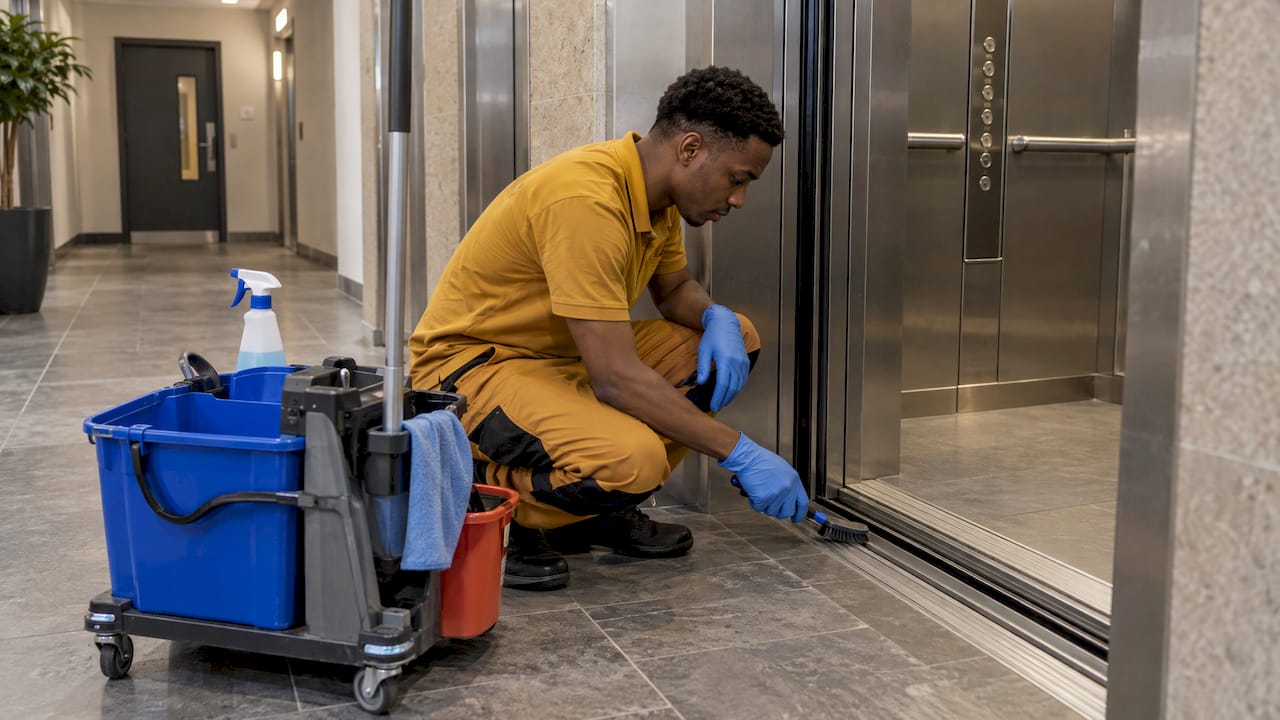
- Lifts: cars, thresholds, door tracks and mirrors
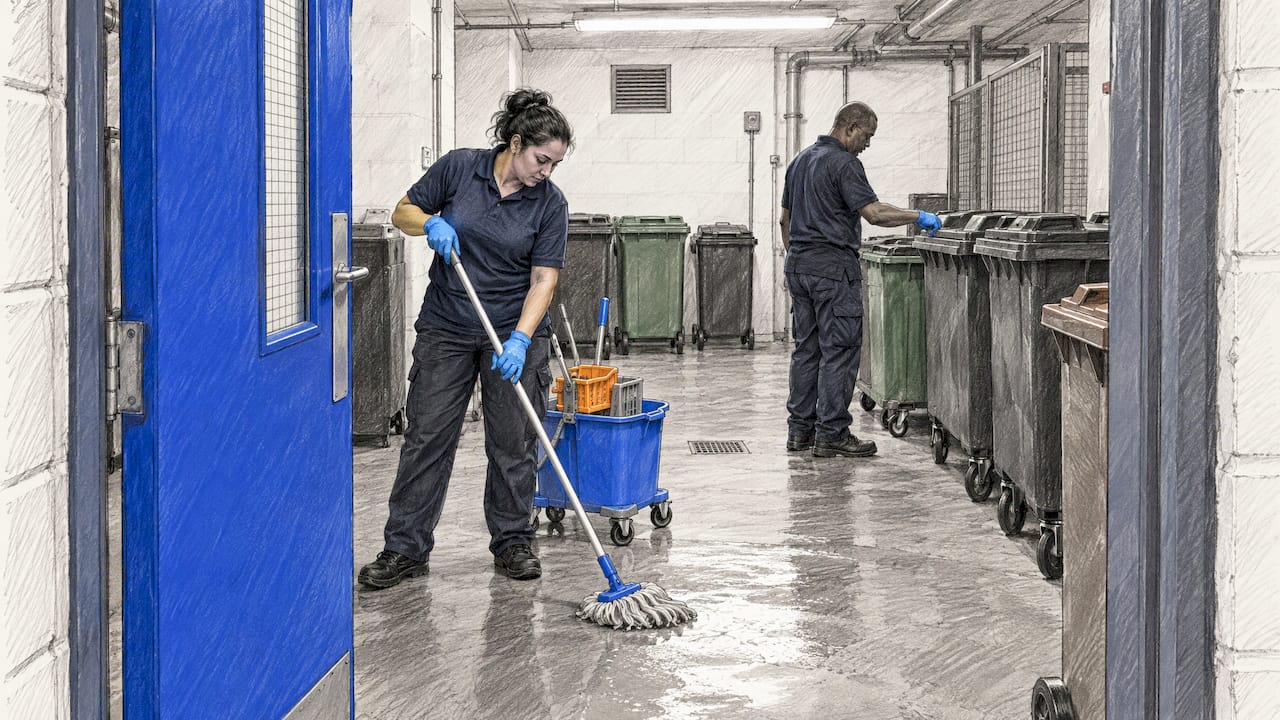
- Bin stores, chutes and refuse rooms
- Bike stores and storage corridors
- Car parks, ramps and pedestrian routes
- Front glazing and entrance doors
- Amenity spaces in build-to-rent buildings, where the operator wants them included
Real specifications are granular. The City of London’s Barbican Estate service level agreement for common parts sets out daily bin and recycling area cleaning and daily lift lobby, entrance and lift car cleaning. Stair sweeping and mopping, carpet vacuuming and lift threshold polishing are weekly. Door, fire-escape stair and balcony cleaning is monthly, and carpet shampooing is “as required”. That is the level of detail to aim for: a task, an area and a frequency on each line.
Write tasks as verbs a supervisor can tick off: sweep and damp mop, wipe touch points, empty and reline bins, remove cobwebs, spot clean walls, clean lift tracks. Avoid “general cleaning” and “maintain to a high standard”.
How do I define frequencies, hours and standards?
Define the frequency words
Do not assume everyone reads “daily” the same way. The Barbican SLA defines daily as Monday to Friday, weekly as once in any working week and monthly as once per calendar month. Clarion Housing Association’s communal cleaning specification goes further. It defines “on every occasion”, “as required” and “after refuse collection”, and it also covers twice-yearly and quarterly work. Its “as required” means the contractor assesses the need on each visit and needs no client authorisation, with the work included in the standard cost.
That last point matters. If “as required” is undefined, every spill, graffiti mark or flood of leaves becomes a variation request.
Set hours as a total and a window
State the weekly hours for the whole contract, the days covered and the window in which work happens. Clarion’s specification sets normal working hours as 8am to 8pm, Monday to Friday. For a block with 150 flats, decide whether you want a full-time cleaner on site daily, weekend cover and part-time support for peak tasks such as bin stores. Specify what happens when the cleaner is absent: cover from the contractor, not a gap in the rota.
If you want a dedicated on-site team, say so in the scope. That is how we work on large residential developments: a full-time cleaner with part-time support, which keeps the same faces and the same routine in the building.
Write the standard, not only the task
An outcome standard turns a task list into something measurable: “floors free of visible dirt, debris and stains”, “no overflowing bins at any inspection”. Slough’s estates cleaning specification also ties quality to a recognised benchmark by requiring BICSc (British Institute of Cleaning Science) membership and best-practice delivery. Requiring a professional body’s membership is a simple way to anchor the standard.
What does a sample specification for a 150-flat block look like?
This is an illustration of format, not a recommended universal figure. Your site survey sets the real hours and frequencies.
| Area | Task | Frequency | Standard |
|---|---|---|---|
| Entrance and lobby | Sweep, damp mop, clean glass, wipe touch points | Daily | No visible dirt or smears at start of concierge shift |
| Lifts (cars and thresholds) | Wipe walls, mirrors, buttons; mop floor; clean door tracks | Daily | Free of marks and debris |
| Corridors (all floors) | Vacuum carpets or mop hard floors | Weekly per floor, spot clean daily | No debris at flat doors |
| Stairwells | Sweep and mop, wipe handrails | Weekly, handrails daily | Free of litter and spillages |
| Bin stores and chutes | Clear surrounding area, wash floor, wipe bin fronts | Daily, wash down weekly | No overflow, no odour, no litter outside doors |
| Bike store | Sweep, remove litter | Weekly | Clear floor and walkways |
| Car park | Litter pick, sweep entrances | Weekly | No loose litter at inspection |
| Front windows and doors | Clean internal and external glass at ground level | Monthly | Streak-free |
| Carpets and hard floors | Deep clean or machine scrub | Quarterly or twice yearly | Per periodic works schedule |
| Spillages and fly-tipping surrounds | Clean on discovery | As required | Included in standard hours |
Below the table, add one line for total weekly hours, the start and finish window, the named supervisor and the reporting method. Bidders then price the same thing.
How do periodic works fit in?
Keep deep cleans, window cleaning and carpet and hard floor care out of the daily task list. List each as a separate scheduled item with its own frequency, method and access needs, such as water-fed poles or machine scrubbing. State whether the work is included in the contract sum or priced per visit. Our guides to commercial deep cleaning scope and timing and commercial window cleaning in London set out what to include in each.
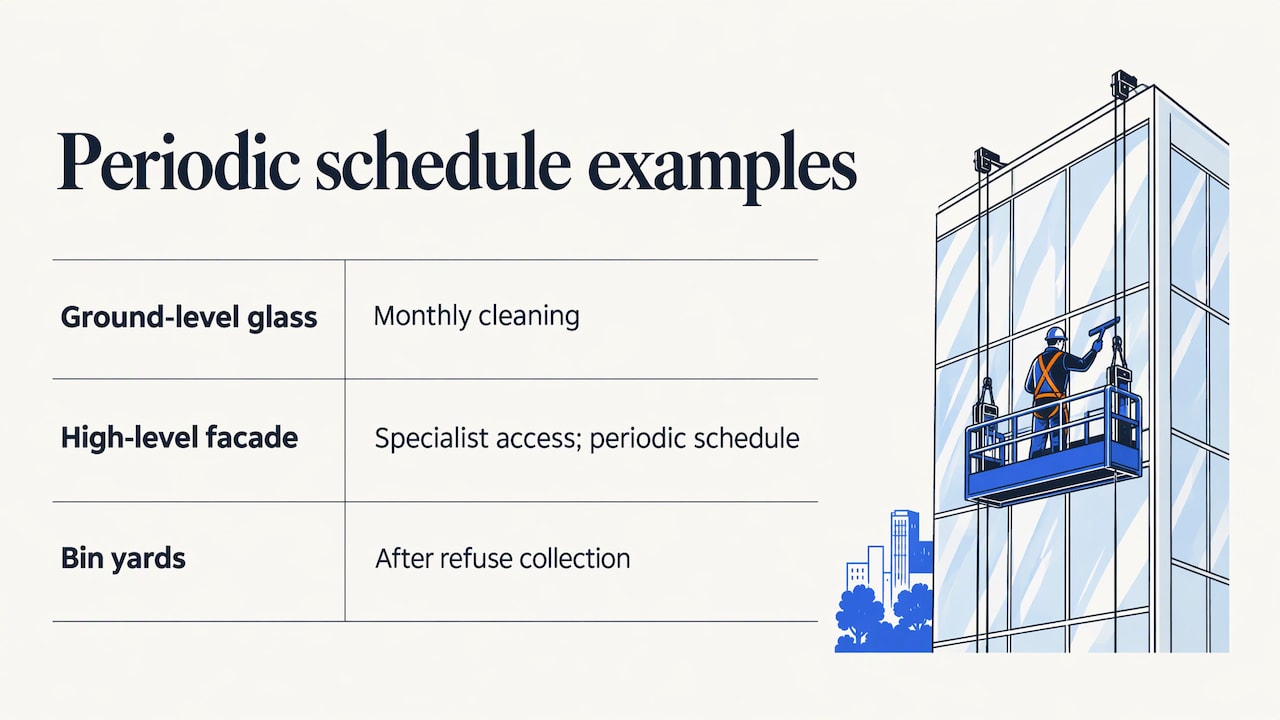
Two London illustrations show why the split matters.
Illustration 1: a build-to-rent tower in Stratford. The operator wants a hotel-standard lobby and residents’ lounge, with daily cleaning of both. Glazed frontage is high, so the scope separates ground-level glass (monthly) from high-level facade work, which needs specialist access and sits in the periodic schedule. Bidders can see exactly what is in the day rate and what is not.
Illustration 2: a 200-flat estate in Southwark. Four blocks, shared bin yards and a podium car park. The specification gives each block its own task table, but one estate-wide schedule for bin yards, with “after refuse collection” as the trigger. The agent can audit each block separately and compare them.
What exclusions do managing agents often forget?
Exclusions protect both sides. Write them down, with the name of whoever does the work instead.
- Fire door and fire safety equipment checks. The Fire Safety (England) Regulations 2022 came into force on 23 January 2023. For multi-occupied residential buildings over 11 metres, responsible persons must check communal fire doors quarterly. Cleaners may report damage they see, but the checks themselves are not a cleaning task.
- Lift maintenance and repairs, beyond cleaning cars and thresholds
- Chute unblocking and drain clearance
- Pest control and specialist biohazard clean-ups
- Graffiti removal that needs specialist treatment
- Gutter cleaning, roof and high-level facade work
- Landscaping, grounds and leaf clearance outside the cleaned footprint
- Bulk waste and fly-tipping removal
- Flat interiors and private balconies
- Light bulb replacement and minor repairs
- Water hygiene tasks such as flushing and temperature logging
Pair this list with an interface clause saying who reports defects to whom. Our post on communal cleaning responsibilities and who does what breaks down the usual split between cleaner, concierge, maintenance team and managing agent.
Who supplies consumables and equipment?
Say it plainly. Clarion’s specification requires the contractor to provide all cleaning materials within its rates and to make safety assessments available for inspection. Follow that model: the contractor supplies cleaning chemicals, machines and equipment, and holds COSHH assessments for the products used on site. COSHH is the UK law on controlling hazardous substances at work.
Decide separately who supplies washroom or communal-area consumables, such as bin liners, if the building has any. Those lines are easy to leave blank and then argue about.
The service charge pays for all of this, and leaseholders can challenge what they cannot see. If arrears are an issue, a clear scope also helps support the budget behind them; see this guide to commercial service charge collection for the collection side.
How do I make performance measurable?
A scope without monitoring is a wish list. Specify four things.
- Inspections. Slough’s specification uses random inspections and measurable targets, including a 90%+ quality inspection score and 100% schedule adherence, with monthly review at joint management board meetings. It also allows pro-rata reclamation for non-attendance.
- Evidence. Require dated visit reports with photographs for each area. It turns “we cleaned it” into a record.
- Review cadence. Monthly review of scores, complaints and open actions, with a trend look each quarter.
- Escalation. A defined score below which remedial action is triggered, and a timescale for fixing it.
We provide photo-evidenced visit reports and carry out monthly reviews, and each contract has one named account manager. Those are the reporting lines we recommend you ask every bidder to commit to in writing.
Also add a frequency review at each contract review, as Clarion does. Buildings change: a new amenity floor or a bin store move alters the work.
How should variations and handover be written?
Variations clause: state that changes are agreed in writing before work starts, priced from the schedule of rates the contractor submitted, and recorded in the monthly review. Add a clause covering “as required” work so routine incidents do not count as variations.
If you are replacing a contractor, the scope also drives handover: rota mapping, key transfer, TUPE where it applies and continuity of standards. Our page on switching cleaning contractor in London explains how a takeover works. For regulatory background, our cleaning regulations guide for building managers covers the UK rules to reference.
How does Harmony turn a site survey into a written scope?
For large residential developments, we run daily on-site common-area cleaning for entrances, lobbies, stairwells, corridors, lifts, bin stores, front windows, bike stores and car parks. In week one, we turn the site survey into a written scope and rota, so the document you tender against matches the building. Our team members are Enhanced DBS-checked and trained, and we are SafeContractor approved, ISO 9001 and ISO 14001 certified, a BICSc member and a Living Wage employer. See our communal cleaning service for managing agents in London for how a contract is set up.
If you are drafting a specification now, you can also share a draft with us through the quote form, and we will map it to the building.
What do we think a good scope looks like?
Most specifications fail because they describe a building, not a service. A list of rooms tells a bidder nothing about how the building should feel on a Tuesday morning.
Our view is that the best scope is short on adjectives and long on tasks, frequencies and evidence. We build ours around a dedicated on-site team, because a cleaner who knows the block spots the leaking bin chute or the stained lift carpet before a resident does. One named account manager owns the relationship, photo-evidenced visit reports show the work, and a monthly review keeps the specification honest as the building changes.
We would rather you wrote a scope that holds us to account than a vague one. It makes the contract easier to run for everyone.
Drahim Hasula, CEO and Founder of Harmony Cleaning
FAQ
How long should a cleaning specification be?
For a single 150-flat block, a few pages is enough: a site description, a task table, definitions, periodic works, exclusions, consumables, reporting and variations. Length is not the point. Every line should be something you could inspect on a site visit.
Should the scope list tasks or outcomes?
Both. Tasks tell the cleaner what to do, and outcomes tell the inspector what good looks like. A line such as “sweep and mop stairwells weekly, free of litter and spillages at inspection” covers both.
What is the difference between “daily” and “as required”?
Daily means a fixed task every working day, and you should define the days. “As required” means the contractor assesses the need at each visit and acts without waiting for approval. Define both in the contract so incidents are not treated as extras.
Do I need to include TUPE in the scope?
If you are replacing a contractor, ask bidders to state how they will handle staff transfer where TUPE applies, and to confirm the data they rely on. It is a handover item rather than a task, but it belongs in the tender pack.
How often should the scope be reviewed?
Review performance monthly and the scope itself at least at each contract review, as Clarion’s model does. Revisit it sooner if the building adds amenities, changes bin arrangements or alters opening hours.
Sources
- SLAs - Estate management, City of London (Barbican Estate)
- Communal Cleaning Specification, Clarion Housing Association
- Estates Cleaning Services Specification, Slough Borough Council (2024)
- Future Delivery of the Estate Cleaning Service, Brent Council (2018)
- What our recent instructions reveal about cleaning procurement trends, NJC DNA (2026)
- Fire Safety (England) Regulations 2022, GOV.UK
- Commercial Service Charge Collection: A UK Landlord’s Guide
Request a free quote through our quote form, email admin@harmony-cleaning.co.uk or call 020 8092 8835.