/ Blog ·
Cleaning Contract Takeover: Switching Without Disruption


If your block’s cleaner keeps missing visits, you can switch without a gap in service. Read the contract and its notice terms first, then write a specification you can measure. Check TUPE before you award, and agree a named mobilisation plan with the incoming contractor, covering keys, rotas and resident communication. A good takeover runs the outgoing and incoming teams side by side, so the lobby is never left uncleaned. This guide walks a London managing agent or block manager through each step, from the first read of the contract to day 90.
TL;DR
- Review notice, termination and handover clauses before you tell anyone, and keep a dated log of missed visits as evidence.
- Write the specification by area and frequency, with measurable standards, so the new contract fixes the cause of the failure and not only the contractor.
- Check TUPE early: when cleaning staff are organised to serve your building, they may transfer with their terms, and the outgoing employer must supply staff information at least four weeks before transfer.
- Agree a mobilisation plan with named owners, key transfer, a site walk and a joint audit in the first weeks, then review monthly.
- Tell residents before the change, in plain words, with one contact route.
Table of Contents
- Is it time to switch your block’s cleaning contractor?
- What should you check in your current contract before giving notice?
- How do you write a specification the new contractor can be held to?
- How should you run the tender?
- Does TUPE apply when you change cleaning contractor?
- What happens in the first week of mobilisation?
- How do you handle keys, access and sign-off?
- How do you tell residents about a new cleaning contractor?
- What should the first 90 days look like?
- What does a switch look like in a real London building?
- Who can take over cleaning for a large London block?
- Our view: why a takeover should feel like nothing happened
- FAQ
- Sources
Is it time to switch your block’s cleaning contractor?
One missed visit is a conversation. A pattern is a decision. The signs that a contractor is failing a large residential development are consistent: bin stores overflowing between visits, lift floors and stairwells left, entrance glass streaked, and resident complaints reaching your inbox before the contractor tells you anything.
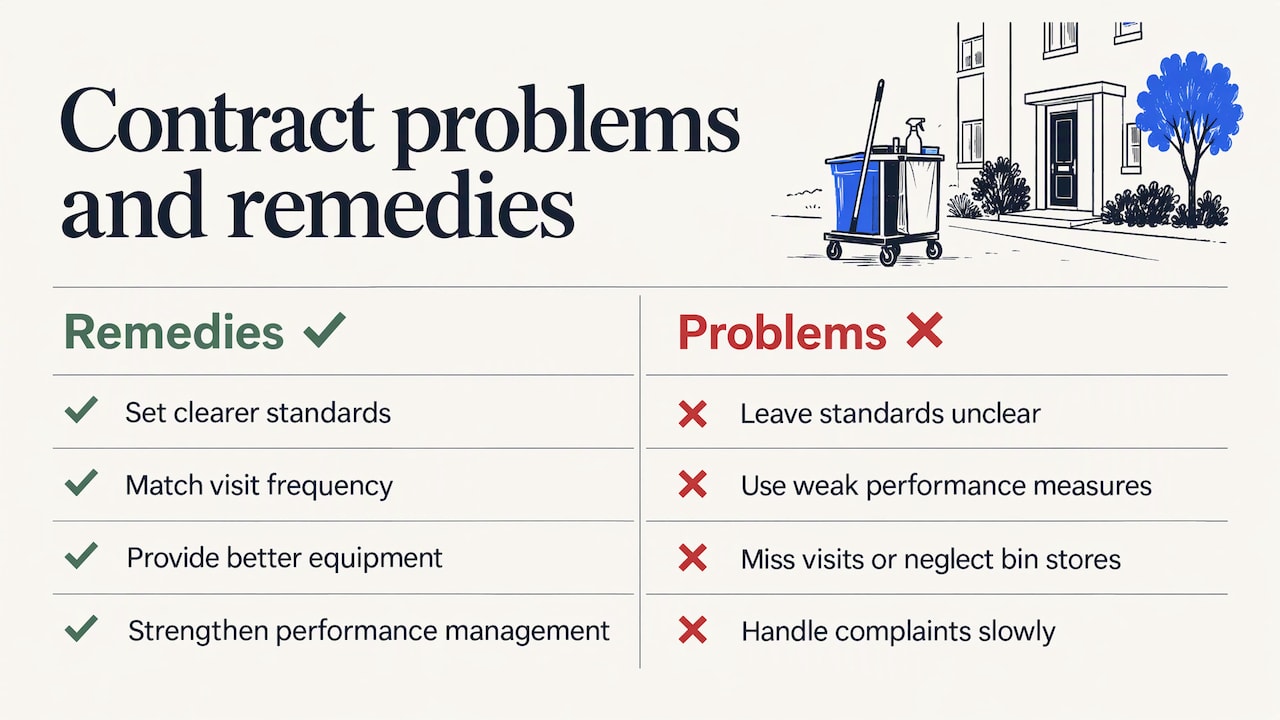
Before you decide, look at whether the failure is the people or the paperwork. Brent Council’s review of its estate cleaning service found that unclear specifications, weak performance measures, missed visits, bin-store problems and slow handling of complaints all undermined resident satisfaction (2019). Its recommendations were clearer standards, appropriate visit frequency, better equipment and stronger performance management. The lesson for a managing agent is that replacing the contractor without rewriting the specification often reproduces the same problems under a new logo.
Start a simple evidence log today. Record the date, the area, what was missed, who reported it and what the contractor said. It supports any conversation about the contract, and it becomes the baseline the new contractor is measured against.
What should you check in your current contract before giving notice?
Read the whole agreement, not only the front page. You are looking for six things:
- Term and notice. The initial term, any rolling renewal, and the notice you must give and how (in writing, to which address, by which date). Notice served the wrong way can restart a renewal period.
- Termination for default. Whether repeated failure to deliver the specification lets you terminate earlier, and what the contract says about warnings and remedy periods.
- Specification and schedules. What was promised by area and frequency. If the specification is vague, note it, because it explains part of the problem.
- Exit and handover provisions. The Cabinet Office’s Contract Management Playbook (March 2026) notes that where services pass between suppliers, the new and previous supplier should collaborate, supported by exit provisions in the previous contract. If your contract has no such clause, you will need to ask for cooperation in writing.
- Keys, fobs and equipment. Who owns the cleaning equipment and consumables on site, and what must be returned.
- Liability and insurance. Any outstanding claims, and the cover the contractor must hold.
If the notice terms or a dispute about performance are unclear, take advice from your own solicitor before you serve notice. Your lease or management agreement with the freeholder or RMC may also set who has authority to terminate, so confirm that too.
For a reminder of how responsibilities are normally split between agent, contractor and residents, see our guide to communal cleaning responsibilities.
How do you write a specification the new contractor can be held to?
The specification is the document that stops the same problems recurring. For a large block or estate, write it by area, not by task list:
- Areas: entrances and lobbies, stairwells, corridors, lifts, bin stores, front windows, bike stores and car parks.
- Frequency: daily, weekly, monthly or periodic, area by area.
- Standard: what “clean” looks like, in terms an inspector can check (floors free of debris and marks, glass free of smears, bin store free of loose waste and odour).
- Hours and presence: on-site hours per week and when the cleaner is in the building. Large developments with a daily presence behave very differently from those served by a visiting team.
- Reporting: how each visit is evidenced, how often you review, and what happens when a standard is missed.
- Supplies and equipment: who provides consumables, machinery and safe storage, and the safety paperwork, including COSHH records.
The Find a Tender specification for one public-sector cleaning contract shows the usual shape: the contractor supplies labour, equipment and materials, holds COSHH and risk-assessment records, trains and supervises staff, carries public liability insurance and shows evidence of managerial checks and completed job sheets. A private residential specification should ask for the same.
The Health and Safety Executive’s COSHH guidance explains the rules on hazardous substances that those records stem from. Ask any bidder to show how its method statements and risk assessments cover your building’s particular hazards: lift lobbies, wet stairwells, bin-store access and car park traffic.
How should you run the tender?
Keep it short and comparable. Send every bidder the same pack: specification, site plan, current staffing information (see the TUPE section below), access arrangements and your timetable. Then ask each to answer the same questions:
- Who will be on site daily, and who covers absence?
- Who is the named contact for you, and how often will they review the service with you?
- How will each visit be evidenced?
- How will they take over from the incumbent, and what is the mobilisation plan?
- What insurance, accreditations and training do they hold?
Compare bids on the same basis. The lowest price is rarely the cheapest outcome if it assumes fewer hours than your specification needs, because the gap shows up as missed areas by week three. Our article on what managing agents should expect from block cleaning in London sets out the questions worth asking at this stage.
Visit a site the bidder already looks after if you can, and ask to see a sample visit report. Check cover, too: our guide to what insurance cover to check first is a short checklist.
Does TUPE apply when you change cleaning contractor?
TUPE (the Transfer of Undertakings (Protection of Employment) Regulations) protects employees when the work they do moves to a new employer. In plain terms: the people cleaning your building may move across to the new contractor with their existing terms.
The key points for a client, from official sources:
- GOV.UK explains that TUPE covers service-provision changes, including a contract retendered to a new contractor, and that employees normally transfer with their terms and continuity of employment.
- Acas says a service-provider change needs an organised grouping of employees carrying out work for the client. There is no minimum group size, and the client and the work must stay mainly the same. Office cleaning is one of its common examples.
- GOV.UK adds that TUPE generally excludes supply-of-goods contracts and short-term single tasks, and protects only employees clearly assigned to the transferring service.
- The outgoing employer must give the new employer information about the employees, normally including identity, age, employment particulars, disciplinary and grievance records from the last two years and any legal claims, at least four weeks before the transfer.
- Employers must inform and consult staff representatives. For transfers completing on or after 1 July 2024, direct consultation without elected representatives is allowed where the employer has fewer than 50 employees or fewer than 10 are transferring.
Why this matters to you as the client: the four-week information deadline means your timetable must allow for it, and it should shape your notice date. TUPE also affects the tender, because staff costs (salary, pensions and other entitlements) belong in every bid. Stephens Scown, an employment-law firm, advises that anonymised staffing details should be obtained before tendering and that employee-specific clauses and indemnities deserve legal review.
TUPE is a legal matter, and whether it applies to your building depends on the facts. Take advice from an employment solicitor or Acas before you serve notice. When a contractor like us takes over, TUPE handling is part of the contract takeover we manage, where it applies.
What happens in the first week of mobilisation?
Mobilisation is the work of preparing the new contractor to deliver at full strength on day one. The Cabinet Office playbook describes it as preparing the supplier and the client for the go-live date, with the exit of the existing supplier usually running at the same time. It also recommends a kick-off meeting with the new supplier’s staff and the client.
For a large London block, week one normally covers:
- Kick-off meeting. You, the concierge or site team, the incoming account manager and the on-site cleaner. Agree owners and dates.
- Site walk against the specification. Walk every area: measurements, surfaces, access routes, storage, water and power, bin-store arrangements and special requirements such as glass atria or car park ramps.
- Rota mapping. Match cleaning hours to your building’s rhythm: deliveries, refuse collection, peak lobby times, quiet hours in residential corridors.
- Safety paperwork. Risk assessments, method statements, COSHH records and any permits your building requires.
- Equipment and consumables. What is stocked on site, where it is stored, and who tops it up.
- Inductions. Fire exits, assembly points, lift procedures, concierge protocols and who to report maintenance issues to.
- Reporting set-up. How visit reports reach you, in what format, and how often you review.
This is where Harmony’s takeover process takes work off your hands: we manage rota mapping, key transfer, TUPE handling and continuity of the service standards, so your team is not coordinating the handover alone. Our dedicated on-site team model means the people who learn your building are the people who clean it. Contracts typically go live within 2-4 weeks of a signed agreement.
How do you handle keys, access and sign-off?
Keys and access are where handovers most often stumble, because the outgoing contractor has little reason to hurry. Do this:
- Make a key and fob register before notice ends: every key, fob, code and alarm credential, who holds it and where it goes.
- Transfer by signature. The outgoing contractor returns items to you, you issue them to the incoming contractor, and both sides sign and date.
- Change codes and deactivate fobs that belonged to departing staff once the handover is complete. Where TUPE transfers staff, issue new credentials in the new employer’s name.
- Photograph the condition of plant rooms, bin stores and storage cupboards on the final day of the outgoing contract, so that any dispute about condition has a baseline.
- Agree a last-day sign-off with the outgoing contractor: areas cleaned, equipment returned, consumables counted.
Keep the outgoing team on a clear footing. They are still your supplier until the last day, and a calm, courteous handover protects the service your residents see.
How do you tell residents about a new cleaning contractor?
Residents notice the change in cleaning before they notice anything else about the building. Tell them early, in plain words, with a single route for feedback. Send the notice through your usual channels: email, resident portal, noticeboard in the lobby and lift.
Short announcement template
Subject: Changes to cleaning in the communal areas at [Building name]
Dear residents,
From [start date], the communal areas at [Building name] will be cleaned by a new contractor. You will see a new cleaning team in the entrance, corridors, stairwells and lifts. The new team will follow the same areas and standards as before, with a clearer schedule and regular checks from us.
There is no change to your service charge arrangements as a result of this notice. If you notice anything that needs attention, please contact [named contact, email or phone] and we will pass it to the cleaning team.
Thank you for your patience while the new team settles in.
[Name], [Managing agent]
Check the final line about service charges against your own position before you send it, and remove it if you cannot confirm it. Do not promise outcomes you do not control. A reassuring tone and an easy way to report a problem do more than a long explanation.
What should the first 90 days look like?
The first three months decide whether the switch holds. The Brent review is a reminder that outcomes depend on measurable standards and active contract management, not only operative effort.
| Period | What happens | Your check |
|---|---|---|
| Days 1-30 | New team settles in. Joint audit on the first days sets a baseline against the specification. Weekly check-ins. A snagging list with owners and dates. | Are all areas covered at the agreed frequency? Are visit reports arriving? |
| Days 31-60 | Snagging items closed. Rota adjusted to the building’s real rhythm. First monthly review. Supplies and equipment confirmed. | Are repeat issues falling? Are resident complaints reducing? |
| Days 61-90 | Standards stable. Review of the specification and any changes to scope. Training needs reviewed. Agree the ongoing review schedule. | Is the service consistent without prompting? Do reports match what you see on site walks? |
Throughout, keep two habits. First, walk the building yourself at different times of day, because reports tell you what was done and a walk tells you what residents see. Second, keep the snagging list open and dated: an issue without an owner and a date usually returns.
What does a switch look like in a real London building?
These two examples are illustrations, not client stories.
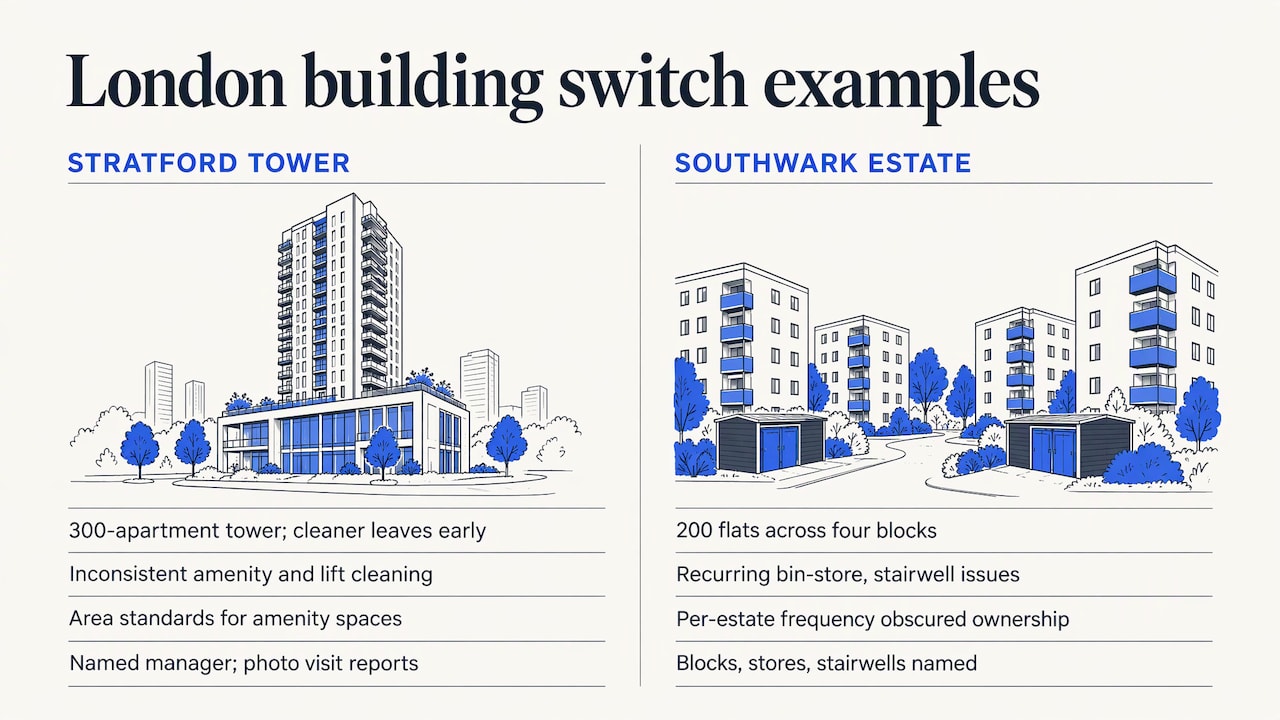
Illustration 1: a build-to-rent tower in Stratford. A 300-apartment tower has a daily cleaner who often leaves early, and the amenity floors and lifts are cleaned inconsistently. The operator reviews the contract, finds a clause allowing termination after repeated unremedied failures, and rewrites the specification by area with separate standards for resident-facing amenity spaces. The tender asks for a named account manager and photo-evidenced visit reports. The agent sets the notice date to leave at least four weeks for staff information under TUPE, and the incoming team shadows the outgoing one for the final days. Residents get a notice two weeks beforehand. At day 30 the joint audit and snagging list are reviewed. Our page on build-to-rent cleaning in London describes how these buildings differ.
Illustration 2: a 200-flat estate in Southwark. An estate of four blocks has a rotating team and recurring problems at the bin stores and ground-floor stairwells. The housing association finds the specification lists frequency per estate and not per block, so nobody was clearly responsible for each store. The new specification names each block, each bin store and each stairwell, with visit frequency and a reporting line to the estates team. At mobilisation, the site walk adds the car park and bike stores, which the old contract had left out. The Housing Ombudsman’s complaints handling expectations make a clear audit trail useful, so visit reports are filed against each block.
In both cases the lesson is the same: the switch works when the specification is exact and the handover has named owners.
Who can take over cleaning for a large London block?
Harmony Cleaning is a London commercial and communal cleaning company. Our focus is daily on-site common-area cleaning for large residential developments of 100+ apartments, build-to-rent buildings and multi-block estates: entrances, lobbies, stairwells, corridors, lifts, bin stores, front windows, bike stores and car parks. Typical contracts run 50+ hours a week with a full-time cleaner plus part-time support on site.
For a contractor change we handle rota mapping, key transfer, TUPE handling and continuity of your service standards, and we assign one named account manager, provide photo-evidenced visit reports and carry out monthly reviews. Our staff are Enhanced DBS-checked and trained, and we are SafeContractor approved, ISO 9001 and ISO 14001 certified, a BICSc member and a Living Wage employer, with £10m public liability cover.
See how we run communal cleaning for managing agents in London and our dedicated page on switching cleaning contractor in London. You can also see all our services.
Our view: why a takeover should feel like nothing happened
Most failing cleaning contracts we see described by managing agents have the same root: nobody is clearly responsible for each area, and nobody checks. Changing contractor does not fix that on its own. A clear specification, a dedicated on-site team that learns the building, one named account manager, photo-evidenced visit reports and a monthly review do.
We believe a takeover should be planned like a small project: owners, dates, a site walk, a key register, a joint audit, and a calm message to residents. Our takeover work covers rota mapping, key transfer, TUPE handling where it applies and continuity of your standards, so the building keeps being cleaned while the contract changes hands.
Our team has 20+ years of combined experience, and we would rather you ask hard questions of any contractor, including us, about who will be on your site every day.
Drahim Hasula, CEO and Founder of Harmony Cleaning
FAQ
How long does a cleaning contract takeover take?
It depends on your notice period, the four-week TUPE information window where TUPE applies, and the mobilisation plan. Many managing agents plan the tender and notice together so the new contractor can start the day the old one ends. Harmony goes live within 2-4 weeks of a signed agreement.
Do cleaning staff transfer to the new contractor?
Often they can. GOV.UK says employees normally transfer with their terms where TUPE applies to a service-provision change. Whether it applies depends on whether an organised group of employees is assigned to your site, so take advice from an employment solicitor or Acas when you plan.
Can we switch if the contract has not expired?
Possibly, if the contract allows termination for default or you serve notice correctly. Read the termination, notice and remedy clauses first, keep your dated log of failures and take legal advice before you serve anything.
What should we tell residents?
Tell them who is starting, when, what stays the same and how to report a problem. Use the template above, send it before the start date and name one contact.
What happens to keys and access during the handover?
Use a signed key and fob register: the outgoing contractor returns items to you, and you issue them to the incoming contractor. Change codes and deactivate fobs once the handover is complete.
Sources
- Business transfers, takeovers and TUPE: Overview (GOV.UK)
- Information about employees during transfers (GOV.UK)
- Consulting and informing (GOV.UK)
- What a TUPE transfer is (Acas)
- The Contract Management Playbook, March 2026 (Cabinet Office)
- Future Delivery of the Estate Cleaning Service, 2019 (Brent Council)
- Schedule 4: Specification (Find a Tender)
- Tendering for a New Contract? What HR matters should you consider (Stephens Scown, 2018)
- COSHH (Health and Safety Executive)
To request a free quote, use our quote form, email admin@harmony-cleaning.co.uk or call 020 8092 8835.