/ Blog ·
Corridor Cleaning Service for London Residential Blocks

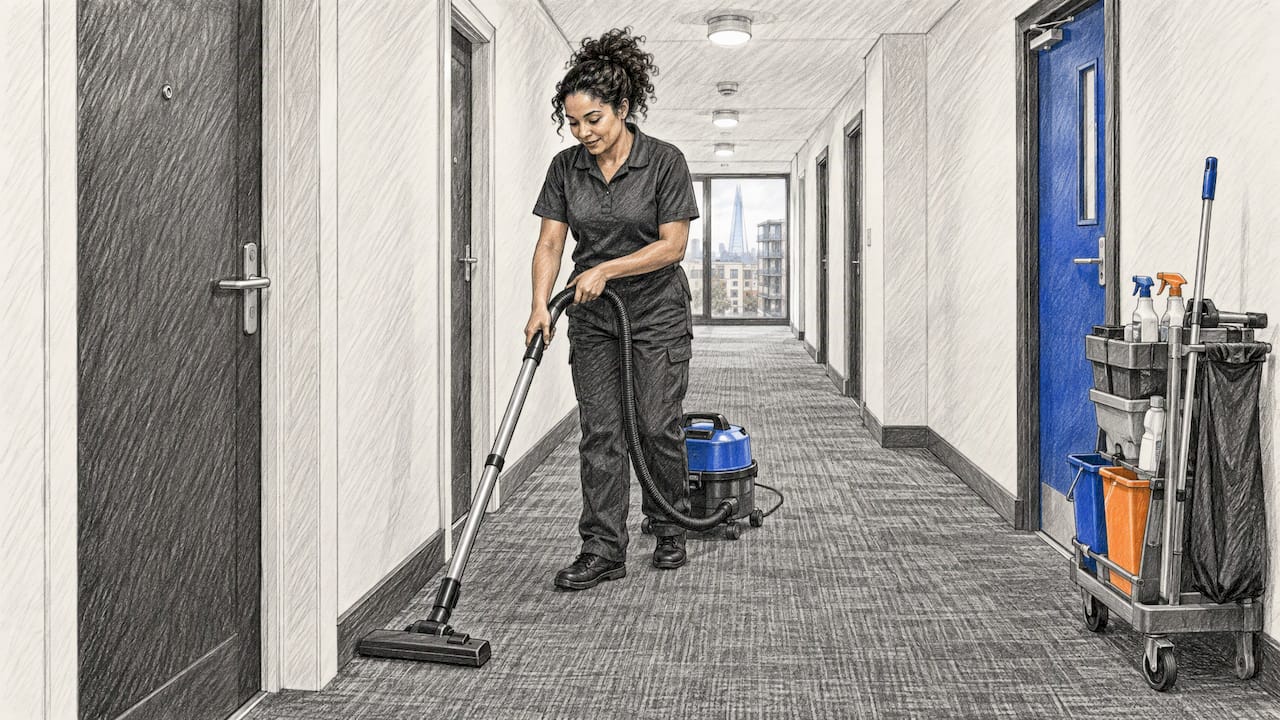
A corridor cleaning service for a large London block should cover more than a vacuum and a mop. It should clean floors, skirting, doors, handrails, door furniture and light fittings within reach, keep escape routes clear, and run on frequencies set by floor type and footfall. The most reliable way to hold that standard is the same on-site cleaner walking the same corridors every weekday, which is how we run daily common-area contracts at Harmony Cleaning.
This guide is for block managers and managing agents writing or reviewing a specification for blocks of 100+ apartments, from build-to-rent towers in Stratford to multi-block estates in Southwark.
TL;DR
- Specify corridors by zone: ground floor and lift lobbies get daily attention, upper-floor corridors are cleaned on a lower, set frequency.
- Write the task list into the contract: floors, skirting, handrails, door furniture, light fittings within reach, spot cleaning.
- Escape routes must stay clear and wet floors must be signed and left dry; fire safety sits with the responsible person.
- Day cleaning suits most blocks, with noisy tasks scheduled around resident hours.
- Photo-evidenced visit reports and monthly reviews show whether the specification is being met.
Table of Contents
- What does a corridor cleaning service include in a large London block?
- How often should corridors be cleaned?
- Which corridors need daily attention?
- How do you keep escape routes clear while cleaning?
- Day or evening: when should corridors be cleaned?
- How do you check the corridors are being cleaned to standard?
- Why does the same cleaner every weekday matter?
- Promo: corridors covered by an on-site team
- Perspective: what we have learned about corridors
- FAQ
- Sources
What does a corridor cleaning service include in a large London block?
Public specifications show the usual scope. Quadrant Housing Trust’s 2025 tender for 37 Tower Hamlets blocks lists hallways, corridors and walkways, all hard and soft flooring, landings, stairwells including risers and nosings, lifts, entrances and door furniture, communal walls, woodwork, ceilings, light fittings, sockets and skirtings. Extras include carpet shampooing and deep cleaning of hard floors.
For a block manager, that translates into a core task list:
- Vacuuming of carpeted corridors and sweeping then mopping of hard floors.
- Spot cleaning of marks, spills and stains as they appear.
- Skirting boards and door frames wiped down.
- Handrails, door furniture and other high-touch points cleaned.
- Light fittings and ledges dusted within reach.
- Litter and deliveries debris removed, with bin chute areas checked.
Putting the list in the contract matters because “corridor cleaning” alone is read differently by every contractor. The related guide on what communal area cleaning covers and how often sets out the wider scope around the corridor.
How often should corridors be cleaned?
Frequency should follow footfall. Milton Keynes Council’s cleaning and caretaking service standard notes that busier areas get dirty faster, which is the basis for treating zones differently. Landlords vary widely. Islington’s Caretaker Quality Assurance Manual (2024/25) has entrance halls swept and washed daily, stairs and landings checked daily and swept and washed weekly, and handrails weekly. Tower Hamlets’ caretaking schedule puts internal corridor sweeping and mopping on a monthly cycle, which is a minimum for council estates, not a model for a premium private block.
For large private and build-to-rent blocks with a full-time cleaner on site, the table below is a sensible starting specification. These are suggested specifications to adapt, not legal requirements.
| Zone | Floor type | Suggested frequency | Typical tasks |
|---|---|---|---|
| Ground-floor corridors and entrance routes | Hard floor | Daily, Monday to Friday | Sweep and mop, spot clean, door furniture, glass |
| Lift lobbies (all floors with high traffic) | Hard floor or carpet | Daily, with spot checks | Vacuum or mop, marks, handrails, call buttons |
| Upper-floor corridors | Carpet | Vacuum two to three times a week, spot clean daily | Vacuum, spot clean, skirting, door furniture |
| Upper-floor corridors | Hard floor | Mop two to three times a week, spot clean daily | Sweep, mop, skirting, light fittings in reach |
| Skirting, doors, frames | All | Weekly rotation | Wipe down by floor |
| Light fittings and high ledges within reach | All | Monthly to quarterly | Dust and wipe |
| Carpet deep clean | Carpet | Periodic, set by wear | Extraction or shampoo |
| Hard-floor deep clean | Hard floor | Periodic, set by wear | Machine scrub |
Milton Keynes also specifies that high levels, including cobwebs, are cleaned once every 12 months where a step ladder reaches, a useful anchor for the higher-level line.
Which corridors need daily attention?
Ground floors and lift lobbies take the most traffic: deliveries, bikes, prams, wet weather and move-ins. Corridors near the lift on each floor see more footfall than the far ends. If your block has a corridor leading to the bin store or the car park, treat that as ground-floor traffic too.
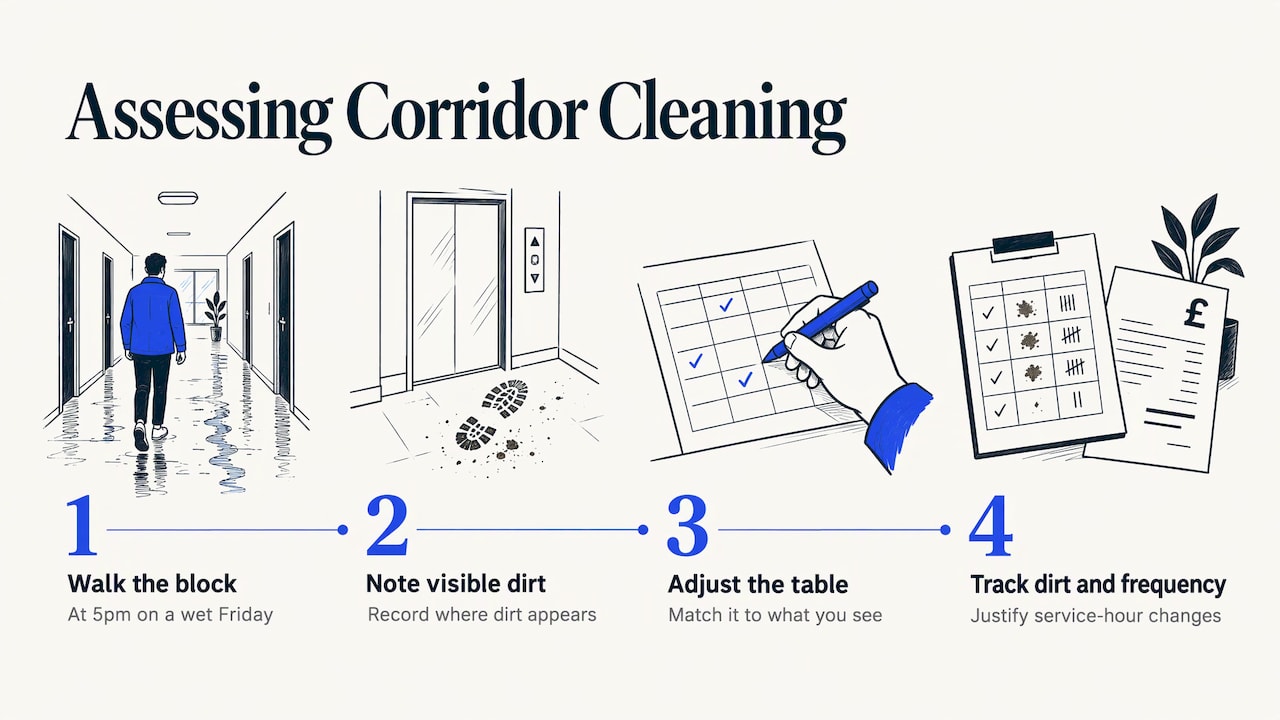
A useful method is to walk the block at 5pm on a wet Friday and note where the dirt is. Adjust the table to match what you see rather than treating every floor the same. Tracking visible dirt against frequency is also how you justify either increasing or reducing hours at service charge review. Our guide to service charge cleaning budgets covers that conversation with leaseholders.
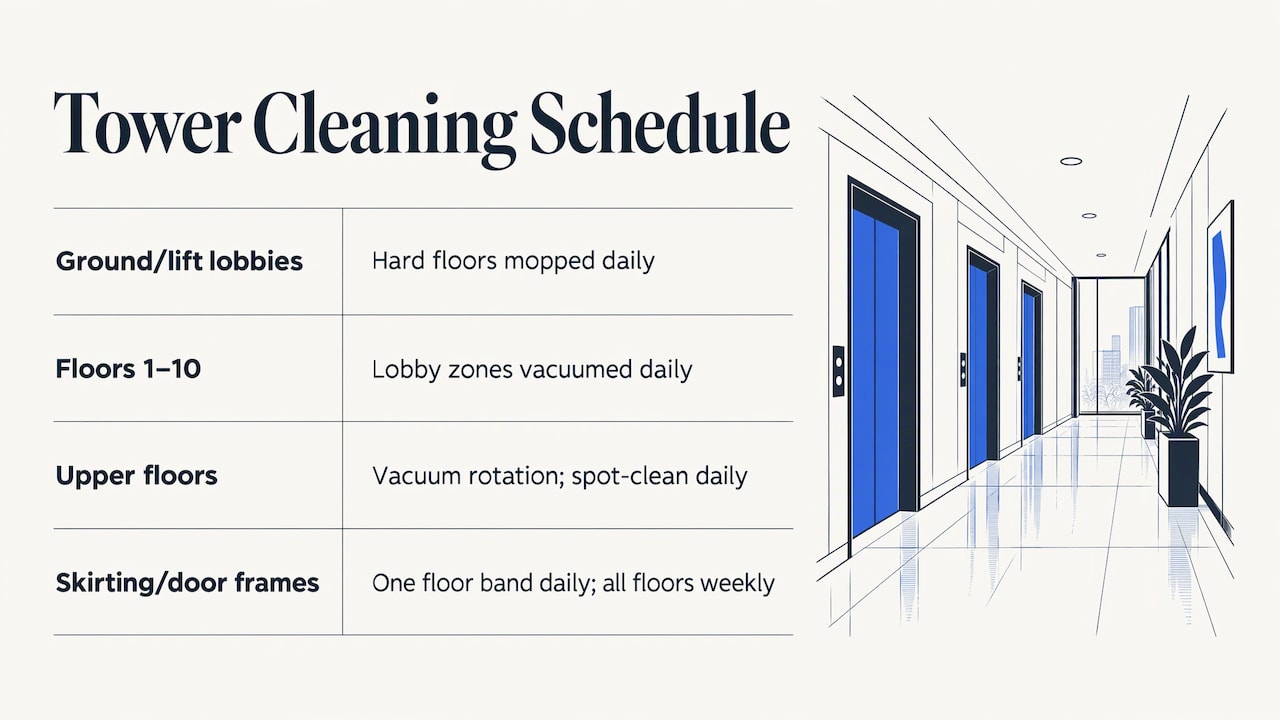
Worked example: a build-to-rent tower in Stratford
This is an illustration, not a client story. Picture a 30-storey tower with 350 apartments, a concierge desk and four lifts. Ground floor and lift lobbies are hard-floored and mopped daily. Upper floors are carpeted, with two corridors per floor. The specification sets daily vacuuming for lobby zones on floors one to ten, where the lower floors see more movement, and a rotating schedule for higher floors, with spot cleaning every day for all of them. Skirting and door frames are done one band of floors per day across the week, so every floor is covered weekly.
Worked example: a 200-flat estate in Southwark
Again an illustration. Four linked blocks of five storeys with open deck access and internal stairwells. Hard-floor corridors and stairs dominate. The specification sets daily sweeping and mopping of entrances and ground-floor corridors, stairwell and landing cleaning on a set weekly rotation, handrails weekly, and a periodic deep clean of hard floors. Because the blocks are linked, the specification names each core separately so nothing is left to assumption.
How do you keep escape routes clear while cleaning?
Cleaning must never leave a corridor obstructed. In England, the Regulatory Reform (Fire Safety) Order 2005 requires the responsible person, typically the landlord or managing agent, to carry out and review a fire risk assessment covering escape routes and fire doors, as summarised in a landlord guide. For HMOs, the Management of HMOs (England) Regulations 2006 require means of escape to be kept clear, and a 2026 local authority standards guide states that corridors, halls and lobbies must be free from obstruction. Check your own building’s fire risk assessment for what applies to it.
Practical rules to write into the specification:
- Equipment, trolleys and bags are never left in a corridor or stairwell unattended.
- Fire doors are never wedged open to speed up mopping.
- Wet floors are signed while being mopped, and the sign is removed once dry. Both Milton Keynes and Clarion’s communal cleaning specification require this.
- Cleaners report blocked routes, faulty lighting and damaged fire doors to the manager rather than moving items themselves.
Cleaning chemicals fall under COSHH, which Clarion’s specification also names, together with the Health & Safety at Work Act 1974.
Day or evening: when should corridors be cleaned?
For most large blocks, daytime cleaning is the better choice. A cleaner on site during the working day sees problems as they happen, such as a spill by the lift, and deals with them straight away. Evening cleaning avoids footfall but leaves a morning’s marks until the next day, and gives you no one present during peak movement.
The way to think about it is by task:
- Daytime: vacuuming, spot cleaning, handrails, door furniture, glass, general checks.
- Quiet periods: mopping long hard-floor runs, with signs and one half of a corridor open at a time.
- Scheduled windows: carpet extraction and machine scrubbing, announced in advance.
Noise and resident hours
Vacuums and floor machines carry in corridors, especially in timber-framed or lightly insulated buildings. Set out in the specification the earliest and latest start for machine work, which floors are done at which times, and how residents are told in advance of deep cleans. Avoid machine work early in the morning and late evening, and keep it away from floors with known night-shift residents where possible. Notices on lift and entrance noticeboards a few days ahead cut complaints considerably.
How do you check the corridors are being cleaned to standard?
A specification only works if you can inspect it. Islington’s manual describes standards using text and photographs so that residents and contractors share one benchmark, and arranges independent quality control inspections each month. Milton Keynes describes a good standard as swept, mopped, clean floors free of litter, marks or stains, with clear corridors.
For your own contract, ask for:
- A written task list by zone, matching the table above.
- Photo-evidenced visit reports so you can see the corridors without being on site.
- A monthly review against that list.
- A named contact who answers for the contract.
Where an incumbent is falling short, a handover is a chance to reset the specification. Our page on switching cleaning contractor in London covers rota mapping, key transfer and TUPE where it applies.
Why does the same cleaner every weekday matter?
A rotating team cleans to the list. A resident cleaner learns the building: which corridor collects deliveries, which door sticks, which carpet stains near the lift. They notice a flickering light or a propped fire door the day it happens and report it. For a large block that daily familiarity does more for corridor standards than adding hours does.
Promo: corridors covered by an on-site team
For blocks of 100+ apartments, Harmony Cleaning provides a dedicated on-site team for daily common-area cleaning, one named account manager, photo-evidenced visit reports and monthly reviews. Corridors, stairwells, lifts, lobbies and bin stores sit in the same contract. Staff are Enhanced DBS-checked and trained, and we are SafeContractor approved, ISO 9001 and ISO 14001 certified, a BICSc member and a Living Wage employer. See communal cleaning for managing agents in London or the block cleaning guide.

We also cover carpet and hard-floor care and periodic deep cleans, which suit the machine work that corridors need on a longer cycle.
Perspective: what we have learned about corridors
Corridors are the part of a block every resident walks daily, so they shape how people judge the whole building. A specification that names the tasks, the zones and the frequencies leaves little to interpretation.
Our view is that a dedicated on-site team, with one named account manager, photo-evidenced visit reports and monthly reviews, gives block managers a corridor standard they can see rather than assume. Our team brings 20+ years of combined experience to that approach.
Drahim Hasula, CEO and Founder of Harmony Cleaning
Drahim Hasula
FAQ
Can corridor cleaning be included in a wider communal cleaning contract?
Yes, and for large blocks it usually should be. Corridors, stairwells, lifts, entrances and bin stores are normally specified together so one team and one account manager are responsible for the whole shared space.
How do I specify cleaning for carpeted and hard-floor corridors in the same block?
Set separate lines for each floor type. Carpet needs regular vacuuming and spot cleaning with periodic extraction, while hard floors need sweeping, mopping with wet-floor signs and periodic machine scrubbing.
Who is responsible for fire safety in corridors?
Under the Regulatory Reform (Fire Safety) Order 2005, the responsible person, often the landlord or managing agent, carries out and reviews the fire risk assessment. A cleaning contractor keeps routes clear and reports defects to you.
How do I know corridors are actually being cleaned?
Ask for visit reports with photographs and hold a monthly review against the written task list. Signed attendance logs are also used in large housing contracts, such as Clarion’s specification.
Sources
- Communal Cleaning Services at Tower Hamlets, Find a Tender (2025)
- Tower Hamlets caretaking and cleaning schedule
- Islington Caretaker Quality Assurance Manual 2024/25
- Milton Keynes Cleaning and Caretaking Service Standard (2023)
- Clarion Communal Cleaning Specification
- HMO standards guide (2026)
- Houses in Multiple Occupation: Landlord’s Guide 2026
Request a free quote at our contact form, email admin@harmony-cleaning.co.uk or call 020 8092 8835.